
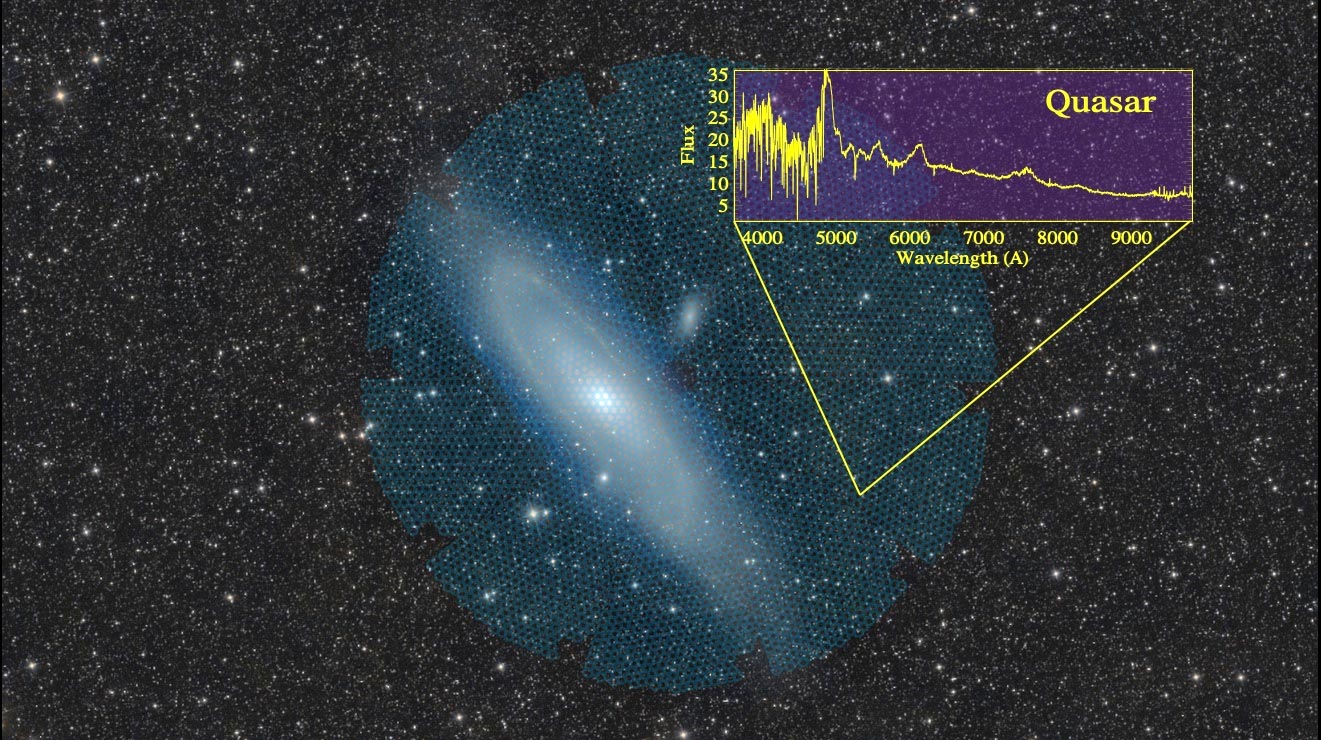
International collaboration, under the aegis of Berkeley Lab, aims for 3D map of the universe, unraveling of mysterious ‘dark energy.’
A five-year quest to map the universe and unravel the mysteries of “dark energy” began officially on May 17, at Kitt Peak National Observatory near Tucson, Arizona. To complete its quest, the Dark Energy Spectroscopic Instrument (DESI) will capture and study the light from tens of millions of galaxies and other distant objects in the universe.
DESI is an international science collaboration managed by the Department of Energy’s Lawrence Berkeley National Laboratory (Berkeley Lab) with primary funding for construction and operations from DOE’s Office of Science.
By gathering light from some 30 million galaxies, project scientists say DESI will help them construct a 3D map of the universe with unprecedented detail. The data will help them better understand the repulsive force associated with “dark energy” that drives the acceleration of the expansion of the universe across vast cosmic distances.
Jim Siegrist, Associate Director for High Energy Physics at DOE, said “We are excited to see the start of DESI, the first next-generation dark energy project to begin its science survey. We also congratulate Berkeley Lab, which continues to enhance our capabilities for studying the nature of dark energy, since leading the initial discovery in 1999. DOE’s Berkeley Lab successfully led the 13-nation DESI team, including U.S. government, private and international contributions, in the design, fabrication, and commissioning of the world’s premier multi-object spectrograph. The strong interagency collaboration with NSF has enabled DOE to install and operate DESI on their Mayall telescope, which is required to carry out this amazing experiment. Along with its primary mission of dark energy studies, the data set will be of use by the wider scientific community for a multitude of astrophysics studies.”
Revolutionizing Cosmic Spectroscopy
What sets DESI apart from previous sky surveys? The project director, Berkeley Lab’s Michael Levi, said, “We will measure 10 times more galaxy spectra than ever obtained. These spectra get us a third dimension.” Instead of two-dimensional images of galaxies, quasars, and other distant objects, he explained, the instrument collects light, or spectra, from the cosmos such that it “becomes a time machine where we place those objects on a timeline that reaches as far back as 11 billion years ago.”
A 3D journey provided by DESI, following the path of light 11 billion years backwards through nearby bright galaxies (yellow), luminous red galaxies (red), emission-line galaxies (green), and quasars (blue) that back-light the tenuous intergalactic medium (white lines). The long, thin volume of the universe shown here fits behind your palm held at arm’s length and shows 30 thousand galaxies measured by DESI in 5 hours. DESI will survey almost one thousand times more volume over the next five years. Credit: David Kirkby/DESI collaboration
“DESI is the most ambitious of a new generation of instruments aimed at better understanding the cosmos – in particular, its dark energy component,” said project co-spokesperson Nathalie Palanque-Delabrouille, a cosmologist at France’s Alternative Energies and Atomic Energy Commission (CEA). She said the scientific program – including her own interest in quasars – will allow researchers to address with precision two primary questions: what is dark energy; and the degree to which gravity follows the laws of general relativity, which form the basis of our understanding of the cosmos.
“It’s been a long journey from the first steps that we took almost a decade ago to design the survey, then to decide which targets to observe, and now to have the instruments so that we can achieve those science goals,” Palanque-Delabrouille, said. “It’s very exciting to see where we stand today.”
The formal start of DESI’s five-year survey follows a four-month trial run of its custom instrumentation that captured four million spectra of galaxies – more than the combined output of all previous spectroscopic surveys.
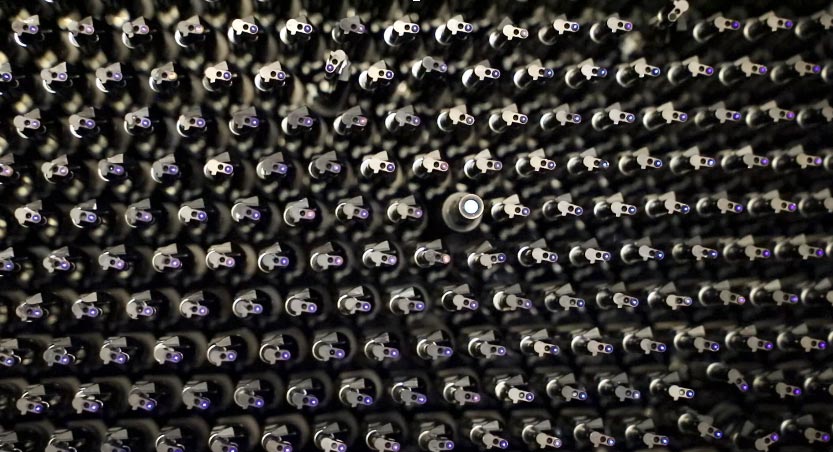
The DESI instrument was installed on the Nicholas U. Mayall 4-meter Telescope at Kitt Peak National Observatory. Kitt Peak National Observatory is a program of the National Science Foundation’s (NSF) NOIRLab, which has allowed the Department of Energy to operate the Mayall Telescope for the DESI survey. The instrument includes new optics that increase the field of view of the telescope and includes 5,000 robotically controlled optical fibers to gather spectroscopic data from an equal number of objects in the telescope’s field of view.
5,000 Galaxies at Once
“We’re not using the biggest telescopes,” said Berkeley Lab’s David Schlegel, who is DESI project scientist. “It’s that the instruments are better and very highly multiplexed, meaning that we can capture the light from many different objects at once.”
In fact, the telescope “is literally pointing at 5,000 different galaxies simultaneously,” Schlegel said. On any given night, he explains, as the telescope is moved into a target position, the optical fibers align to collect light from galaxies as it is reflected off the telescope mirror. From there, the light is fed into a bank of spectrographs and CCD cameras for further processing and study.
“It’s really a factory that we have – a spectra factory,” said survey validation lead, Christophe Yeche, also a cosmologist at CEA. “We can collect 5,000 spectra every 20 minutes. In a good night, we collect spectra from some 150,000 objects.”
“But it’s not just the instrument hardware that got us to this point – it’s also the instrument software, DESI’s central nervous system,” said Klaus Honscheid, a professor of physics at Ohio State University who directed the design of the DESI instrument control and monitoring systems. He credits scores of people in his group and around the world who have built and tested thousands of DESI’s component parts, most of which are unique to the instrument.
Light’s Hidden Messages
Spectra collected by DESI are the components of light corresponding to the colors of the rainbow. Their characteristics, including wavelength, reveal information such as the chemical composition of objects being observed as well as information about their relative distance and velocity.
As the universe expands, galaxies move away from each other, and their light is shifted to longer, redder wavelengths. The more distant the galaxy, the greater its “redshift.” By measuring galaxy redshifts, DESI researchers will create a 3D map of the universe. The detailed distribution of galaxies in the map is expected to yield new insights on the influence and nature of dark energy.
“Dark energy is one of the key science drivers for DESI,” said project co-spokesperson Kyle Dawson, a professor of physics and astronomy at University of Utah. “The goal is not so much to find out how much there is – we know that about 70% of the energy in the universe today is dark energy – but to study its properties.”
Cosmic Snapshots Through Time
The universe is expanding at a rate determined by its total energy contents, Dawson explains. As the DESI instrument looks out in space and time, he says, “we can literally take snapshots today, yesterday, 1 billion years ago, 2 billion years ago – as far back in time as possible. We can then figure out the energy content in these snapshots and see how it is evolving.”
DESI is supported by the DOE Office of Science and by the National Energy Research Scientific Computing Center, a DOE Office of Science user facility. Additional support for DESI is provided by the U.S. National Science Foundation, the Science and Technologies Facilities Council of the United Kingdom, the Gordon and Betty Moore Foundation, the Heising-Simons Foundation, the French Alternative Energies and Atomic Energy Commission (CEA), the National Council of Science and Technology of Mexico, the Ministry of Economy of Spain, and by the DESI member institutions.
The DESI collaboration is honored to be permitted to conduct scientific research on Iolkam Du’ag (Kitt Peak), a mountain with particular significance to the Tohono O’odham Nation.
Never miss a breakthrough: Join the SciTechDaily newsletter.
Follow us on Google and Google News.
4 Comments
There is no dark energy. Galaxies fly apart because the Center of Our Universe, from which galaxies are born, with each born galaxy, has less and less mass and, accordingly,
less gravity.
In telescopes you can find the Center of Our Universe. I think it has (geometrically 1 – 8 – 64 or 1 – 10 – 100) 64 or 100 sleeves.
https://www.youtube.com/watch?v=tFUM3vAlaGc
read the article before posting: “The goal is not so much to find out how much there is – we know that about 70% of the energy in the universe today is dark energy – but to study its properties.”
Also, pseudoscience link.
My “pseudoscience” is being patented by others:
https://arxiv.org/abs/2105.06301
https://www.sciencealert.com/wild-new-paper-proposes-the-center-of-the-milky-way-might-not-be-a-black-hole
I am glad that I turned science in the right direction.
Hello how are you