
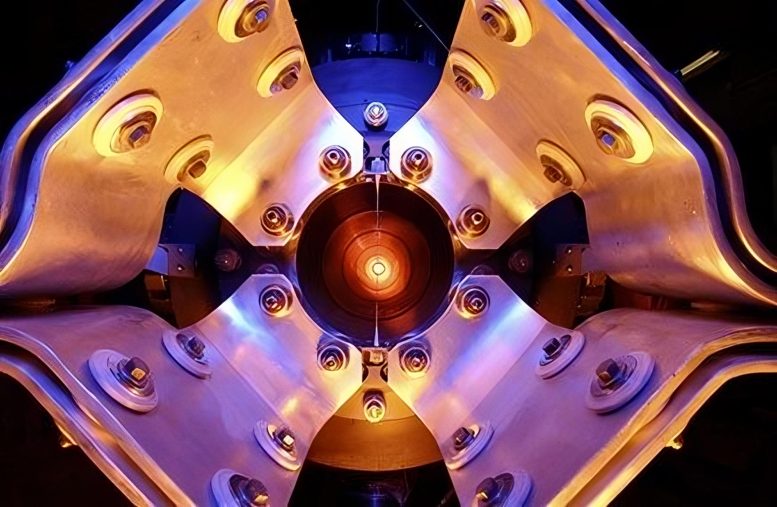
The MINERvA experiment at Fermilab, utilizing the NuMI beam, has made the first precise depiction of a proton using neutrinos instead of light as the imaging tool.
The Science
The building blocks of atomic nuclei, protons and neutrons, are comprised of quarks and gluons that interact strongly with each other. Due to the strength of these interactions, determining the structure of protons and neutrons through theoretical calculation is challenging.
Therefore, scientists must resort to experimental methods to determine their structure. Neutrino experiments utilize targets consisting of nuclei comprised of numerous protons and neutrons bound together, which makes it difficult to deduce information about the structure of protons from these measurements.
By scattering neutrinos from the protons that are the nuclei of hydrogen atoms in the MINERvA detector, scientists have provided the first measurements of this structure with neutrinos using unbound protons.
The Impact
Researchers are building several large neutrino experiments, including DUNE and the Sanford Underground Research Facility. These experiments will help make precise measurements of neutrino properties. This in turn will answer questions about how neutrinos affected the structure of our Universe.
Those experiments require an accurate understanding of how neutrinos interact on the heavy nuclei in the experiments, such as argon in the case of DUNE. Building a theory of those interactions requires separating the effects of neutrino scattering from protons or neutrons and the effects of the binding in the nucleus.
By measuring this property of free protons, the results from MINERvA will help to build more complete theories of neutrino interactions.
Summary
The primary challenge in the measurement described in this new research is that the hydrogen in MINERvA’s detector is chemically mixed half and half in plastic with carbon atoms. There are six protons in the carbon atom, so the carbon background reaction is much larger.
By developing a novel technique to measure the direction of the outgoing neutron in the reaction, anti-muon neutrino on proton creates anti-muon and neutron, researchers can separate the two reaction types.
This allows the study of the residual backgrounds using the same parallel reaction in a neutrino beam, where no reaction on the hydrogen atoms is possible. This measurement of structure is interpreted as the axial vector form factor of the proton, a technical term for the structure revealed by neutrino scattering so that it can be used as inputs to predictions of neutrino reactions.
Reference: “Measurement of the axial vector form factor from antineutrino–proton scattering” by T. Cai, M. L. Moore, A. Olivier, S. Akhter, Z. Ahmad Dar, V. Ansari, M. V. Ascencio, A. Bashyal, A. Bercellie, M. Betancourt, A. Bodek, J. L. Bonilla, A. Bravar, H. Budd, G. Caceres, M. F. Carneiro, G. A. Díaz, H. da Motta, J. Felix, L. Fields, A. Filkins, R. Fine, A. M. Gago, H. Gallagher, S. M. Gilligan, R. Gran, E. Granados, D. A. Harris, S. Henry, D. Jena, S. Jena, J. Kleykamp, A. Klustová, M. Kordosky, D. Last, T. Le, A. Lozano, X.-G. Lu, E. Maher, S. Manly, W. A. Mann, C. Mauger, K. S. McFarland, B. Messerly, J. Miller, O. Moreno, J. G. Morfín, D. Naples, J. K. Nelson, C. Nguyen, V. Paolone, G. N. Perdue, K.-J. Plows, M. A. Ramírez, R. D. Ransome, H. Ray, D. Ruterbories, H. Schellman, C. J. Solano Salinas, H. Su, M. Sultana, V. S. Syrotenko, E. Valencia, N. H. Vaughan, A. V. Waldron, M. O. Wascko, C. Wret, B. Yaeggy and L. Zazueta, 1 February 2023, Nature.
DOI: 10.1038/s41586-022-05478-3
The study was funded by the Department of Energy Office of Science, Office of High Energy Physics, by the University of Rochester’s Messersmith Graduate Fellowships, and by the National Science Foundation’s Graduate Research Fellowships. The Fermilab Accelerator Complex that creates the NuMI neutrino beam used for MINERvA and other experiments is a DOE Office of Science user facility.
Never miss a breakthrough: Join the SciTechDaily newsletter.
Follow us on Google and Google News.
2 Comments
Science of time and the theory of everything new edition by Bhausaheb Bhosle
Science of time and the theory of everything new edition by Bhausaheb Bhosle.