
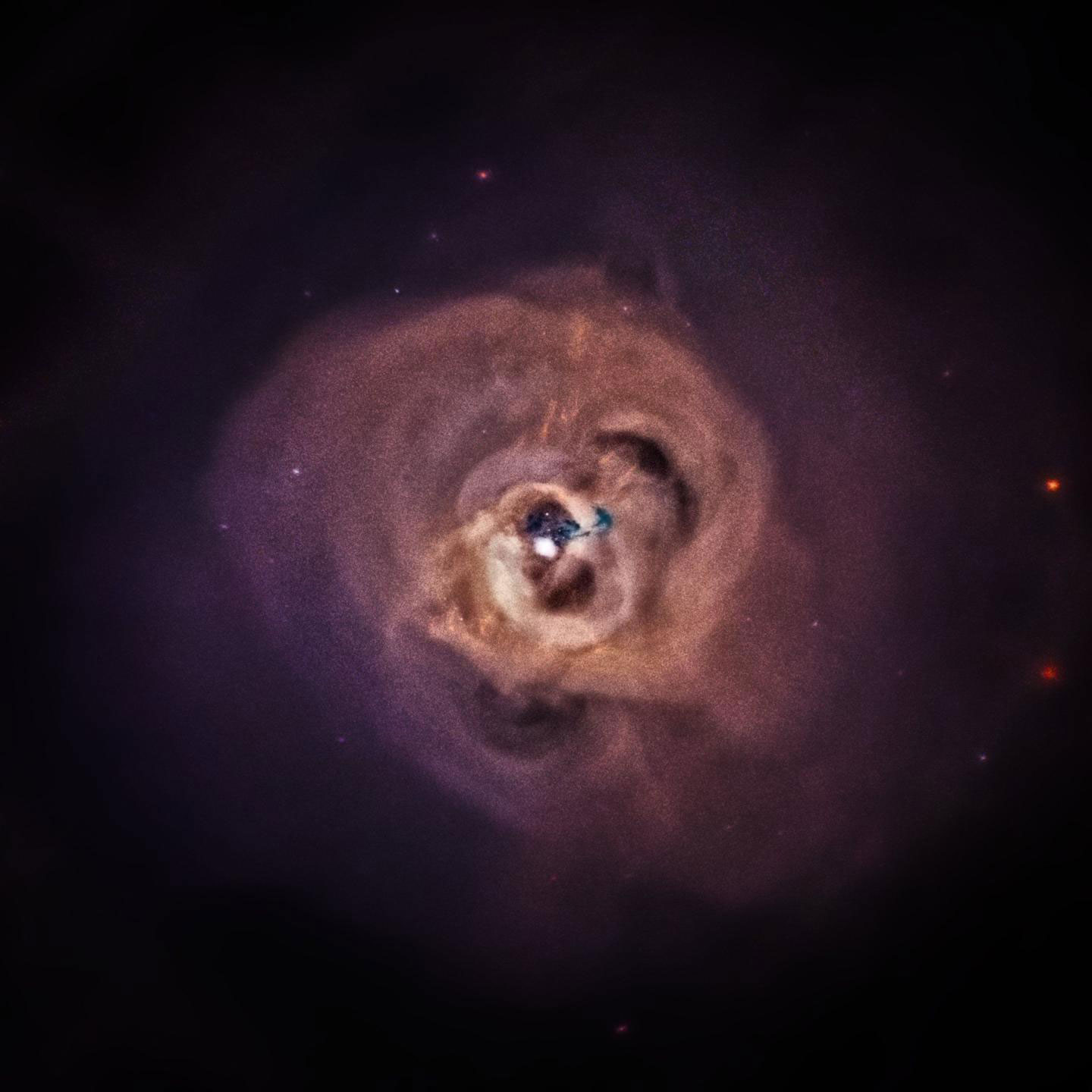
Dark matter is increasingly puzzling. Around the world, physicists have been trying for decades to determine the nature of these matter particles, which do not emit light and are therefore invisible to the human eye. Their existence was postulated in the 1930s to explain certain astronomical observations. As visible matter, like the one that makes up the stars and the Earth, constitutes just 5 percent of the universe, it has been proposed that dark matter must represent 23 percent of what is out there. But to date and despite intensive research, it has proved impossible to actually identify the particles involved. Researchers at Johannes Gutenberg University Mainz (JGU) have now presented a novel theory of dark matter, which implies that dark matter particles may be very different from what is normally assumed. In particular, their theory involves dark matter particles which are extremely light — almost one hundred times lighter than electrons, in stark contrast to many conventional models that involve very heavy dark matter particles instead.
According to common theory, dark matter must exist because otherwise stars would not continue to rotate around the center of their galaxies as they in fact do. Among the particularly favored candidates for dark matter are so-called weakly interacting massive particles, or WIMPs. Researchers are searching for these in the Italian Gran Sasso underground laboratory, for example. But recent scientific publications in the field of astroparticle physics are increasingly taking the view that WIMPs are unlikely to be viable prospects when it comes to dark matter. “We, too, are currently actively on the search for possible alternatives,” said Professor Joachim Kopp of Mainz University.
The physicist, together with his colleagues Vedran Brdar, Jia Liu, and Xiao-Ping Want, took a closer look at the results of observations undertaken by several independent groups in 2014. The groups reported the presence of a previously undetected spectral line, with an energy of 3.5 kiloelectron volts (keV), in x-ray light from distant galaxies and galaxy clusters. This unusual x-ray radiation might offer a clue to the nature of dark matter. It has been previously pointed out that dark matter particles might decay, thereby emitting x-rays. However, Joachim Kopp’s team at the Mainz-based Cluster of Excellence on Precision Physics, Fundamental Interactions and Structure of Matter (PRISMA) is taking another approach.
X-ray radiation produced by the annihilation of dark matter
The PRISMA researchers propose a scenario in which two dark matter particles collide, resulting in their mutual annihilation. This is analogous to what happens, for instance, when an electron meets with its antiparticle, a positron. “It has long been assumed that it would not be possible to observe such annihilation of dark matter if it were made of particles that light,” explained Kopp. “We have subjected our new model to scrutiny and have compared it with experimental data, and it all fits together much better than in the case of older models.”
According to Kopp’s model, dark matter particles would be fermions with a mass of only a few kiloelectron volts, frequently called sterile neutrinos. Such lightweight dark matter is usually considered problematic because it makes it difficult to explain how galaxies could have been formed. “So far, we have been able to deal with these concerns,” explained Kopp. “Our model provides an elegant way out.” The supposition that the annihilation of dark matter is a two-step process is of crucial importance in this context: during the initial stage of the process, an intermediate state is formed, which later disintegrates into the observed x-ray photons. “The results of our calculations show that the resulting x-ray signature correlates closely with the observations and thus offers a novel explanation for these,” added Kopp.
At the same time, the new model itself is so general that it will offer an interesting starting point for the search for dark matter even if it turns out that the spectral line discovered in 2014 has a different origin. Theoretical and experimental physicists at JGU are currently working on the proposed ESA mission e-ASTROGRAM, which aims at analyzing astrophysical x-ray radiation with previously unachieved accuracy.
Reference: “X-Ray Lines from Dark Matter Annihilation at the keV Scale” by Vedran Brdar, Joachim Kopp, Jia Liu and Xiao-Ping Wang, 5 February 2018, Physical Review Letters.
DOI: 10.1103/PhysRevLett.120.061301
Never miss a breakthrough: Join the SciTechDaily newsletter.
Follow us on Google and Google News.