
Close Menu
    Facebook X (Twitter) Instagram
    SciTechDaily
    • Biology
    • Chemistry
    • Earth
    • Health
    • Physics
    • Science
    • Space
    • Technology
    Facebook X (Twitter) Pinterest YouTube RSS
    SciTechDaily
    Home»Earth»Using Google’s 10,000-km-Long Underwater Fiber-Optic Cable as a Seafloor Seismic Sensor
    Earth

    Using Google’s 10,000-km-Long Underwater Fiber-Optic Cable as a Seafloor Seismic Sensor

    By American Association for the Advancement of ScienceMarch 6, 2021No Comments3 Mins Read
    Facebook Twitter Pinterest Telegram LinkedIn WhatsApp Email Reddit
    Share
    Facebook Twitter LinkedIn Pinterest Telegram Email Reddit
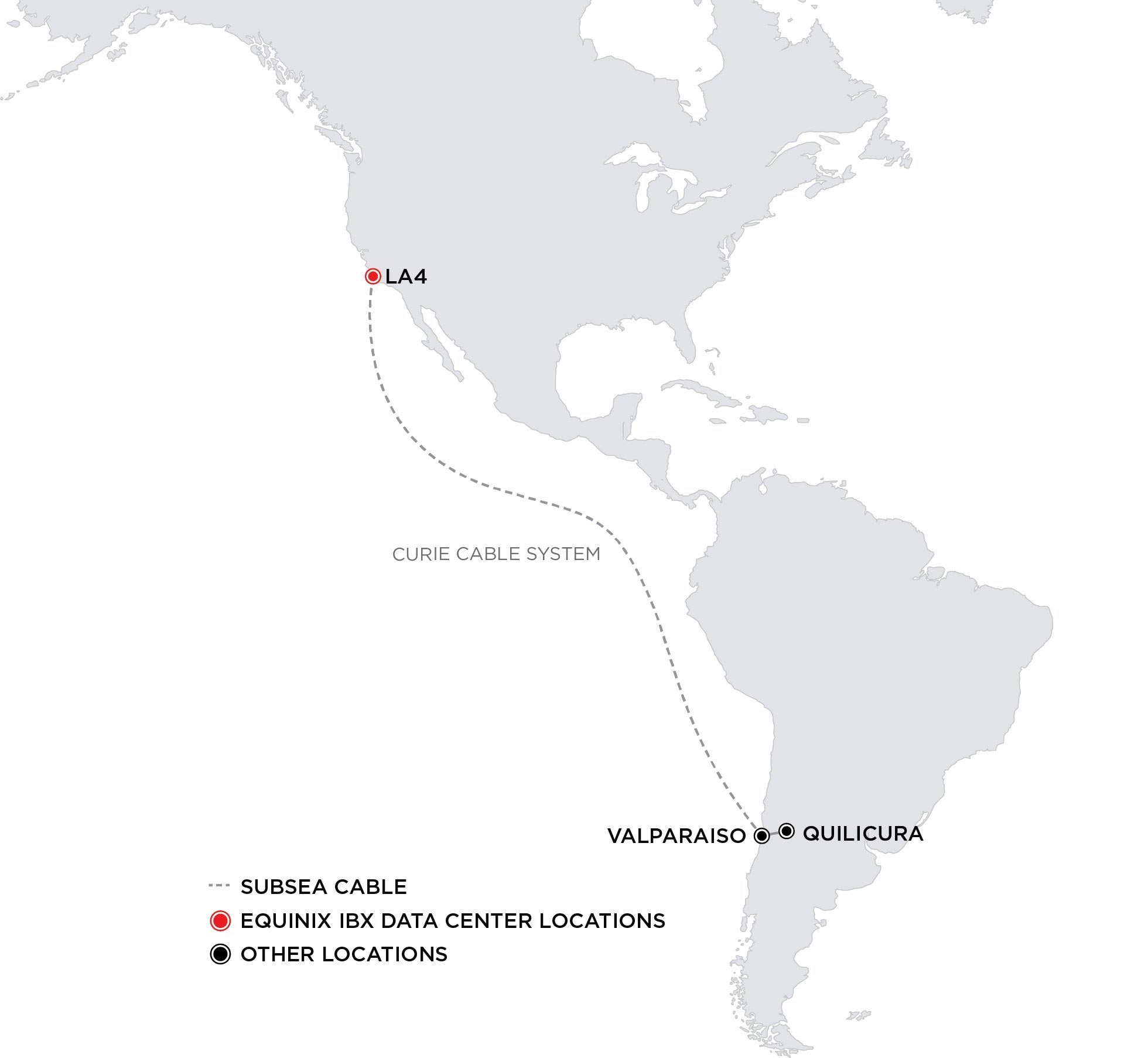
    Curie Subsea Cable Route
    Curie Subsea Cable Route from Equinix LA4 International Business Exchange in Los Angeles to Chile. Credit: Equinix

    Researchers used Google’s Curie submarine cable to detect earthquakes and storm waves by monitoring changes in light polarization caused by strain. 

    Using “Curie” — Google’s 10,000-kilometer-long (6,200 miles) underwater fiber-optic cable connecting Los Angeles, California and Valparaiso, Chile — researchers have demonstrated a novel method for detecting deep-sea seismic activity and waves at the ocean’s surface.

    The approach, which monitors the traffic that courses ceaselessly through networks of transcontinental telecommunication cables, successfully detected storm swell events and earthquakes across a nine-month observation period. “This approach requires no new infrastructure or instrumentation, but instead relies on utilizing observations already made to extract the telecommunications data received at the end of the cable,” writes William Wilcock in a related Perspective.

    Real-Time Monitoring of the Deep

    The new study suggests that the approach could transform our oceanwide web-work of fiber optics into a continuous, real-time earthquake and tsunami monitoring and detection system. Monitoring seismic activity on the seafloor is crucial for studying Earth’s crust and detecting offshore earthquakes and tsunami threats. However, deploying and maintaining geophysical instruments on the seafloor is difficult and expensive, and, as a result, underwater seismic stations are relatively rare in vast regions of the ocean.

    Several emerging technologies are being explored to address this data gap, including laser interferometry and distributed acoustic sensing methods that effectively transform existing trans-oceanic fiber-optic telecommunications cables into kilometers-long seismic sensors. However, to date, these solutions have remained limited by the need for specialized laser detection equipment and dedicated “dark fibers.”

    Curie Cable and Polarized Light: A Scientific Breakthrough

    According to Zhongwen Zhan and colleagues, if only a fraction of the million-kilometer submarine fiber optic network was used as geophysical sensors, vast improvements in the amount of seismic data and coverage for large portions of the seafloor could be achieved.

    Zhan et al. present a new approach using the polarized light signals commonly used to transmit information through optical telecommunication cables and the Google-owned Curie submarine fiber optic cable, which spans the Pacific Ocean’s seismically active eastern margin between North and South America. Because light polarization is sensitive to temperature changes, the seafloor’s thermal stability allowed the authors to monitor the regular optical telecommunication traffic and attribute observed changes to seismic- and pressure-related strain in the cable.

    Zahn et al. recorded ~30 ocean storm swell events and ~20 moderate-to-large earthquakes across the nine-month continuous observation period, including the magnitude 7.4 earthquake event near Oaxaca, Mexico in June of 2020.

    Read Using Underwater Telecommunication Cables to Detect Earthquakes for more on this research.

    Reference: “Optical polarization–based seismic and water wave sensing on transoceanic cables” by Zhongwen Zhan, Mattia Cantono, Valey Kamalov, Antonio Mecozzi, Rafael Müller, Shuang Yin and Jorge C. Castellanos, 26 February 2021, Science.
    DOI: 10.1126/science.abe6648

    Never miss a breakthrough: Join the SciTechDaily newsletter.
    Follow us on Google and Google News.

    American Association for the Advancement of Science Earthquakes Fiber Optics Geophysics Tectonic Plates
    Share. Facebook Twitter Pinterest LinkedIn Email Reddit

    Related Articles

    Seismology and Geophysics: Understanding the Devastating Haiti Earthquakes

    Solving a Tectonic Puzzle: Explaining “Silent Earthquakes” Along New Zealand’s North Island

    Major Los Angeles Earthquake Threat May Be Posed by Overlooked Strand of the Southern San Andreas Fault

    Innovative New Model Reveals Previously Unrecognized Complexity of Oceanic Earthquake Zones

    Largest Earthquakes and Their Tsunamis May Be Directed by Deep, Slow-Slip Action

    Strange Precariously Balanced Rocks Provide Earthquake Forecasting Clues

    Deep Underground “Rock-Melting” Forces Explain Quakes on San Andreas Fault

    New Clues to Deep Earthquakes Could Help Unravel One of the Most Mysterious Geophysical Processes on Earth

    Earthquakes Deform Gravity – New Algorithm Could Enable Early Warning Systems

    Leave A Reply Cancel Reply

    • Facebook
    • Twitter
    • Pinterest
    • YouTube

    Don't Miss a Discovery

    Subscribe for the Latest in Science & Tech!

    Trending News

    Artificial Sweeteners May Harm Future Generations, Study Suggests

    Splashdown! NASA Artemis II Returns From Record-Breaking Moon Mission

    What If Consciousness Exists Beyond Your Brain

    Scientists Finally Crack the 100-Million-Year Evolutionary Mystery of Squid and Cuttlefish

    Beyond “Safe Levels”: Study Challenges What We Know About Pesticides and Cancer

    Researchers Have Found a Dietary Compound That Increases Longevity

    Scientists Baffled by Bizarre “Living Fossil” From 275 Million Years Ago

    Your IQ at 23 Could Predict Your Wealth at 27, Study Finds

    Follow SciTechDaily
    • Facebook
    • Twitter
    • YouTube
    • Pinterest
    • Newsletter
    • RSS
    SciTech News
    • Biology News
    • Chemistry News
    • Earth News
    • Health News
    • Physics News
    • Science News
    • Space News
    • Technology News
    Recent Posts
    • What if Dark Matter Has Two Forms? Bold New Hypothesis Could Explain a Cosmic Mystery
    • Researchers Expose Hidden Chemistry of “Ore-Forming” Elements in Biology
    • Geologists Reveal the Americas Collided Earlier Than We Thought
    • 20x Difference: Study Reveals True Source of Airborne Microplastics
    • Scientists Uncover Hidden Force Powering Yellowstone’s Supervolcano
    Copyright © 1998 - 2026 SciTechDaily. All Rights Reserved.
    • Science News
    • About
    • Contact
    • Editorial Board
    • Privacy Policy
    • Terms of Use

    Type above and press Enter to search. Press Esc to cancel.