
Close Menu
    Facebook X (Twitter) Instagram
    SciTechDaily
    • Biology
    • Chemistry
    • Earth
    • Health
    • Physics
    • Science
    • Space
    • Technology
    Facebook X (Twitter) Pinterest YouTube RSS
    SciTechDaily
    Home»Science»When Solids and Liquids Meet: In Nanoscale Detail
    Science

    When Solids and Liquids Meet: In Nanoscale Detail

    By DOE/Lawrence Berkeley National LaboratoryDecember 2, 2019No Comments2 Mins Read
    Facebook Twitter Pinterest Telegram LinkedIn WhatsApp Email Reddit
    Share
    Facebook Twitter LinkedIn Pinterest Telegram Email Reddit
    Nanoscale Peek at the Solid-Liquid Interface
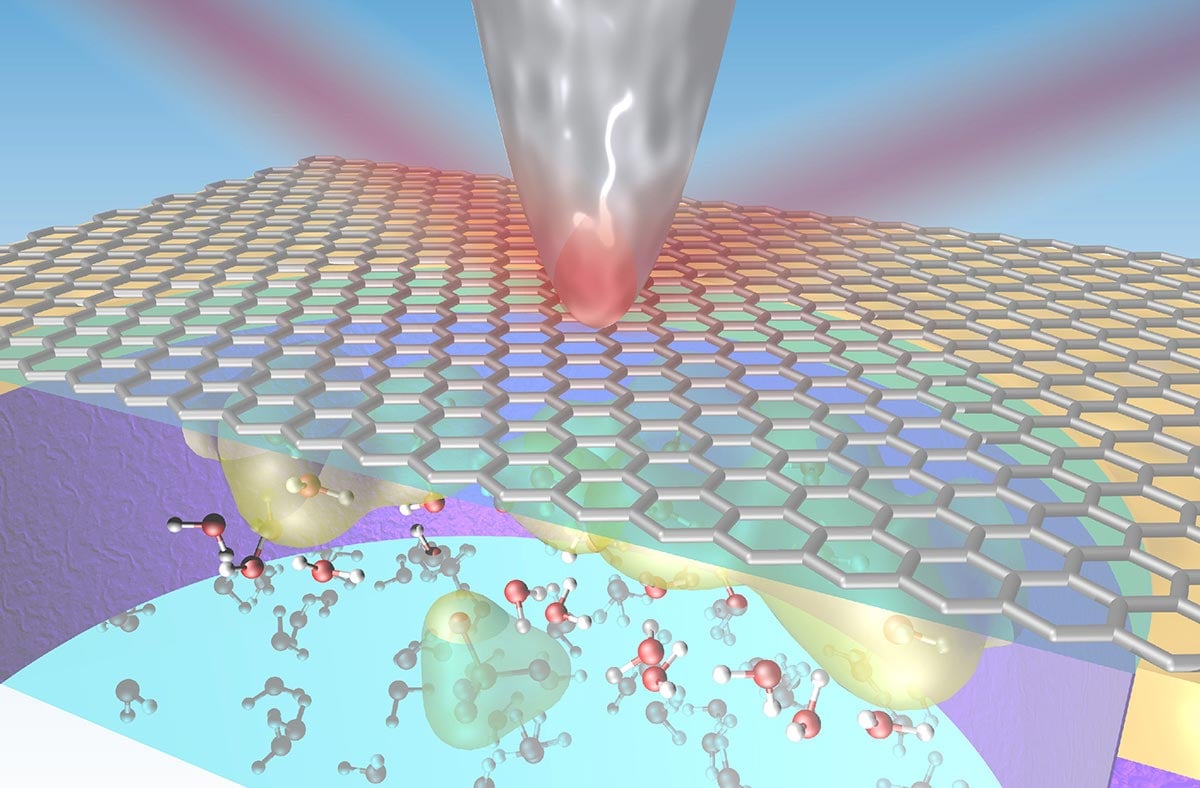
    Infrared light is focused onto the sharp metallic tip of an atomic force microscope, enabling the acquisition of vibrational spectra from a graphene-liquid interface. Credit: Artem Baskin, Jonathon Larson/Berkeley Lab

    How a liquid interacts with the surface of a solid is important in batteries and fuel cells, chemical production, corrosion phenomena, and many biological processes.

    To better understand this solid-liquid interface, researchers at Berkeley Lab developed a platform to explore these interactions under real conditions (“in situ”) at the nanoscale using a technique that combines infrared light with an atomic force microscopy (AFM) probe. The results were published in the journal Nano Letters.

    The team explored the interaction of graphene with several liquids, including water and a common battery electrolyte fluid. Graphene is an atomically thin form of carbon. Its single-layer atomic structure gives the material some unique properties, including incredible mechanical strength and high electrical conductivity.

    Researchers used a beam of infrared light produced at Berkeley Lab’s Advanced Light Source and they focused it at the tip of an AFM probe that scanned across a section of graphene in contact with the liquids. The infrared technique provides a nondestructive way to explore the active nanoscale chemistry of the solid-liquid interface.

    By measuring the infrared light scattered from the probe’s tip, researchers collected details about the chemical compounds and the concentration of charged particles along the solid-liquid interface. The same technique, which revealed hidden features at this interface that were not seen using conventional methods, can be used to explore a range of materials and liquids.

    Reference: “Infrared Nanospectroscopy at the Graphene–Electrolyte Interface” by Yi-Hsien Lu, Jonathan M. Larson, Artem Baskin, Xiao Zhao, Paul D. Ashby, David Prendergast, Hans A. Bechtel, Robert Kostecki and Miquel Salmeron, 15 July 2019, Nano Letters.
    DOI: 10.1021/acs.nanolett.9b01897

    Researchers from the Lab’s Materials Sciences Division, Molecular Foundry, and Energy Storage and Distributed Resources Division participated in the study. The Molecular Foundry and Advanced Light Source are DOE Office of Science user facilities.

    Never miss a breakthrough: Join the SciTechDaily newsletter.
    Follow us on Google and Google News.

    DOE Lawrence Berkeley National Laboratory Nanotechnology
    Share. Facebook Twitter Pinterest LinkedIn Email Reddit

    Related Articles

    Nanoscale Quantum Sensors Image Stress and Magnetism at High Pressures

    Illuminating Seafloor Seismology With Existing ‘Dark’ Fiber-Optic Cables and Distributed Acoustic Sensing

    Scientists Use X-Rays and Infrared Light to Explore Egyptian Mummy Bones [Video]

    Scientists Develop an Ultrathin Invisibility Cloak

    Berkeley Lab Uses Solar Energy and Renewable Hydrogen to Produce Methane

    Researchers Develop Powerful New Microscale Torsional Muscles

    Berkeley Researchers Create First Soluble 2D Supramolecular Organic Frameworks

    Optically Switchable Chiral THz Metamolecules

    Berkeley Lab Reports Direct Observation of Oriented Attachment in Nanocrystal Growth

    Leave A Reply Cancel Reply

    • Facebook
    • Twitter
    • Pinterest
    • YouTube

    Don't Miss a Discovery

    Subscribe for the Latest in Science & Tech!

    Trending News

    The Universe Is Expanding Too Fast and Scientists Can’t Explain Why

    “Like Liquid Metal”: Scientists Create Strange Shape-Shifting Material

    Early Warning Signals of Esophageal Cancer May Be Hiding in Plain Sight

    Common Blood Pressure Drug Shows Surprising Power Against Deadly Antibiotic-Resistant Superbug

    Scientists Uncover Dangerous Connection Between Serotonin and Heart Valve Disease

    Scientists Discover a “Protector” Protein That Could Help Reverse Hair Loss

    Bone-Strengthening Discovery Could Reverse Osteoporosis

    Scientists Uncover Hidden Trigger Behind Stem Cell Aging

    Follow SciTechDaily
    • Facebook
    • Twitter
    • YouTube
    • Pinterest
    • Newsletter
    • RSS
    SciTech News
    • Biology News
    • Chemistry News
    • Earth News
    • Health News
    • Physics News
    • Science News
    • Space News
    • Technology News
    Recent Posts
    • A Common Diabetes Drug May Hold the Key to Stopping HIV From Coming Back
    • Ancient “Syphilis-Like” Disease in Vietnam Challenges Key Scientific Assumptions
    • Drinking Alcohol To Cope in Your 20s Could Damage Your Brain for Life
    • Scientists Crack Alfalfa’s Chromosome Mystery After Decades of Debate
    • Ancient Ant-Plant Alliance Collapses As Predatory Wasps Move In
    Copyright © 1998 - 2026 SciTechDaily. All Rights Reserved.
    • Science News
    • About
    • Contact
    • Editorial Board
    • Privacy Policy
    • Terms of Use

    Type above and press Enter to search. Press Esc to cancel.