
Close Menu
    Facebook X (Twitter) Instagram
    SciTechDaily
    • Biology
    • Chemistry
    • Earth
    • Health
    • Physics
    • Science
    • Space
    • Technology
    Facebook X (Twitter) Pinterest YouTube RSS
    SciTechDaily
    Home»Space»Vega Older Than Previously Thought, Could Harbor Life
    Space

    Vega Older Than Previously Thought, Could Harbor Life

    By SciTechDailyDecember 4, 20125 Comments2 Mins Read
    Facebook Twitter Pinterest Telegram LinkedIn WhatsApp Email Reddit
    Share
    Facebook Twitter LinkedIn Pinterest Telegram Email Reddit
    vega-lyra-age-fast-spinning
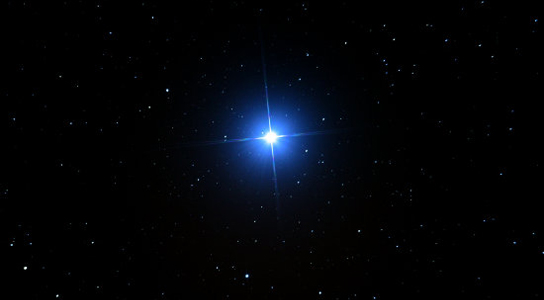
    Vega in the night sky. Credit: Martin S. Mitchell

    Vega is situated in the constellation Lyra, 25 light-years away from Earth, and it is the fifth brightest star in the sky. In 1983, astronomers discovered dust orbiting Vega, suggesting that it had a solar system. Vega was thought to be only a couple of hundred million years old, probably too young for any planet to have spawned life. However, new estimates show that Vega is significantly older than previously thought.

    The scientists will publish their findings in The Astrophysical Journal Letters, but a preprint is available through arXiv. Astronomers have learned that the star spins fast, about once every 17 hours, which stirs up the star’s interior, and forces the surface composition to match the overall composition of the star. This means that scientists had been overestimating the star’s abundance of heavy metals, meaning that they overestimated its mass and underestimated its age. Massive stars evolve more slowly.

    The astronomers studied Vega using the CHARA interferometer, an array of telescopes in California, and modeled the observations by using new computations of how fast-spinning stars age.

    Vega is 2.15 times as massive as the sun, but between 625 million and 850 million years old. Suitable planets could have formed and sufficient time has elapsed for the development of primitive life.

    Reference: “Resolving Vega and the inclination controversy with CHARA/MIRC” by J. D. Monnier, Xiao Che, Ming Zhao, S. Ekstrom, V. Maestro, J. Aufdenberg, F. Baron, C. Georgy, S. Kraus, H. McAlister, E. Pedretti, S. Ridgway, J. Sturmann, L. Sturmann, T. ten Brummelaar, N. Thureau, N. Turner and P. G. Tuthill, 15 November 2012, The Astrophysical Journal Letters.
    DOI: 10.1088/2041-8205/761/1/L3

    Never miss a breakthrough: Join the SciTechDaily newsletter.
    Follow us on Google and Google News.

    Astronomy Popular Stars Stellar Evolution
    Share. Facebook Twitter Pinterest LinkedIn Email Reddit

    Related Articles

    The Hunt for Cosmic Dawn: HERA Doubles Sensitivity to Unlock the Secrets of the Early Universe

    New Survey Maps Where Stars Are Born

    WISE Discovers Mystery Dust Around an Unusual Class of Interacting Binary Stars

    VLT Reveals That O Stars, Which Drive the Evolution of Galaxies, Don’t Live Alone

    Herschel Image of the Vela C Region

    Mysterious Disappearance of Dust Ring Leaves Astronomers Searching for Solutions

    “Impossible” Discovery, Red Dwarf Binaries with Orbital Periods of 2.5 Hours

    NASA Data Reveals Significant Changes in Exoplanet’s Atmosphere

    Black Hole Rips Apart a Helium Rich Star

    5 Comments

    1. Ti My on December 4, 2012 12:58 pm

      Vega is relatively close to earth. If that is the case, how can a star that is 4.5 billion years old ( Sol ) be in proximity of a star that is very young in star years 600-800 million years old? What spawned Vega’s birth and if it was a super nova or some sizable event, how come it didn’t effect the earth?

      Reply
      • Dan on December 5, 2012 7:25 pm

        The stars all move around the galaxy independent of each other. The orbits, velocities, and inclinations all independent of each other. Hundreds of millions of years ago Vega and our sun could have been thousands of light years apart or even o n other sides of the galaxy. Were only neighbors for a very small point of time. Vega was probably born in a stellar nebula.

        Reply
    2. Gimli on December 15, 2012 4:14 pm

      Don’t massive stars actually evolve and therefore age much quicker, not more slowly, as is claimed in this article. Isn’t that why with a reduced mass Vega is actually older than they previously estimated?

      Reply
      • Adam on January 21, 2017 7:35 am

        Agreed. I was surprised by the article stating that massive stars evolve slowly. 2.135 times the size of Sol is not massive in my opinion, nor do I really think it’s the Author’s either. Astrophysicists agree that massive stars live fast and die young. They burn through their hydrogen really fast when they are stars like VY Canis Majoris (30 solar masses). I have read that this behavior usually begins in stars around 5+ solar masses.

        Reply
    3. neuct on March 1, 2022 6:01 pm

      vega <3

      Reply
    Leave A Reply Cancel Reply

    • Facebook
    • Twitter
    • Pinterest
    • YouTube

    Don't Miss a Discovery

    Subscribe for the Latest in Science & Tech!

    Trending News

    Scientists May Have Found the Key to Jupiter and Saturn’s Moon Mystery

    Scientists Uncover Brain Changes That Link Pain to Depression

    Saunas May Do More Than Raise Body Temperature – They Activate Your Immune System

    Exercise in a Pill? Metformin Shows Surprising Effects in Cancer Patients

    Hidden Oceans of Magma Could Be Protecting Alien Life

    New Study Challenges Alzheimer’s Theories: It’s Not Just About Plaques

    Artificial Sweeteners May Harm Future Generations, Study Suggests

    Splashdown! NASA Artemis II Returns From Record-Breaking Moon Mission

    Follow SciTechDaily
    • Facebook
    • Twitter
    • YouTube
    • Pinterest
    • Newsletter
    • RSS
    SciTech News
    • Biology News
    • Chemistry News
    • Earth News
    • Health News
    • Physics News
    • Science News
    • Space News
    • Technology News
    Recent Posts
    • Physicists Discover a Strange New Kind of One-Dimensional Particle
    • Scientists Discover Unexpected Climate Benefit Hidden in Forest Soils
    • The Grand Canyon’s “Swiss Cheese” Rocks Hold a Critical Secret
    • Scientists Discover 430,000-Year-Old Wooden Tools, Rewriting Human History
    • Scientists Make Breakthrough on 40-Year-Old 2D Physics Puzzle
    Copyright © 1998 - 2026 SciTechDaily. All Rights Reserved.
    • Science News
    • About
    • Contact
    • Editorial Board
    • Privacy Policy
    • Terms of Use

    Type above and press Enter to search. Press Esc to cancel.