
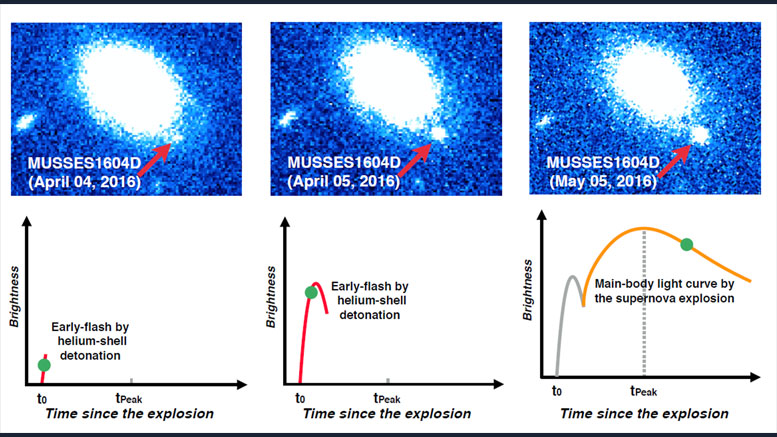
A new study reveals evidence that the brightest stellar explosions in our universe could be triggered by the helium nuclear explosion at the surface of a white dwarf star.
Many stars end their lives through a spectacular explosion. Most massive stars will finally explode as a supernova. Though a white dwarf is the remnant of an intermediate-mass star like our Sun, it may explode as well if a white dwarf is a member of a close binary star system where two stars orbit around each other. This type of supernovae is classified as Ia.
Because of the uniform and extremely high brightness (about 5 billion times brighter than the Sun) of type Ia supernovae, they are widely used as the standard candle for the distance measurement in astronomy. The most successful example using type Ia supernovae is the discovery of the accelerating expansion of our universe (Nobel Prize in Physics 2011). Though great success has been made in the type Ia supernova cosmology, we are still puzzled by the essential issues of what the progenitor systems of type Ia supernovae are and how type Ia supernova explosions are ignited.
In order to find new clues to figure out these long-standing issues, Jiang and his collaborators aim to catch type Ia supernovae within a few days, or even a day, after their explosions (hereafter “early-phase type Ia supernovae”), using the Hyper Suprime-Cam mounted on the Subaru telescope, the most powerful survey facility in the world. Their scientific project was established in 2016, named as “MUSSES”, an abbreviation of “the MUlti-band Subaru Survey for Early-phase type Ia supernovae (SNe Ia)”, including researchers from the University of Tokyo, Kyoto University, the National Astronomical Observatory of Japan (NAOJ) and other institutions in Japan and foreign countries.
“We discovered over 100 supernova candidates in one night with Subaru/Hyper Suprime-Cam, including several supernovae that had only exploded a few days earlier. Not only that, a type Ia supernova, named MUSSES1604D, soon after the explosion has been discovered. Surprisingly, MUSSES1604D in the first few days was much brighter than we expected, and we also found other peculiarities of this amazing object through follow-up observations with many large telescopes around the world,” said Jiang.
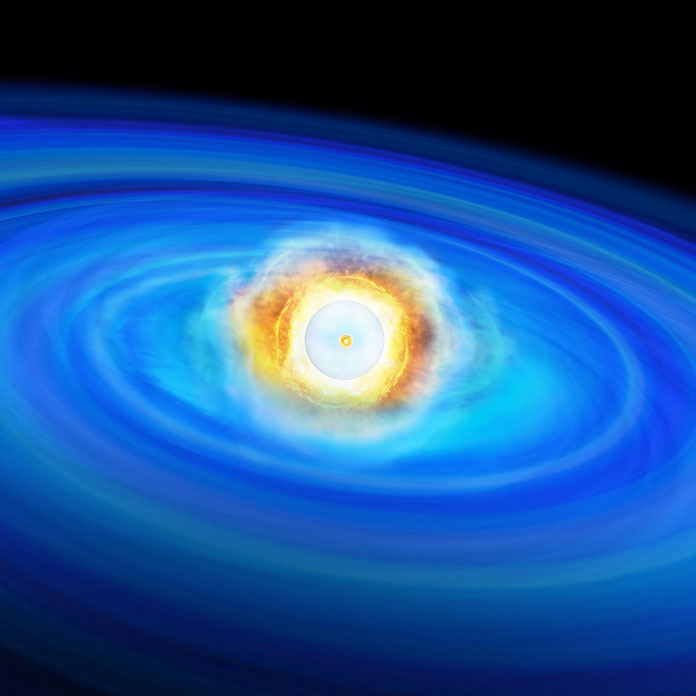
In order to figure out the origin of this mysterious object, intensive computational simulations were conducted by Toshikazu Shigeyama (U-Tokyo) and Keiichi Maeda (Kyoto University), based on different kinds of theoretical models. After more than 3-months of discussions and numerous computational experiments, they finally confirmed that the features of this supernova are not consistent with predictions from popular scenarios, but instead, can be naturally explained by a specific explosion mechanism. In this scenario, the accumulation of helium on the surface of the white dwarf first ignites explosive helium burning and shock waves generated by this precursor event propagate inward, and eventually ignite carbon burning in the core of the white dwarf. “Once we noticed the possibility of this He detonation scenario, every peculiarity was just readily explained. This is the first robust evidence that one theoretically predicted stellar explosion mechanism proposed in the early 1980s, does truly exist in our universe,” said Maeda.
This result answers how the explosion of type Ia supernovae can be ignited for the first time and has opened the door to the essential understanding of these spectacular phenomena in our universe. Moreover, considering that type Ia supernovae are bright sources and have been used as a standard candle in the distant universe, this finding also brings astronomers new ideas to further promote the accuracy of the cosmological use of type Ia supernovae. Jiang’s team will carry out further investigations by keep running the MUSSES project. “We are expecting to find many more supernovae within a day of the explosion, which should bring us further insight into the mechanism of supernovae. A more precise understanding of their history and behavior will help all researchers to perform more accurate cosmological measurements,” said Doi.
Reference: “A hybrid type Ia supernova with an early flash triggered by helium-shell detonation” by Ji-an Jiang, Mamoru Doi, Keiichi Maeda, Toshikazu Shigeyama, Ken’ichi Nomoto, Naoki Yasuda, Saurabh W. Jha, Masaomi Tanaka, Tomoki Morokuma, Nozomu Tominaga, Željko Ivezić, Pilar Ruiz-Lapuente, Maximilian D. Stritzinger, Paolo A. Mazzali, Christopher Ashall, Jeremy Mould, Dietrich Baade, Nao Suzuki, Andrew J. Connolly, Ferdinando Patat, Lifan Wang, Peter Yoachim, David Jones, Hisanori Furusawa and Satoshi Miyazaki, 5 October 2017, Nature.
DOI: 10.1038/nature23908
Never miss a breakthrough: Join the SciTechDaily newsletter.
Follow us on Google and Google News.