
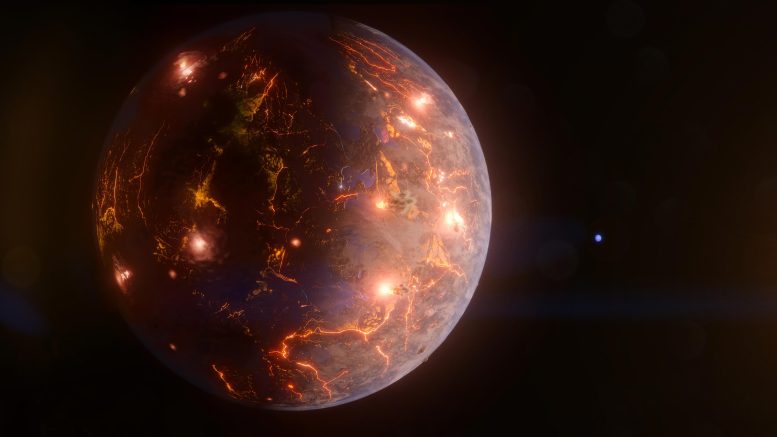
The planet, named LP 791-18 d, was located and observed using data from NASA’s Tess satellite and the Spitzer Space Telescope.
A team of scientists led by researchers at the University of Montreal has recently discovered an Earth-sized exoplanet, a world beyond our solar system, that may be carpeted with volcanoes and potentially hospitable to life. Called LP 791-18 d, the planet could undergo volcanic outbursts as often as Jupiter’s moon Io, the most volcanically active body in our solar system. The team includes Mohamad Ali-Dib, a research scientist at the NYU Abu Dhabi (NYUAD) Center for Astro, Particle, and Planetary Physics.
The planet was found and studied using data from NASA’s Transiting Exoplanet Survey Satellite (TESS), the Spitzer Space Telescope, as well as a suite of ground-based observatories. Dr. Ali-Dib specifically led the study of the planetary system’s stability and discovered that the orbits of its planets are long-term stable. His work moreover put significant constraints on the presence of additional unknown earth-sized planets in the system, as these might destabilize its orbits.

In the paper titled “A temperate Earth-sized planet with tidal heating transiting an M6 star” published in the journal Nature, the researchers explain how they detected and studied the new planet.
LP 791-18 d was discovered orbiting a small red dwarf star located approximately 90 light-years away in the southern constellation Crater. Researchers estimate that the newly discovered planet is only slightly larger and more massive than Earth.
Gravitational Interactions and Volcanic Activity
There are two other previously known planets in this system, referred to as LP 791-18 b and c. Each time planets c and d passed each other in orbit, the larger planet c produced a gravitational pull on planet d. This consistently deformed planet d and created an internal friction, which substantially heated the planet’s interior and produced volcanic activity at its surface.
The study moreover noted that LP 791-18 d is tidally locked, meaning it has one side that permanently faces its star, while the other is in continuous darkness. Tidal-locking, in addition to the significant amount of volcanic activity suspected across the planet would enable LP 791-18 d to sustain an atmosphere, and allow water to condense on its night side. This is significant, because the ability of a planet to sustain water in liquid form is key to its potential habitability.
Planet LP 791-18 c was recently approved to be observed using NASA’s James Webb Space Telescope. The findings of the new paper indicate that LP 791-18 d should be similarly studied to further investigate its ability to sustain life.
“The discovery of an Earth-size planet in the habitable zone that is potentially volcanically active is a huge step forward in the search for life outside the solar system,” said Ali-Dib. “The next step is to observe the system using the JWST to see what it can tell us about its atmosphere.”
For more on this discovery, see Earth-Size Planet Discovered by Astronomers May Be Carpeted With Volcanoes.
Reference: “A temperate Earth-sized planet with tidal heating transiting an M6 star” by Merrin S. Peterson, Björn Benneke, Karen Collins, Caroline Piaulet, Ian J. M. Crossfield, Mohamad Ali-Dib, Jessie L. Christiansen, Jonathan Gagné, Jackie Faherty, Edwin Kite, Courtney Dressing, David Charbonneau, Felipe Murgas, Marion Cointepas, Jose Manuel Almenara, Xavier Bonfils, Stephen Kane, Michael W. Werner, Varoujan Gorjian, Pierre-Alexis Roy, Avi Shporer, Francisco J. Pozuelos, Quentin Jay Socia, Ryan Cloutier, Jeremy Dietrich, Jonathan Irwin, Lauren Weiss, William Waalkes, Zach Berta-Thomson, Thomas Evans, Daniel Apai, Hannu Parviainen, Enric Pallé, Norio Narita, Andrew W. Howard, Diana Dragomir, Khalid Barkaoui, Michaël Gillon, Emmanuel Jehin, Elsa Ducrot, Zouhair Benkhaldoun, Akihiko Fukui, Mayuko Mori, Taku Nishiumi, Kiyoe Kawauchi, George Ricker, David W. Latham, Joshua N. Winn, Sara Seager, Howard Isaacson, Alex Bixel, Aidan Gibbs, Jon M. Jenkins, Jeffrey C. Smith, Jose Perez Chavez, Benjamin V. Rackham, Thomas Henning, Paul Gabor, Wen-Ping Chen, Nestor Espinoza, Eric L. N. Jensen, Kevin I. Collins, Richard P. Schwarz, Dennis M. Conti, Gavin Wang, John F. Kielkopf, Shude Mao, Keith Horne, Ramotholo Sefako, Samuel N. Quinn, Dan Moldovan, Michael Fausnaugh, Gábor Fűűrész and Thomas Barclay, 17 May 2023, Nature.
DOI: 10.1038/s41586-023-05934-8
Never miss a breakthrough: Join the SciTechDaily newsletter.
Follow us on Google and Google News.
1 Comment
Mustafar?! 🤔