
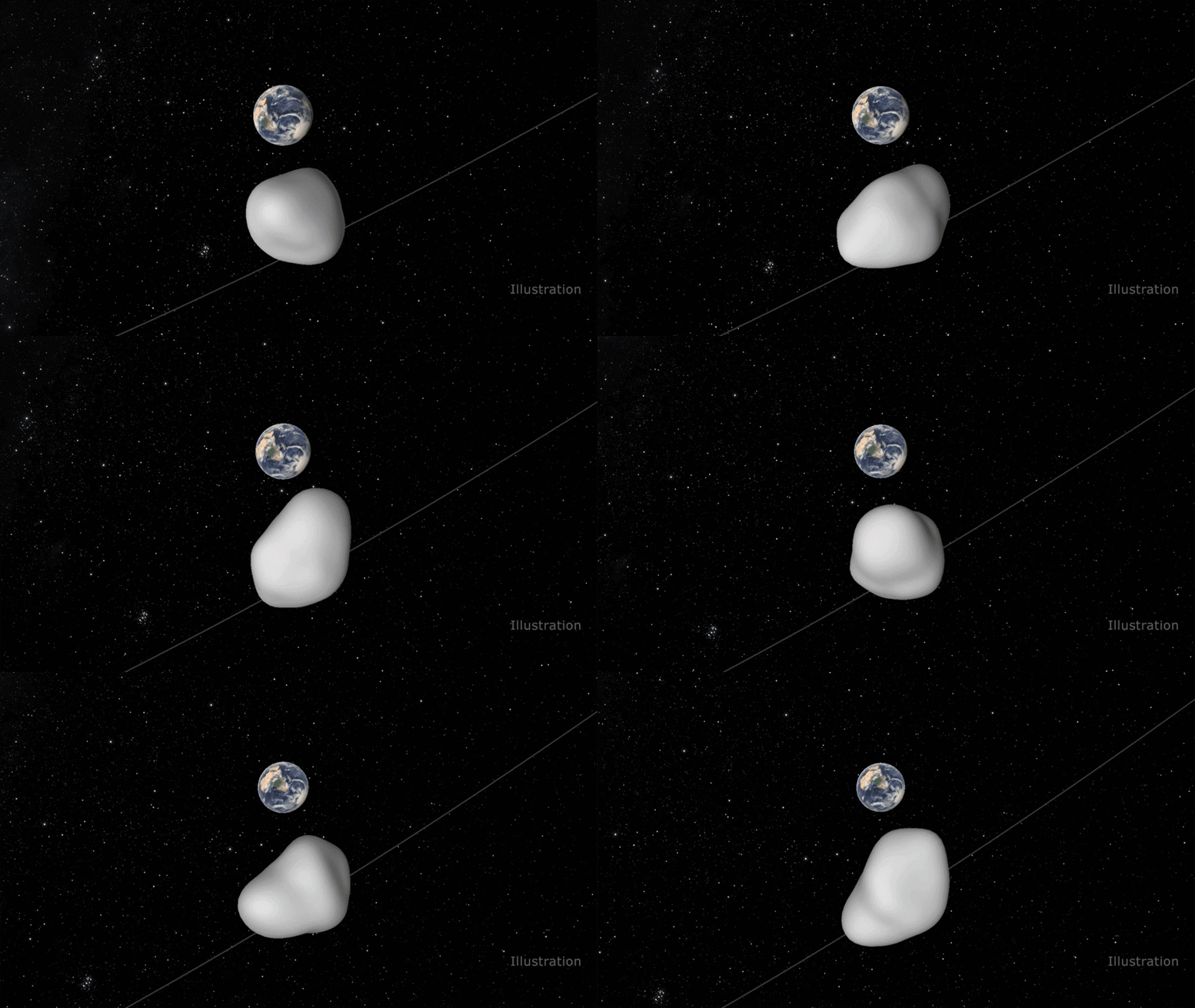
On October 12, asteroid 2012 TC4 will safely pass by Earth at a distance of approximately 26,000 miles (42,000 kilometers).
Passing by the Earth at a little over one-tenth the distance to the Moon and just above the orbital altitude of communications satellites, this encounter with TC4 is being used by asteroid trackers around the world to test their ability to operate as a coordinated international asteroid warning network.
2012 TC4 is estimated to be 45 to 100 feet (15 to 30 meters) in size. Orbit prediction experts say the asteroid poses no risk of impact with Earth. Nonetheless, its close approach to Earth is an opportunity to test the ability of a growing global observing network to communicate and coordinate their optical and radar observations in a real scenario.
This asteroid was discovered by the Panoramic Survey Telescope and Rapid Response System (Pan-STARRS) on Hawaii back in 2012. Pan-STARRS conducts a near-Earth object (NEO) survey funded by NASA’s NEO Observations Program, a key element of NASA’s Planetary Defense Coordination Office. However, 2012 TC4 traveled out of the range of asteroid-tracking telescopes shortly after it was discovered.
Based on the observations they were able to make in 2012, asteroid trackers predicted that it should come back into view in the fall of 2017. Observers with the European Space Agency and the European Southern Observatory were the first to recapture 2012 TC4, in late July 2017, using one of their large 8-meter aperture telescopes. Since then, observers around the world have been tracking the object as it approaches Earth and reporting their observations to the Minor Planet Center.
This “test” of what has become a global asteroid-impact early-warning system is a volunteer project, conceived and organized by NASA-funded asteroid observers and supported by the NASA Planetary Defense Coordination Office (PDCO).
As explained by Michael Kelley, program scientist and NASA PDCO lead for the TC4 observation campaign, “Asteroid trackers are using this flyby to test the worldwide asteroid detection and tracking network, assessing our capability to work together in response to finding a potential real asteroid-impact threat.”
No asteroid currently known is predicted to impact Earth for the next 100 years.
Asteroid TC4’s closest approach to Earth will be over Antarctica at 1:40 AM EDT. Tens of professionally run telescopes across the globe will be taking ground-based observations from visible to near-infrared to radar. Amateur astronomers may contribute more observations, but the asteroid will be very difficult for backyard astronomers to see, as current estimates are that it will reach a visual magnitude of only about 17 at its brightest, and it will be moving very fast across the sky.
Many of the observers who are participating in this exercise are funded by NASA’s NEO Observations Program but observers supported by other countries’ space agencies and space institutions around the world are now involved in the campaign.
Vishnu Reddy, an assistant professor at the University of Arizona’s Lunar and Planetary Laboratory in Tucson, is leading the 2012 TC4 campaign. Reddy is principal investigator for a NASA-funded near-Earth asteroid characterization project. “This campaign is a team effort that involves more than a dozen observatories, universities and labs around the globe so we can collectively learn the strengths and limitations of our near-Earth object observation capabilities,” he said. “This effort will exercise the entire system, to include the initial and follow-up observations, precise orbit determination, and international communications.”
In September, asteroid observers were able to conduct a “pre-test” of a coordinated tracking for the close approach of a much larger asteroid known as 3122 Florence. Florence, one of the largest known NEOs, at 2.8 miles (4.5 kilometers) in size, passed by Earth on September 1 at 18 times the distance to the Moon. Coordinated observations of this asteroid revealed, among other things, that Florence has two moons.
Never miss a breakthrough: Join the SciTechDaily newsletter.
Follow us on Google and Google News.