
Close Menu
    Facebook X (Twitter) Instagram
    SciTechDaily
    • Biology
    • Chemistry
    • Earth
    • Health
    • Physics
    • Science
    • Space
    • Technology
    Facebook X (Twitter) Pinterest YouTube RSS
    SciTechDaily
    Home»Space»VLT Survey Telescope Views the Lagoon Nebula
    Space

    VLT Survey Telescope Views the Lagoon Nebula

    By European Southern ObservatoryJanuary 22, 2014No Comments4 Mins Read
    Facebook Twitter Pinterest Telegram LinkedIn WhatsApp Email Reddit
    Share
    Facebook Twitter LinkedIn Pinterest Telegram Email Reddit
    VLT Survey Telescope Views the Lagoon Nebula
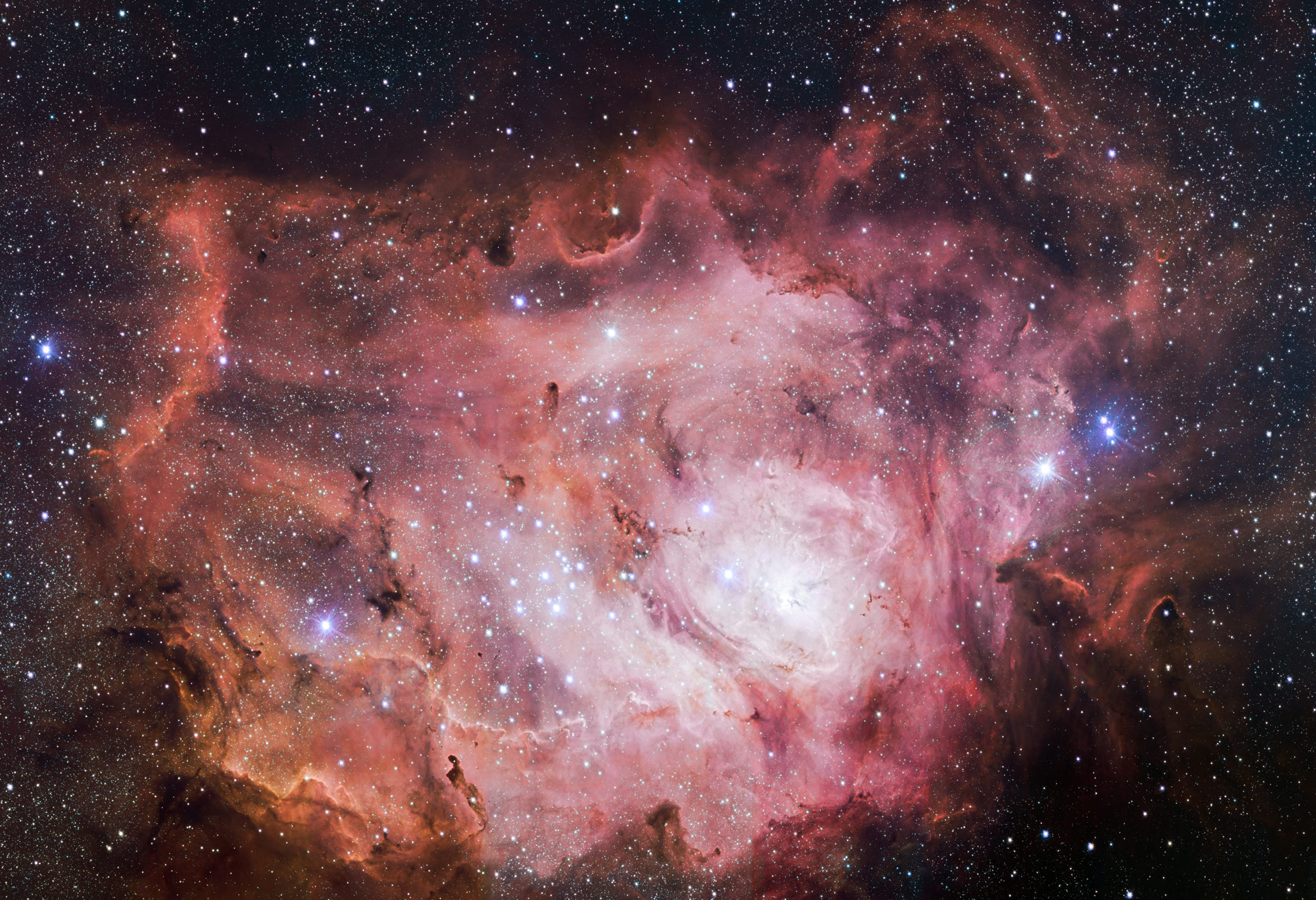
    The VLT Survey Telescope (VST) at ESO’s Paranal Observatory in Chile has captured this richly detailed new image of the Lagoon Nebula. This giant cloud of gas and dust is creating intensely bright young stars, and is home to young stellar clusters. This image is a tiny part of just one of eleven public surveys of the sky now in progress using ESO telescopes. Together these are providing a vast legacy of publicly available data for the global astronomical community. Credit: ESO/VPHAS+ team

    This new image from the VLT Survey Telescope shows the Lagoon Nebula, which is located roughly 5,000 light-years from us in the constellation of Sagittarius.

    The VLT Survey Telescope (VST) at ESO’s Paranal Observatory in Chile has captured this richly detailed new image of the Lagoon Nebula. This giant cloud of gas and dust is creating intensely bright young stars, and is home to young stellar clusters. This image is a tiny part of just one of eleven public surveys of the sky now in progress using ESO telescopes. Together these are providing a vast legacy of publicly available data for the global astronomical community.

    The Lagoon Nebula is an intriguing object located around 5,000 light-years from us in the constellation of Sagittarius (The Archer). Also known as Messier 8, it is a giant cloud 100 light-years across, where new stars are forming within its plumes of gas and dust. This new 16,000-pixel-wide image is from the VLT Survey Telescope (VST), one of two dedicated survey telescopes at ESO’s Paranal Observatory in northern Chile. A zoomable version of the image allows the viewers to explore the many nooks and crannies of this fascinating object.

    The VST was not pointed at the Lagoon deliberately, it simply was included as part of a huge imaging survey called VPHAS+ that covered a much larger region of the Milky Way. VPHAS+ is just one of three imaging surveys using visible light with the VST. These are complemented by six infrared surveys with the VISTA survey telescope.

    The surveys are addressing many important questions in modern astronomy. These include the nature of dark energy, searching for brilliant quasars in the early Universe, probing the structure of the Milky Way and looking for unusual and hidden objects, studying the neighboring Magellanic Clouds in great detail, and many other topics. History shows that surveys often find things that are unexpected and these surprises are crucial for the progress of astronomical research.


    This video sequence gives a close-up look at a richly detailed new image of the Lagoon Nebula captured by the VLT Survey Telescope at ESO’s Paranal Observatory in Chile. This giant cloud of gas and dust is creating intensely bright young stars, and is home to young stellar clusters. This image is a tiny part of just one of eleven public surveys of the sky now in progress using ESO telescopes. Together these are providing a vast legacy of publicly available data for the global astronomical community. ESO/VPHAS+ team

    As well as the nine imaging surveys with VISTA and the VST there are also two additional surveys that are in progress using other ESO telescopes. One, the Gaia-ESO Survey, is using the Very Large Telescope at Paranal to map the properties of more than 100,000 stars in the Milky Way, and another (PESSTO) is following up on transient objects such as supernovae using the New Technology Telescope at La Silla.

    Some of these surveys began back in 2010, and some much more recently, but data from all of them are now being made public and are accessible to astronomers around the world through ESO’s archive.

    Although they are still in progress, the surveys are already allowing astronomers to make many discoveries. Just a few of these new results include new star clusters found in the VVV survey, the best map yet of the central parts of our Milky Way, a very deep view of the infrared sky and, very recently, some of the most distant quasars discovered so far (from the VISTA VIKING survey).

    The ESO Public Surveys will continue for many years, and their astronomical legacy value will stretch many decades into the future.

    Never miss a breakthrough: Join the SciTechDaily newsletter.
    Follow us on Google and Google News.

    Astronomy European Southern Observatory Very Large Telescope
    Share. Facebook Twitter Pinterest LinkedIn Email Reddit

    Related Articles

    Pinwheel Firework: Stunning Telescope Image Captures Grand Design Spiral Galaxy

    Astronomers Discover Micronovae: A New Kind of Thermonuclear Stellar Explosion

    New Planet Discovered Next Door – Orbiting Proxima Centauri

    Mysterious Galactic Nomads: At Least 70 Rogue Planets Uncovered in Our Milky Way

    Surprise Planet Discovered Around Extreme Star Pair

    Supermassive Black Holes on a Collision Course: Closest Pair of Supermassive Black Holes to Earth Ever Discovered

    Strange 160 Mile-Long “Dog-Bone” Asteroid Kleopatra Captured in Detailed Images

    Astronomers Find Small Rocky Planet – Just Half the Mass of Venus

    Stunning Galactic Fireworks: New ESO Images Reveal Spectacular Features of Nearby Galaxies

    Leave A Reply Cancel Reply

    • Facebook
    • Twitter
    • Pinterest
    • YouTube

    Don't Miss a Discovery

    Subscribe for the Latest in Science & Tech!

    Trending News

    Massive Study Warns Marijuana Use in Teens Is Linked to Serious Mental Illness

    Scientists Discover a Completely Unexpected Way T Cells Kill Cancer

    Scientists Just Found the Solar System’s Original “Planet Factory”

    Study Warns Widely Used Food Preservatives Linked to High Blood Pressure and Heart Disease

    New Treatment Could Reverse Osteoarthritis Within Weeks

    Physicists Have Measured “Negative Time” in Bizarre Quantum Experiment

    The Deadly Tapeworm Spreading Across America Has Reached the Pacific Northwest

    Could Low Vitamin D Be Making Your Pain Worse?

    Follow SciTechDaily
    • Facebook
    • Twitter
    • YouTube
    • Pinterest
    • Newsletter
    • RSS
    SciTech News
    • Biology News
    • Chemistry News
    • Earth News
    • Health News
    • Physics News
    • Science News
    • Space News
    • Technology News
    Recent Posts
    • Scientists Discover Some “Zombie Cells” May Actually Help You Live Longer
    • Scientists Discover Two Strange Dead Stars That Defy Astronomical Expectations
    • Scientists Find a Smarter Way To Measure the Universe Using Exploding Stars
    • Earth May Be Seeding Venus With Life, According to New Research
    • Streetlights Are Trapping Thousands of Isopods in Mysterious “Death Spirals”
    Copyright © 1998 - 2026 SciTechDaily. All Rights Reserved.
    • Science News
    • About
    • Contact
    • Editorial Board
    • Privacy Policy
    • Terms of Use

    Type above and press Enter to search. Press Esc to cancel.