
Close Menu
    Facebook X (Twitter) Instagram
    SciTechDaily
    • Biology
    • Chemistry
    • Earth
    • Health
    • Physics
    • Science
    • Space
    • Technology
    Facebook X (Twitter) Pinterest YouTube RSS
    SciTechDaily
    Home»Space»Pinwheel Firework: Stunning Telescope Image Captures Grand Design Spiral Galaxy
    Space

    Pinwheel Firework: Stunning Telescope Image Captures Grand Design Spiral Galaxy

    By European Southern ObservatoryNovember 8, 20223 Comments2 Mins Read
    Facebook Twitter Pinterest Telegram LinkedIn WhatsApp Email Reddit
    Share
    Facebook Twitter LinkedIn Pinterest Telegram Email Reddit
    Spiral Galaxy NGC 4254 Coma Pinwheel Messier 99
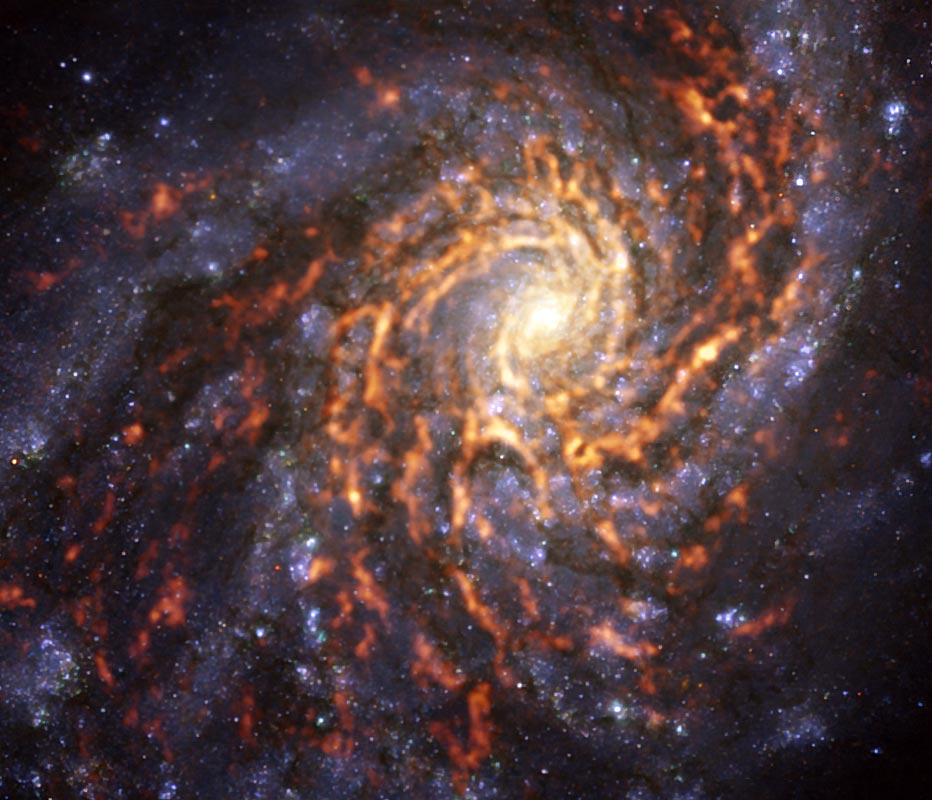
    This image of the spiral galaxy NGC 4254, also known as the Coma Pinwheel or Messier 99, is a composite of data taken with ESO’s Very Large Telescope (VLT) and the Atacama Large Millimeter/submillimeter Array (ALMA). Credit: ESO/PHANGS

    This stunning image clearly displays the well-defined arms of the spiral galaxy NGC 4254, also known as the Coma Pinwheel or Messier 99. Because of its distinctive pinwheel shape with prominent arms, it’s called a grand design spiral galaxy.

    It was discovered on March 17, 1781, by French astronomer Pierre Méchain. He reported it to fellow French astronomer Charles Messier, who included the object in the Messier Catalogue of comet-like objects. Modern technology has allowed us to observe galaxies like this in significantly greater detail compared to when it was first observed by Méchain and Messier in the 18th century.

    NGC 4254 is a grand design spiral galaxy in the northern constellation Coma Berenices approximately 49,000,000 light-years from the Milky Way. In Latin, Coma Berenices means “Berenice’s Hair” and refers to Queen Berenice II of Egypt, who sacrificed her long hair as a religious offering.

    This image is a composite of data taken with ESO’s Very Large Telescope (VLT) and the Atacama Large Millimeter/submillimeter Array (ALMA), co-owned by ESO. The VLT data, shown in blue and purple tones, was captured with the Multi-Unit Spectroscopic Explorer (MUSE) instrument, mapping the distribution of stars. The ALMA data – shown here by the red and orange regions – originates from cold clouds of gas which can eventually collapse into stars. Comparing these two datasets allows for a better understanding of how stars form.

    This image was taken as part of the Physics at High Angular resolution in Nearby GalaxieS (PHANGS) survey, which produces high-resolution images of nearby galaxies across all wavelengths of light. This will allow astronomers to learn more about the diverse range of galactic environments found in our Universe.

    Never miss a breakthrough: Join the SciTechDaily newsletter.
    Follow us on Google and Google News.

    ALMA Astronomy European Southern Observatory Popular Very Large Telescope
    Share. Facebook Twitter Pinterest LinkedIn Email Reddit

    Related Articles

    A Cosmic First: Astronomers Uncover a Planet-Forming Disc in Another Galaxy

    The Genesis of Jupiters: Incredible New Image Reveals Secrets of Planet Birth

    Planet-Forming Disc Ripped Apart by Its Three Central Stars – Leaving It Warped and With Tilted Rings

    ESO Telescope Sees Telltale Signs of a Baby Planet Coming Into Existence

    ALMA Views a Key Stage in the Birth of Giant Planets

    Planetary Nebula Fleming 1 Likely Has Two White Dwarfs Circling Each Other at Its Center

    ESO’s New Image of Spiral Galaxy NGC 1187

    VLT Reveals That O Stars, Which Drive the Evolution of Galaxies, Don’t Live Alone

    Scientists Detect Dark Galaxies for the First Time

    3 Comments

    1. Jason P on November 8, 2022 5:31 am

      Pinwheel firework a.k.a. a Catherine Wheel

      Reply
    2. Darrell Rogers on November 8, 2022 11:49 am

      Very introspective article.

      Reply
    3. SmokinTruth on November 8, 2022 3:28 pm

      49 million light years away huh….hahahaha! Do people even realize how far these supposed distances are? We are supposed to believe that we can just see infinite distances if we use the right telescope….what a frickin joke. Wake up people. What astronomers are seeing and have been seeing as long as there have been telescopes and eyes to look through them, are not nearly as far as they would have you believe.
      Don’t take my word for it, just zoom in REAL close to any star in the night sky and you will see the truth.

      Reply
    Leave A Reply Cancel Reply

    • Facebook
    • Twitter
    • Pinterest
    • YouTube

    Don't Miss a Discovery

    Subscribe for the Latest in Science & Tech!

    Trending News

    The Universe Is Expanding Too Fast and Scientists Can’t Explain Why

    “Like Liquid Metal”: Scientists Create Strange Shape-Shifting Material

    Early Warning Signals of Esophageal Cancer May Be Hiding in Plain Sight

    Common Blood Pressure Drug Shows Surprising Power Against Deadly Antibiotic-Resistant Superbug

    Scientists Uncover Dangerous Connection Between Serotonin and Heart Valve Disease

    Scientists Discover a “Protector” Protein That Could Help Reverse Hair Loss

    Bone-Strengthening Discovery Could Reverse Osteoporosis

    Scientists Uncover Hidden Trigger Behind Stem Cell Aging

    Follow SciTechDaily
    • Facebook
    • Twitter
    • YouTube
    • Pinterest
    • Newsletter
    • RSS
    SciTech News
    • Biology News
    • Chemistry News
    • Earth News
    • Health News
    • Physics News
    • Science News
    • Space News
    • Technology News
    Recent Posts
    • A Common Diabetes Drug May Hold the Key to Stopping HIV From Coming Back
    • Ancient “Syphilis-Like” Disease in Vietnam Challenges Key Scientific Assumptions
    • Drinking Alcohol To Cope in Your 20s Could Damage Your Brain for Life
    • Scientists Crack Alfalfa’s Chromosome Mystery After Decades of Debate
    • Ancient Ant-Plant Alliance Collapses As Predatory Wasps Move In
    Copyright © 1998 - 2026 SciTechDaily. All Rights Reserved.
    • Science News
    • About
    • Contact
    • Editorial Board
    • Privacy Policy
    • Terms of Use

    Type above and press Enter to search. Press Esc to cancel.