
Close Menu
    Facebook X (Twitter) Instagram
    SciTechDaily
    • Biology
    • Chemistry
    • Earth
    • Health
    • Physics
    • Science
    • Space
    • Technology
    Facebook X (Twitter) Pinterest YouTube RSS
    SciTechDaily
    Home»Physics»Von Kármán’s Vortices: Key Mathematical Insight About Swirling, Asymmetrical Flow Patterns
    Physics

    Von Kármán’s Vortices: Key Mathematical Insight About Swirling, Asymmetrical Flow Patterns

    By Adam Voiland, NASA Earth ObservatoryJanuary 5, 20211 Comment3 Mins Read
    Facebook Twitter Pinterest Telegram LinkedIn WhatsApp Email Reddit
    Share
    Facebook Twitter LinkedIn Pinterest Telegram Email Reddit
    Cabo Verde Islands von Karman Vortices Annotated
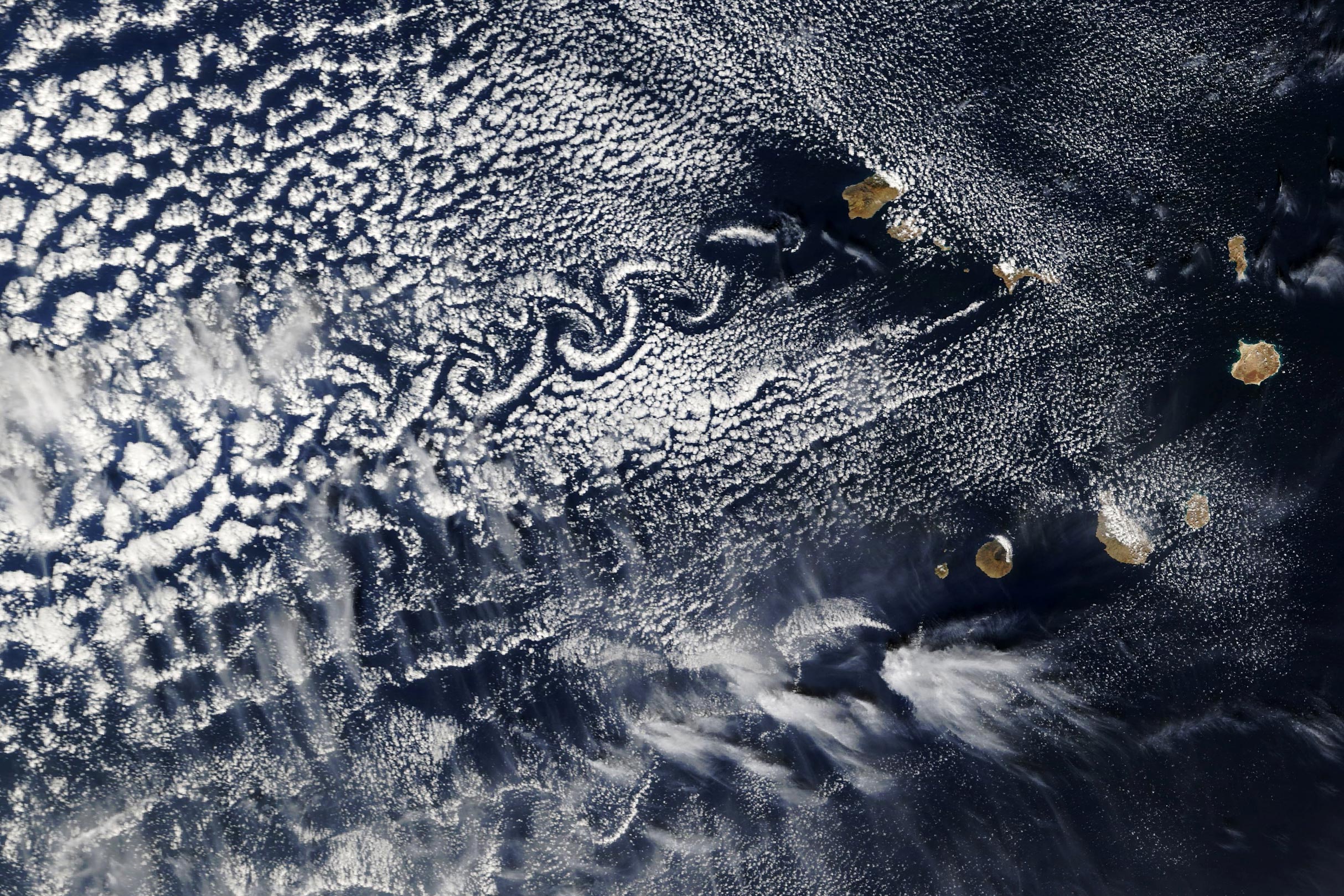
    On December 20, 2020, von Karman Vortices were observed near the Cabo Verde Islands. (Click image for high-resolution view.) Credit: NASA Earth Observatory image by Lauren Dauphin, using MODIS data from NASA EOSDIS/LANCE and GIBS/Worldview.

    The tall volcanic islands of Cabo Verde create swirling cloud patterns called von Kármán vortex streets. These formations, captured by NASA’s MODIS, were first explained mathematically by Theodore von Kármán over a century ago.

    On a clear day, the towering peaks on Fogo, Santa Antão, and São Nicolau stand out amid the flatter islands of Cabo Verde (Cape Verde). These three volcanic islands, the tallest in the archipelago, stand high enough to generate rain shadow effects that support unique dry forests on some of the islands.

    The height also helps these islands disturb passing air masses and clouds in a way that Theodore von Kárm—an accomplished mathematician, aerospace engineer, and one of the Jet Propulsion Laboratory’s founders—likely would have appreciated. The trails are called von Kármán vortex streets, a distinctive pattern that can occur when a fluid passes a tall, isolated, stationary object. In 1912, von Kármán was the first to describe the oscillating flow features in mathematical terms while he was working as a graduate assistant for the pioneering German fluid dynamicist Ludwig Prandtl.

    Though a French scientist was the first to photograph the feature, von Kármán’s key insight was a mathematical proof demonstrating that staggered vortices were the most lasting flow pattern that such features can produce. “I found that only the anti-symmetric arrangement could be stable, and only for a certain ratio of the distance between the rows and the distance between two consecutive vortices of each row,” von Kármán later wrote about the discovery. In other words, the vortices are always offset and never line up.

    The Moderate Resolution Imaging Spectroradiometer (MODIS) on NASA’s Terra captured this image of the swirling trails of clouds on December 20, 2020. The dry forests appear slightly darker than the rest of the islands.

    Von Kármán was a student at the University of Göttingen (Germany) when he made his insight about the vortices. He remained in Germany until 1930, with a three-year interruption to serve in the Austro-Hungarian army. Concerned about the rise of the Nazis in Germany, von Kármán accepted an offer to direct the new Daniel Guggenheim Aeronautical Laboratory at the California Institute of Technology in 1930. That lab later became NASA’s Jet Propulsion Laboratory in 1958.


    Never miss a breakthrough: Join the SciTechDaily newsletter.
    Follow us on Google and Google News.

    Fluid Mechanics JPL NASA NASA Earth Observatory
    Share. Facebook Twitter Pinterest LinkedIn Email Reddit

    Related Articles

    Toxic Toll: Where Warehouses Rise, So Does Air Pollution

    Testing Einstein’s Relativity: NASA Unleashes Ultra-Cool Quantum Technology in Space

    NASA Unveils Secrets of Death Valley’s Temporary Lake

    NASA’s SWOT Satellite Reveals the Depths of California’s Weather Woes

    Ultracold Bubbles on Space Station: New Quantum Research Experiments With an Exotic State of Matter

    Ocean Physics Explain Incredible Cyclones on Jupiter

    Upgrading the Space Station’s Cold Atom Physics Laboratory With Mixed Reality

    Scientists Concerned As Denman Glacier Retreats Both Above and Below the Water Line

    NASA’s Cold Atom Laboratory to Study Ultra-Cold Quantum Gases

    1 Comment

    1. xABBAAA on January 10, 2021 7:41 am

      … some wars will never settle, there are Gods and Titans…

      Reply
    Leave A Reply Cancel Reply

    • Facebook
    • Twitter
    • Pinterest
    • YouTube

    Don't Miss a Discovery

    Subscribe for the Latest in Science & Tech!

    Trending News

    Two Drinks a Day May Be Riskier Than Many Americans Think

    A Lost Human Lineage May Have Left a Genetic Legacy in People Today

    Study Reveals a Surprising Link Between Birth Control Pills and Binge Eating

    NASA’s HiRISE Captures Perseverance Rover Completing a Marathon on Mars

    Ancient DNA Reveals the Hidden Origins of China’s Mysterious Shimao Civilization

    Scientists Discover a Surprising Link Between Sleep, Genes, and Alzheimer’s

    Popular Childhood Drinks Linked to Higher Blood Pressure Later in Life

    Scientists Just Challenged a 70-Year-Old Myth About the Human Brain

    Follow SciTechDaily
    • Facebook
    • Twitter
    • YouTube
    • Pinterest
    • Newsletter
    • RSS
    SciTech News
    • Biology News
    • Chemistry News
    • Earth News
    • Health News
    • Physics News
    • Science News
    • Space News
    • Technology News
    Recent Posts
    • NASA Reveals the Black Sea’s Stunning Annual Turquoise Transformation
    • First Close-Up Images Reveal Shackleton’s Lost Ship on the Ocean Floor
    • Stanford Scientists Solve a 252-Million-Year-Old Mass Extinction Mystery
    • Scientists Discover the Brain Protein That Helps Alzheimer’s Spread Through the Brain
    • The Ancient Survival Mechanism Making Weight Loss So Difficult
    Copyright © 1998 - 2026 SciTechDaily. All Rights Reserved.
    • Science News
    • About
    • Contact
    • Editorial Board
    • Privacy Policy
    • Terms of Use

    Type above and press Enter to search. Press Esc to cancel.