
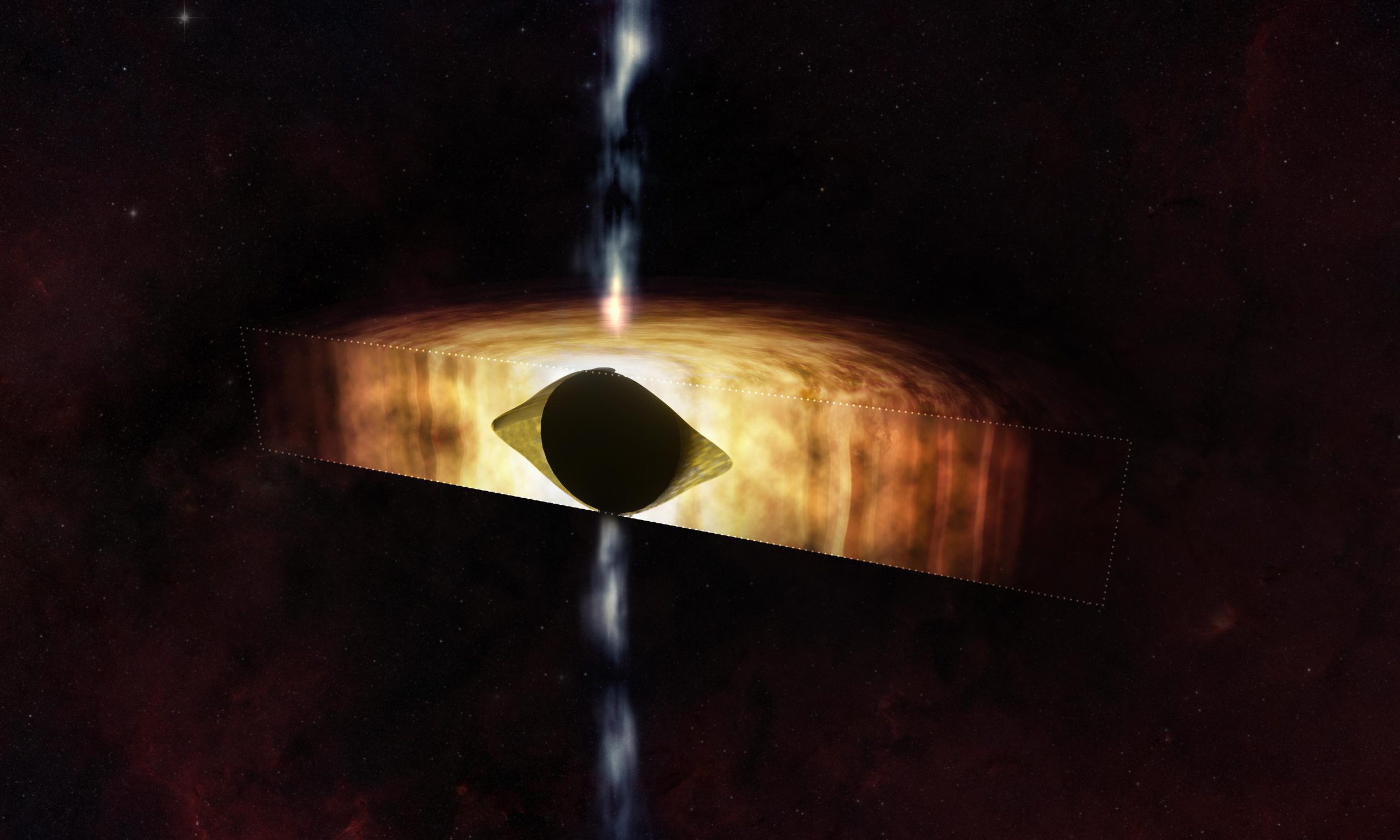
Researchers revealed that the black hole’s spinning speed could provide an ‘incredibly powerful kick’ to surrounding matter.
The supermassive black hole in the center of the Milky Way is spinning so quickly it is warping the spacetime surrounding it into a shape that can look like a football, according to a new study using data from NASA’s Chandra X-ray Observatory and the U.S. National Science Foundation’s Karl G. Jansky Very Large Array (VLA). That football shape suggests the black hole is spinning at a substantial speed, which researchers estimated to be about 60% of its potential limit.
The work, led by Penn State Berks Professor of Physics Ruth Daly, was published in the Monthly Notices of the Royal Astronomical Society.
Astronomers call this giant black hole Sagittarius A* (Sgr A*). It is located about 26,000 light-years away from Earth in the center of the galaxy. To determine how quickly Sgr A* is spinning — one of its fundamental properties, along with mass — the researchers applied a method that uses X-ray and radio data to assess how material is flowing towards and away from the black hole. The method was developed and published by Daly in 2019 in The Astrophysical Journal.
Insights Into Sgr A*’s Dynamics
“Our work may help settle the question of how fast our galaxy’s supermassive black hole is spinning,” Daly said. “Our results indicate that Sgr A* is spinning very rapidly, which is interesting and has far-reaching implications.”
The team found the angular velocity — the number of revolutions per second — of Sgr A*’s spin is about 60% of the maximum possible value, a limit set because material cannot travel faster than the speed of light.
Past estimations of Sgr A*’s speed have been made with different techniques and by other astronomers, with results ranging from no rotation at all to spinning at almost the maximum rate.
“This work, however, shows that this could change if the amount of material in the vicinity of Sgr A* increases,” Daly said.
As a black hole rotates, it pulls “spacetime” — the combination of time and the three dimensions of space — and nearby matter. The gravitational pull also squashes the spacetime, altering its shape depending on how it’s observed. Spacetime appears circular if the black hole is viewed from the top. From the side, however, the spacetime is shaped like a football. The faster the spin, the flatter the football.
The Future of Sgr A* and Its Effects
The spin can also serve as an energy source, Daly said, if matter — such as gas or the remnants of a star that wanders too close — exists in the vicinity of the black hole. As the black hole spins, matter can escape in the form of narrow jets called collimated outflows. However, Sgr A* currently has limited nearby matter, so the black hole has been relatively quiet, with weakly collimated outflows, in recent millennia.
“A spinning black hole is like a rocket on the launch pad,” said Biny Sebastian, a co-author from the University of Manitoba in Winnipeg, Canada. “Once material gets close enough, it’s like someone has fueled the rocket and hit the ‘launch’ button.”
This means that in the future, if the properties of the matter and the magnetic field strength close to the black hole change, part of the enormous energy of the black hole’s spin could drive more powerful outflows. This source material could come from gas or from the remnants of a star torn apart by the black hole’s gravity if that star wanders too close to Sgr A*.
“Jets powered and collimated by a galaxy’s spinning central black hole can profoundly affect the gas supply for an entire galaxy, which affects how quickly and even whether stars can form,” said co-author Megan Donahue from Michigan State University. “The ‘Fermi bubbles’ seen in X-rays and gamma rays around our Milky Way’s black hole show the black hole was probably active in the past. Measuring the spin of our black hole is an important test of this scenario.”
Fermi bubbles refer to structures that emit gamma rays above and below the black hole that researchers have theorized resulted from prior massive outflows.
The researchers used the outflow method to determine the spin of Sgr A*. Daly’s approach incorporates consideration of the relationship between the spin of the black hole and its mass, the properties of the matter near the black hole and the outflow properties. The collimated outflow produces the radio waves, while the disk of gas surrounding the black hole emits X-rays. The researchers combined observational data from Chandra and the VLA with an independent estimate of the black hole’s mass from other telescopes to inform the outflow method and determine the black hole’s spin.
“We have a special view of Sgr A* because it is the nearest supermassive black hole to us,” said co-author Anan Lu from McGill University in Montreal, Canada. “Although it’s quiet right now, our work shows that in the future it will give an incredibly powerful kick to surrounding matter. That might happen in a thousand or a million years, or it could happen in our lifetimes.”
For more on this discovery, see Telescopes Reveal Rapid Spin of Milky Way’s Black Hole Warping Spacetime.
Reference: “New black hole spin values for Sagittarius A* obtained with the outflow method” by Ruth A Daly, Megan Donahue, Christopher P O’Dea, Biny Sebastian, Daryl Haggard and Anan Lu, 21 October 2023, Monthly Notices of the Royal Astronomical Society.
DOI: 10.1093/mnras/stad3228
In addition to those mentioned above, co-authors include Christopher O’Dea, University of Manitoba, and Daryl Haggard, McGill University.
NASA’s Marshall Space Flight Center manages the Chandra program. The Smithsonian Astrophysical Observatory’s Chandra X-ray Center controls science operations from Cambridge, Massachusetts, and flight operations from Burlington, Massachusetts.
Never miss a breakthrough: Join the SciTechDaily newsletter.
Follow us on Google and Google News.