
Close Menu
    Facebook X (Twitter) Instagram
    SciTechDaily
    • Biology
    • Chemistry
    • Earth
    • Health
    • Physics
    • Science
    • Space
    • Technology
    Facebook X (Twitter) Pinterest YouTube RSS
    SciTechDaily
    Home»Space»WASP-121b – An Ultrahot Gas-Giant Exoplanet with a Stratosphere
    Space

    WASP-121b – An Ultrahot Gas-Giant Exoplanet with a Stratosphere

    By Harvard-Smithsonian Center for AstrophysicsSeptember 15, 2017No Comments3 Mins Read
    Facebook Twitter Pinterest Telegram LinkedIn WhatsApp Email Reddit
    Share
    Facebook Twitter LinkedIn Pinterest Telegram Email Reddit
    Astronomers Discover an Ultrahot Gas-Giant Exoplanet with a Stratosphere
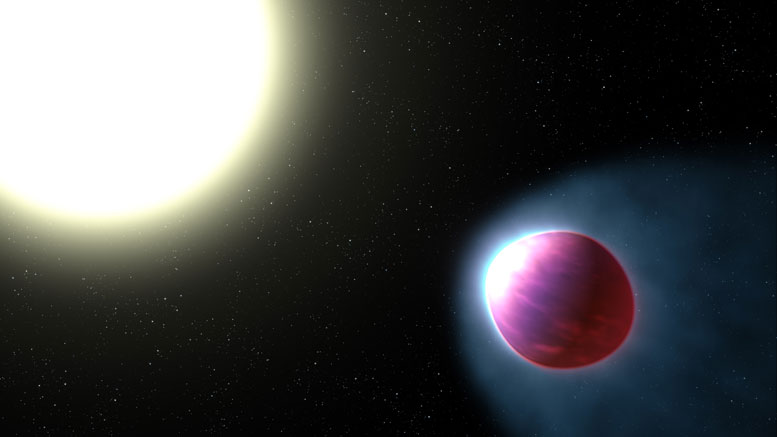
    An artist’s conception of the hot-Jupiter exoplanet WASP-121b with its star. Credit: NASA/ESA /G. Bacon, STSci

    Using the Hubble and Spitzer Space Telescopes, astronomers have discovered the first unambiguous signs of a hot stratosphere, heated to a blazing 2400 Celsius, in exoplanet WASP-121b.

    The stratosphere of a planetary atmosphere is the layer in which the temperatures rise with altitude, in contrast to the tropospheric layer (near the ground) in which the temperature falls with altitude. On the Earth the stratosphere begins at thirty to sixty thousand feet (nine to eighteen thousand meters), depending on the latitude; it terminates at about 160,000 feet (49,000 meters). The temperature inversion of the Earth’s stratosphere is caused principally by ozone, which exists at these higher altitudes and absorbs sunlight to heat the layer. A planet’s stratosphere thus contains information about its chemical composition, and astronomers probing the atmospheres of exoplanets have wondered whether any of them show signs of having a stratosphere. The molecules in this warm gas layer should emit diagnostic spectral lines that could be spotted from Earth.

    CfA astronomer Mercedes Lopez-Morales was the Co-Principal Investigator in a large team of international exoplanet hunters who discovered a stratosphere on the exoplanet WASP-121b, the first unambiguous such discovery. The exoplanet itself, discovered in 2015, is a so-called hot Jupiter, and orbits its star every 1.27 days. Its mass is slightly larger than Jupiter’s, and it orbits so close to its star that its atmospheric temperature is thought to be heated to about 2,200 Celsius or 4,000 Fahrenheit (hence the name, “hot Jupiter”).

    The astronomers used the Hubble Space Telescope and the IRAC camera on the Spitzer Space Telescope to study in the planet during its secondary eclipses: as it passed behind the star, its illuminated Earth-facing side can be seen. The reflected light from the atmosphere enabled scientists to spot faint emission lines of the molecules present, including in this case water molecules at a temperature of about 2,400 Celsius (4,400 Fahrenheit), as well as some other species that are still uncertain. The hot gas is consistent with the presence of a stratospheric layer on the planet. Water had been previously spotted on WASP-121b during a normal transit, but this new result shows that there is water in the stratosphere. The models were able to infer even more detailed information about the atmosphere, for example, that the molecules in that layer absorb about twenty percent of the incident stellar radiation, contributing to the stratosphere being hotter than the general atmosphere.

    Reference: “An Ultrahot Gas-Giant Exoplanet with a Stratosphere” by Thomas M. Evans, David K. Sing, Tiffany Kataria, Jayesh Goyal, Nikolay Nikolov, Hannah R. Wakeford, Drake Deming, Mark S. Marley, David S. Amundsen, Gilda E. Ballester, Joanna K. Barstow, Lotfi Ben-Jaffel, Vincent Bourrier, Lars A. Buchhave, Ofer Cohen, David Ehrenreich, Antonio García Muñoz, Gregory W. Henry, Heather Knutson, Panayotis Lavvas, Alain Lecavelier des Etangs, Nikole K. Lewis, Mercedes López-Morales, Avi M. Mandell, Jorge Sanz-Forcada, Pascal Tremblin and Roxana Lupu, 3 August 2017, Nature.
    DOI: 10.1038/nature23266

    Never miss a breakthrough: Join the SciTechDaily newsletter.
    Follow us on Google and Google News.

    Astronomy Exoplanet Harvard-Smithsonian Center for Astrophysics Hubble Space Telescope Planetary Science Spitzer Space Telescope
    Share. Facebook Twitter Pinterest LinkedIn Email Reddit

    Related Articles

    Helium Discovered in the Eroding Atmosphere of an Exoplanet

    Scientists Discover a Large Amount of Water in an Exoplanet’s Atmosphere

    Space Telescopes Reveal Details of Ten Jupiter-Sized Exoplanet Atmospheres

    Magnetic Winds From a Young Star in the Orion Nebula

    Water Planets in the Habitable Zone: A Closer Look at Kepler 62e and 62f

    Kepler Finds Over 2,300 Candidate Exoplanets

    Earth-like Planets May Have Older and More Evolved Life

    A New Subclass of Extra-Solar Planets Discovered

    New Study Revives Doubted Exoplanet Fomalhaut b

    Leave A Reply Cancel Reply

    • Facebook
    • Twitter
    • Pinterest
    • YouTube

    Don't Miss a Discovery

    Subscribe for the Latest in Science & Tech!

    Trending News

    One of the Universe’s Largest Stars May Be Getting Ready To Explode

    Scientists Discover Enzyme That Could Supercharge Ozempic-Like Weight Loss Drugs

    Popular Sweetener Linked to DNA Damage – “It’s Something You Should Not Be Eating”

    Ancient “Rock” Microbes May Reveal How Complex Life Began

    Researchers Capture Quantum Interference in One of Nature’s Rarest Atoms

    “A Plague Is Upon Us”: The Mass Death That Changed an Ancient City Forever

    Scientists Discover Game-Changing New Way To Treat High Cholesterol

    This Small Change to Your Exercise Routine Could Be the Secret to Living Longer

    Follow SciTechDaily
    • Facebook
    • Twitter
    • YouTube
    • Pinterest
    • Newsletter
    • RSS
    SciTech News
    • Biology News
    • Chemistry News
    • Earth News
    • Health News
    • Physics News
    • Science News
    • Space News
    • Technology News
    Recent Posts
    • Scientists Prove There Are Just Six Degrees of Separation in a Social Network
    • Bee Bacteria Could Fix a Major Flaw in Plant-Based Milk
    • Scientists Discover a Surprising Way To Make Bread Healthier and More Nutritious
    • Natural Compounds Boost Bone Implant Success While Killing Bacteria and Cancer Cells
    • After 60 Years, Scientists Uncover Unexpected Brain Effects of Popular Diabetes Drug Metformin
    Copyright © 1998 - 2026 SciTechDaily. All Rights Reserved.
    • Science News
    • About
    • Contact
    • Editorial Board
    • Privacy Policy
    • Terms of Use

    Type above and press Enter to search. Press Esc to cancel.