

Stomp dancing, head jerking, chattering, and skimming create swirling water patterns that direct brine shrimp and small animals into the birds’ mouths.
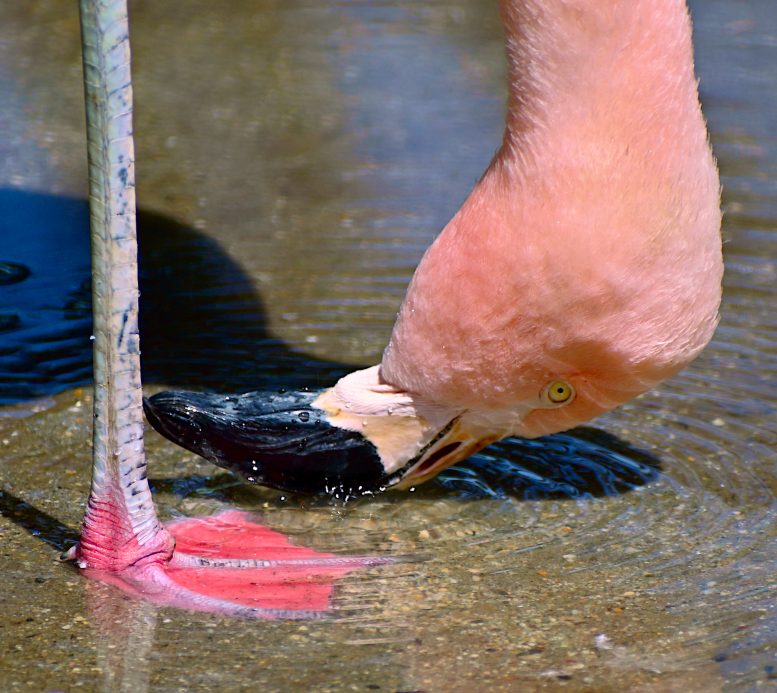
Flamingos standing quietly in shallow alkaline lakes with their heads submerged may appear to be peacefully feeding, but much more is happening beneath the surface.
Researchers studying Chilean flamingos at the Nashville Zoo, along with 3D-printed models of their feet and L-shaped bills, have shown that the birds use their feet, heads, and beaks to generate swirling vortices in the water. These water movements help concentrate their prey, allowing the flamingos to feed more efficiently.
“Flamingos are actually predators, they are actively looking for animals that are moving in the water, and the problem they face is how to concentrate these animals, to pull them together and feed,” said Victor Ortega Jiménez, an assistant professor of integrative biology at the University of California, Berkeley, who specializes in biomechanics. “Think of spiders, which produce webs to trap insects. Flamingos are using vortices to trap animals, like brine shrimp.”
Ortega Jiménez and collaborators at the Georgia Institute of Technology in Atlanta; Kennesaw State University in Marietta, Georgia (KSU-Marietta); and the Nashville Zoo recently published their findings in the Proceedings of the National Academy of Sciences.
The researchers found that flamingos use their flexible webbed feet to stir up bottom sediment and push it forward in swirling patterns. They then jerk their heads upward, like plungers, to pull the swirling sediment toward the surface, creating mini tornadoes. Throughout this process, the birds keep their heads upside down in the vortex, using their angled beaks to chatter and form smaller vortices that guide the sediment and prey into their mouths, where the food is filtered out.

The beak of a flamingo is unique in being flattened on the angled front end, so that when the bird’s head is upside down in the water, the flat portion is parallel to the bottom. This allows the flamingo to employ another technique called skimming. This involves using its long, S-shaped neck to push its head forward while rapidly clapping its beak, creating sheet-like vortices — von Kármán vortices — that trap prey.
This suite of active feeding behaviors belies the flamingo’s reputation as a passive filter feeder, Ortega Jiménez said.
“It seems like they are filtering just passive particles, but no, these animals are actually taking animals that are moving,” he said.
The principles he discovered could be used to design better systems for concentrating and sucking up tiny particles, such as microplastics, from water; better self-cleaning filters, based on chattering; or robots that, like flamingos, can walk and run in mud.
Chattering
Ortega Jiménez, a native of Puebla, Mexico, became fascinated with the feeding behavior of flamingos during a visit to Zoo Atlanta with his wife and daughter before the COVID-19 pandemic. Filming the birds’ feeding behavior, he observed only ripples on the surface.
“We don’t know anything about what is happening inside. That was my question,” he said.
At the time, a postdoctoral fellow at Kennesaw State University in Georgia, Ortega Jiménez focused on flamingo feeding as his next research project. He views himself, he said, as a modern-day Darwinian naturalist, investigating the behavior of animals of all types, from nematodes and flies to springtails and birds, focusing on how the animals interact with and manipulate their surroundings, including air, water, and electromagnetic fields.
From Kennesaw State he moved to the Georgia Institute of Technology to work in the lab of Saad Bhamla, where he collaborated with engineers, and they gained access to Chilean flamingos at the Nashville Zoo. The team filmed them feeding in a large tray, using a laser to illuminate gas bubbles in the water in order to see the vortices created by the heads and beaks of the animals.
After moving to the University of Maine in Orono as an assistant professor, Ortega Jiménez refined 3D printed models of a flamingo beak and foot to study more precisely the movement of water and particles during the beak clapping, or “chattering,” that the birds use when eating.
In 2024, he moved again, to UC Berkeley, where he conducted experiments to see how effective the chattering and foot stomping was in capturing live brine shrimp. The new paper summarizes all of this collaborative work.
At UC Berkeley, he attached a real flamingo beak to an actuator to simulate chattering and added a small pump in the mouth to simulate the tongue and suck up the brine shrimp captured by the mouth. With this setup, he was able to establish that chattering is key to flamingo feeding.
“The chattering actually is increasing seven times the number of brine shrimp passing through the tube,” he said. “So it’s clear that the chattering is enhancing the number of individuals that are captured by the beak.”
Stomp Dancing
The feeding behavior begins with the feet, Ortega Jiménez said. If you look at a flamingo in very shallow water, you can often see its dancing-in-place or circular dancing behavior.
The feet are webbed, but as with many wading birds, they are floppy, so that when the bird lifts a foot, the webbing collapses and comes away from the bottom without the suction that makes it hard for humans to walk in mud. When walking or running, flamingos seem to slide their feet into the water instead of stomping, a technique that could help robots walk in water or mud.
Ortega Jiménez created models of both rigid and flexible flamingo feet to compare how the two designs affect fluid flow, and he found that the floppy feet are much more effective at pushing vortices of sediment out in front of each step. Rigid webbing primarily produces turbulence.
Creating a 3D model of the L-shaped beak, he was able to show that pulling the head straight upward in the water creates a vortex swirling around a vertical axis, again concentrating particles of food. He measured the head speed at about 40 centimeters per second (1.3 feet per second). The small tornadoes were strong enough to entrap even agile invertebrates, such as brine shrimp and the microscopic crustaceans called copepods.
Chattering also creates vortices around the beak. In this case, the flamingo keeps its upper beak stationary, though it is capable of independent motion, and moves only the lower beak — about 12 times per second during chattering, Ortega Jiménez discovered.
Tien Yee, a co-author of the paper and a professor at KSU-Marrieta, employed computational fluid dynamics to simulate on a computer the 3D flow around the beak and the feet. He confirmed that the vortices do indeed concentrate particles, similar to experiments using a 3D-printed head in a flume with both actively swimming brine shrimp and passively floating brine shrimp eggs.
“We observed when we put a 3D printed model in a flume to mimic what we call skimming, they are producing symmetrical vortices on the sides of the beak that recirculate the particles in the water so they actually get into the beak,” Ortega Jiménez said. “It’s this trick of fluid dynamics.”
His next projects are to determine the role of the flamingo’s piston-like tongue and how the comb-like edges of the beak filter prey out of briny and sometimes toxic water.
“Flamingos are super-specialized animals for filter feeding,” he said. “It’s not just the head, but the neck, their legs, their feet, and all the behaviors they use just to effectively capture these tiny and agile organisms.”
Reference: “Flamingos use their L-shaped beak and morphing feet to induce vortical traps for prey capture” by Victor M. Ortega-Jimenez, Tien Yee, Pankaj Rohilla, Benjamin Seleb, Jake Belair and Saad Bhamla, 12 May 2025, Proceedings of the National Academy of Sciences.
DOI: 10.1073/pnas.2503495122
The work was supported by grants from the National Science Foundation (NSF CAREER iOS-1941933), and the Open Philanthropy Project to Bhamla, and from the University of Maine and UC Berkeley to Ortega Jiménez.
Never miss a breakthrough: Join the SciTechDaily newsletter.
Follow us on Google and Google News.
2 Comments
hy
hi