
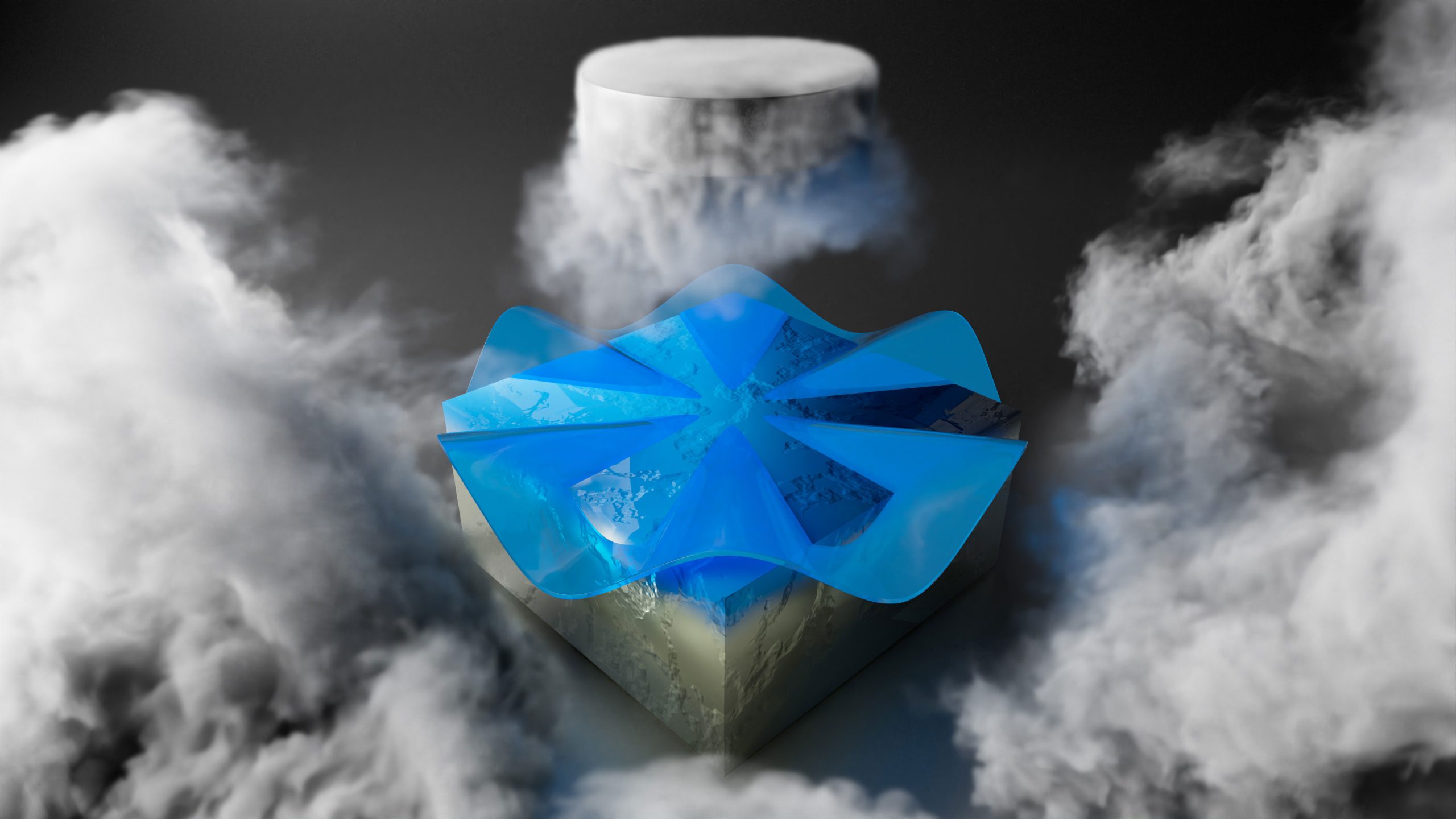
A new study reveals that PtBi2, an otherwise ordinary-looking crystal, hosts an entirely new form of superconductivity confined to its top and bottom surfaces.
Something unusual is happening inside the compound platinum-bismuth-two (PtBi2). A new investigation by scientists at IFW Dresden and the Cluster of Excellence ct.qmat shows that although PtBi2 appears to be a standard metallic crystal, the electrons inside behave in ways that have never been observed in other materials.
In 2024, the same group discovered that the top and bottom surfaces of PtBi2 become superconducting, which means the electrons at these surfaces pair up and move without resistance. Their latest results indicate that this pairing follows rules unlike those of any known superconductor. Even more intriguing, the edges surrounding these superconducting regions host elusive Majorana particles, which could serve as fault-tolerant quantum bits (qubits) for future quantum computers.
Three steps to a unique topological superconductor
We can break down PtBi2’s strange superconductivity in three steps.
First, certain electrons are restricted to the material’s top and bottom surfaces. This behavior represents a ‘topological’ property of PtBi2, created by the way electrons interact with the orderly arrangement of atoms in the crystal. Topological features are extremely stable: they remain unchanged unless the overall symmetry of the material is altered, either by modifying the crystal structure or by applying an electromagnetic field.
In PtBi2, the electrons confined to the top surface always have matching counterparts on the bottom surface, regardless of how many atomic layers separate them. If the crystal were cut in two, each newly exposed surface would naturally develop its own complementary set of surface-confined electrons.
Second, these surface-bound electrons pair up at low temperatures, allowing them to move without any resistance. The rest of the electrons don’t pair up, and keep behaving like normal electrons do. This makes PtBi2 a natural superconductor sandwich, with superconducting top and bottom surfaces and a normal metallic interior.
The topological nature of the surface electrons make PtBi2 a topological superconductor. There are only a handful of other candidate materials thought to have intrinsic topological superconductivity, and to date none of these is supported by convincingly consistent or conclusive experimental evidence.
Finally, new uniquely high-resolution measurements from Dr. Sergey Borisenko’s lab at the Leibniz Institute for Solid State and Materials Research (IFW Dresden) reveal that not all surface-bound electrons pair up equally. Remarkably, surface electrons moving along six symmetrical directions resolutely refuse to pair up. These directions reflect the three-fold rotation symmetry of how the atoms are arranged in the material’s surface.
In normal superconductors, all electrons pair up regardless of what direction they move in. Some unconventional superconductors, like the cuprate materials famous for becoming superconducting at higher temperatures, have a more restricted pairing with a four-fold rotation symmetry. PtBi2 is the first superconductor showing restricted pairing with a six-fold rotation symmetry.
“We have never seen this before. Not only is PtBi2 a topological superconductor, but the electron pairing that drives this superconductivity is different from all other superconductors we know of,” says Borisenko. “We don’t yet understand how this pairing comes about.”
Edges trap elusive Majorana particles
The new study also confirms that PtBi2 offers a new way to produce long-sought-after Majorana particles.
“Our computations demonstrate that the topological superconductivity in PtBi2 automatically creates Majorana particles that are trapped along the edges of the material. In practice, we could artificially make step edges in the crystal, to create as many Majoranas as we want,” notes Prof. Jeroen van den Brink, Director of the IFW Institute for Theoretical Solid State Physics and principal investigator of the Würzburg-Dresden Cluster of Excellence ct.qmat.
A pair of Majorana particles acts as a single electron, but individually they behave very differently. This concept of ‘split electrons’ is the foundation for topological quantum computing, which aims to build more stable qubits. The separation of Majorana particle pairs protects them against noise and errors.
Now that PtBi2’s unique superconductivity and related Majorana particles have been found, a next step is to control them. For example, thinning the material down will change the non-superconducting ‘sandwich filling’, potentially turning it from a conducting metal into an insulator. This also means that the non-superconducting electrons cannot interfere with the use of the Majoranas as qubits. Alternatively, applying a magnetic field will shift the electron energy levels, and could, for example, cause the Majorana particles to move from the edges to the corners of the material.
Reference: “Topological nodal i-wave superconductivity in PtBi2” by Susmita Changdar, Oleksandr Suvorov, Andrii Kuibarov, Setti Thirupathaiah, Grigory Shipunov, Saicharan Aswartham, Sabine Wurmehl, Iryna Kovalchuk, Klaus Koepernik, Carsten Timm, Bernd Büchner, Ion Cosma Fulga, Sergey Borisenko and Jeroen van den Brink, 19 November 2025, Nature.
DOI: 10.1038/s41586-025-09712-6
Never miss a breakthrough: Join the SciTechDaily newsletter.
Follow us on Google and Google News.
1 Comment
This concept of ‘split electrons’ is the foundation for topological quantum computing, which aims to build more stable qubits.
WHY?
Please ask researchers to think deeply:
How do you understand quantum materials or topological materials?
Contemporary physics are sure they are right when working with a system they believe is wrong – they are gonna have a hard time getting out of their rut. The key difference between TVT and traditional physics (e.g., Newtonian mechanics, relativity, quantum mechanics) lies in its perspective on describing the universe. TVT emphasizes the ideal fluid properties and topological structure of space, rather than focusing solely on the direct interactions of particles and forces. This perspective offers a new paradigm for understanding the structure of the universe. Its core predictions (e.g., cosmic-scale vortex networks) have been confirmed across multiple disciplines. For example:
Topological structures, such as vortices, are prevalent in nature and science across a wide range of length scales, ranging from macroscopic cosmic strings (1), mesoscale liquid crystals (2, 3) and ferromagnets (4), nanoscale ferroelectrics and superconductor/superfluid Bose-Einstein condensate states (5, 6), down to the atomic nucleus (7).
——Excerpted from https://www.science.org/doi/10.1126/sciadv.adu6223.
Compromise with pseudoscience and pseudo academic publications is to commit a crime against scientific progress and human advancement. Incommensurability is a core concept introduced by American philosophers of science Thomas Kuhn and Paul Feyerabend to describe the incomparability between successive paradigms during scientific revolutions. This theory emphasizes the fundamental differences between paradigms in their linguistic systems, taxonomic categories, and value judgments, which prevent them from being directly compared or translated through a common standard. In his work The Structure of Scientific Revolutions, Kuhn used this concept alongside “paradigm” to construct a discontinuous model of scientific development.
Topological vortex theory (TVT) not only provides a solid mathematical description for exotic excitations in low-dimensional spacetime but also plays a central role in connecting physical laws across different dimensions. The study of topological vortices and dimensional evolution not only deepens our understanding of nature’s fundamental laws but also prompts us to rethink the very nature of the most basic concepts: “spacetime” and “matter.”
——Excerpted from https://scitechdaily.com/microscope-spacecrafts-most-precise-test-of-key-component-of-the-theory-of-general-relativity/#comment-910609.