
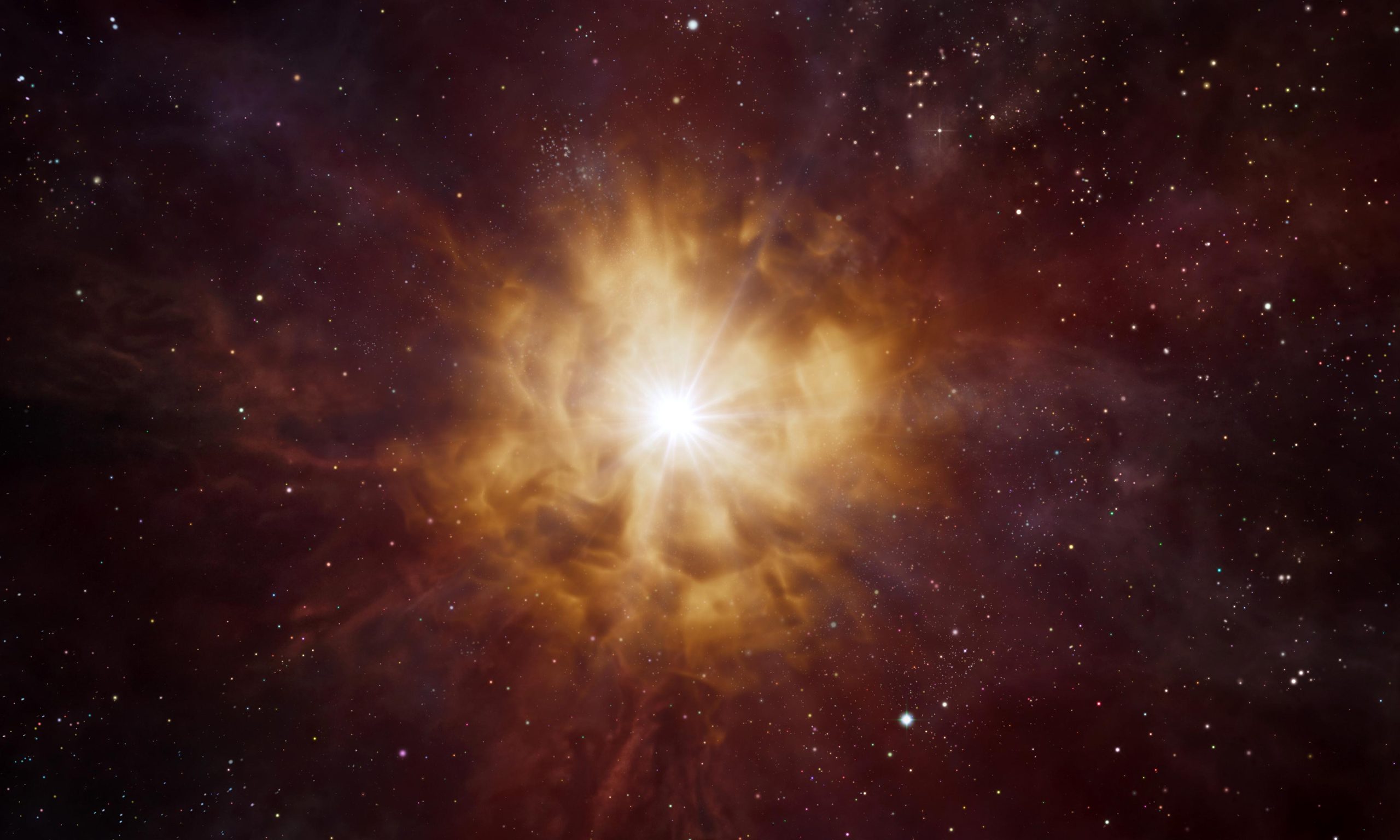
Scientists believe they’ve observed black holes forming from collapsing stars, revealing a process where little material is ejected. Spectroscopy suggests these explosions originated from Wolf-Rayet stars, though other explanations remain.
Astronomers are increasingly drawing back the curtains on black holes. In the past few years, we have finally captured actual photos of these fearsome creatures and measured the gravitational waves – ripples in spacetime – that they create when colliding. But there’s still a lot we don’t know about black holes. One of the biggest enigmas is exactly how they form in the first place.
My colleagues and I now believe we have observed this process, providing some of the best indications yet of exactly what happens when a black hole forms. Our results are published in two papers in Nature and the Astrophysical Journal.
According to both observable and theoretical evidence, the majority of black holes are thought to originate when the core of a large star collapses near the conclusion of its life. The core of a star normally provides pressure or support by using heat from powerful nuclear processes. But when the fuel in such a star runs out and the nuclear reactions halt, the star’s inner layers collapse inward under gravity, compressing to very high densities.
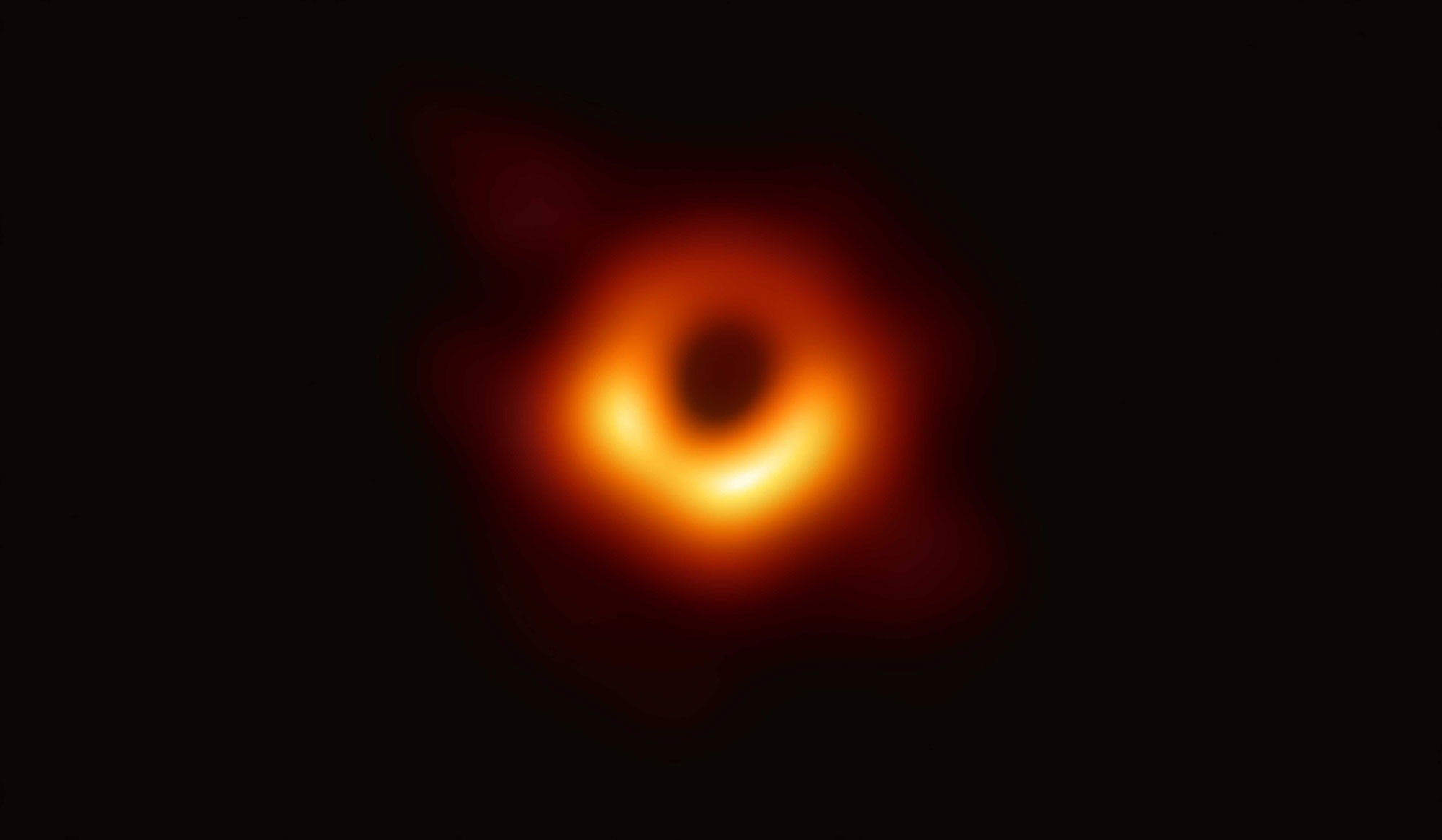
Most of the time, this catastrophic collapse is halted when the star’s core condenses into a solid sphere of matter, rich in particles called neutrons. This leads to a powerful rebound explosion that destroys the star (a supernova), and leaves behind an exotic object known as a neutron star. But models of dying stars show that if the original star is massive enough (40-50 times the mass of the Sun), the collapse will simply continue unabated until the star is crushed down into a gravitational singularity – a black hole.
Explosive Theories
While stars collapsing to form neutron stars are now routinely observed throughout the universe (supernova surveys find dozens of new ones every night), astronomers are not yet entirely sure what happens during the collapse to a black hole. Some pessimistic models suggest the entire star would be swallowed up without much of a trace. Others propose that the collapse to a black hole would produce some other kind of explosion.
For example, if the star is rotating at the time of collapse, some of the infalling material may be focused into jets that escape the star at high velocity. While these jets wouldn’t contain much mass, they’d pack a big punch: if they slammed into something, the effects might be quite dramatic in terms of the energy released.
Up until now, the best candidate for an explosion from the birth of a black hole has been the strange phenomenon known as long-duration gamma-ray bursts. First discovered in the 1960s by military satellites, these events have been hypothesized to result from jets accelerated to mindboggling speeds by newly formed black holes in collapsing stars. However, a longstanding problem with this scenario is that gamma-ray bursts also expel abundant radioactive debris that continues to shine for months. This suggests most of the star exploded outward into space (as in an ordinary supernova), instead of collapsing inward into a black hole.
While this doesn’t mean a black hole can’t have been formed in such an explosion, some have concluded that other models provide a more natural explanation for gamma-ray bursts than a black hole forming. For example, a super-magnetized neutron star could form in such an explosion and produce powerful jets of its own.
Mystery Solved?
My colleagues and I, however, recently uncovered a new and (in our view) much better candidate event for creating a black hole. On two separate occasions in the past three years – once in 2019 and once in 2021 – we witnessed an exceptionally fast and fleeting type of explosion that, much like in gamma-ray bursts, originated from a small amount of very fast-moving material slamming into gas in its immediate environment.
By using spectroscopy – a technique that breaks down light into different wavelengths – we could infer the composition of the star that exploded for each of these events. We discovered that the spectrum was very similar to so-called “Wolf-Rayet stars” – a very massive and highly-evolved type of star, named after the two astronomers, Charles Wolf and Georges Rayet, that first detected them. Excitingly, we were even able to rule out a “normal” supernova explosion. As soon as the collision between the fast material and its environment ceased, the source practically vanished – rather than glowing for a long time.
This is exactly what you would expect if, during the collapse of its core, the star ejected only a small amount of material with the rest of the object collapsing downward into an enormous black hole.
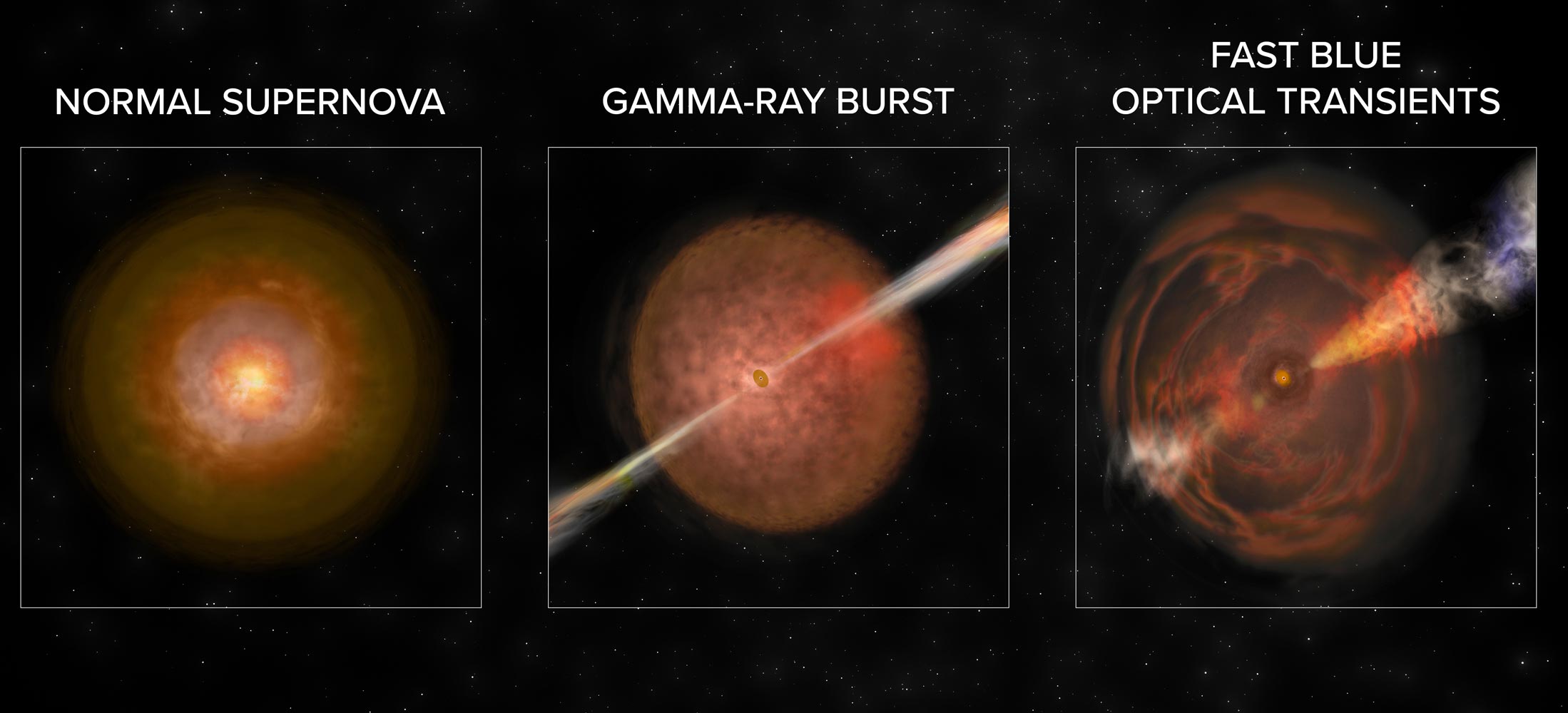
Even while this is the interpretation we favor, there are alternative options. The most prevalent theory is that it was a normal supernova explosion, but the radioactive debris was obscured from view by a large shell of dust formed during the collision. It’s also conceivable that the explosion was a brand-new, unusual kind, and it originated from an undiscovered star.
To answer these questions, we will need to search for more such objects. Until now these kinds of explosions have been difficult to study because they are fleeting and hard to find. We had to use several observatories together in quick succession to characterize these explosions: the Zwicky Transient Facility to discover them, the Liverpool Telescope and the Nordic Optical Telescope to confirm their nature, and large high-resolution observatories (the Hubble Space Telescope, Gemini Observatory, and the Very Large Telescope) to analyze their composition.
While we didn’t initially know exactly what we were seeing when we first discovered these events, we now have a clear hypothesis: the birth of a black hole.
More data from similar events may soon be able to help us verify or falsify this hypothesis and establish the link to other types of unusual, fast explosions that our team and others have been finding. Either way, it seems this truly is the decade we crack the mysteries of black holes.
Written by Daniel Perley, Reader of Astrophysics, Liverpool John Moores University.
This article was first published in The Conversation.
Never miss a breakthrough: Join the SciTechDaily newsletter.
Follow us on Google and Google News.
3 Comments
this may Black hole B- high spin rate approx ……….. Speed of light
White hole B+ general all stars
B for Brightness i consider light as a matter
for details to under stand the behaviour I have need you support to write
Black holes are absolute minimum entropy matter. Nothing creates a black hole except collisions just like the ones in particle colliders. A nuclear bomb cannot be created from a fire in a fireplace.
Our universe turned itself into a gargantuan particle collider creating quark plasma shrapnel that are the galaxies. All the galaxies were initially one black hole. Quark plasma uses the dark matter of space to replenish its mass and density by creating its own elements from the outside of the mass inward. First, the quarks and electron neutrinos of space create neutrons. Then, the neutrons break down to hydrogen. The constantly forming neutrons then fuse with the hydrogen to form helium using the beta minus decay reaction. This process continues creating heavier and heavier elements making the mass get darker and darker until a crust forms, the light is extinguished, and a surface forms.
Black holes were created the second the big bang happened. That is why there are so many that seem to be too far away to have had time to develop.
A Supernova vanishing into nothing, couldn’t that be the way dark matter develops? Let’s say some Supernovas probably are creating dark matter after collapsing, others end up as black holes and yet others as neutron stars and so on, probably depending on which way they explode, the chain reaction they individually create. But why that diversity, is the Universe in a way alive