
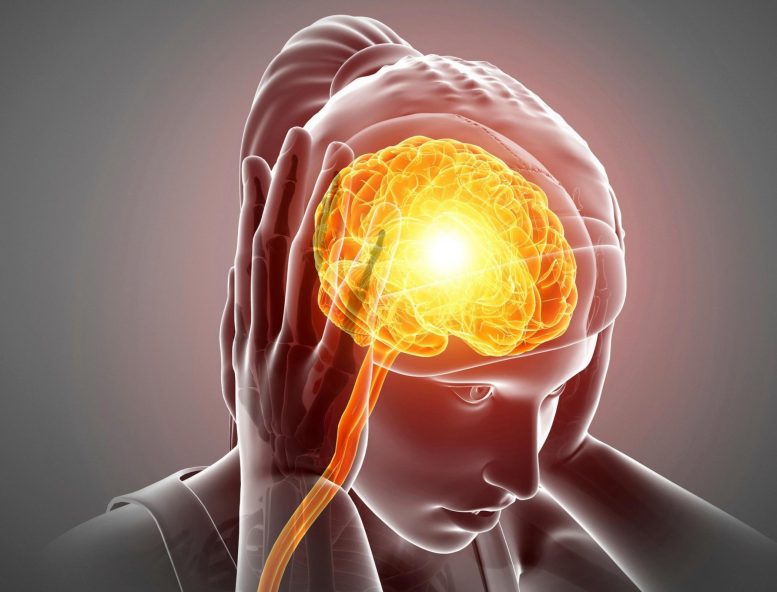
An international consortium of leading migraine scientists identified more than 120 regions of the genome that are connected to risk of migraine.
The groundbreaking study helps researchers better understand the biological basis of migraine and its subtypes and could speed up the search for a new treatment for the condition, which affects over a billion individuals worldwide.
In the largest genome study of migraine yet, researchers have more than tripled the number of known genetic risk factors for migraine. Among the identified 123 genetic regions are two that contain target genes of recently developed migraine-specific drugs.
The study involved leading migraine research groups in Europe, Australia, and the United States working together to pool genetic data from more than 873,000 study participants, 102,000 of whom had migraine.
The new findings, published on February 3, 2022 in the journal Nature Genetics, also uncovered more of the genetic architecture of migraine subtypes than was previously known.
Neurovascular Mechanisms Underlie Migraine Pathophysiology
Migraine is a very common brain disorder with over a billion patients worldwide. The exact cause of migraine is unknown, but it is believed to be a neurovascular disorder with disease mechanisms both within the brain and the blood vessels of the head.
Previous research has shown that genetic factors contribute significantly to the migraine risk. However, it has long been debated whether the two main migraine types – migraine with aura and migraine without aura – share similar genetic background.
To gain more insight into the specific risk genes, researchers from the International Headache Genetics Consortium assembled a large genetic dataset to conduct a genome-wide association study (GWAS), looking for genetic variants that were more common in those who had migraine in general, or one of the two main migraine types.
The results demonstrated that migraine subtypes have both shared risk factors and risk factors that appear specific to one subtype. The analyses highlighted three risk variants that appear specific to migraine with aura and two that appear specific to migraine without aura.
“In addition to implicating tens of new regions of the genome for more targeted investigation, our study provides the first meaningful opportunity to evaluate shared and distinct genetic components in the two main migraine subtypes”, said the first author of the study, Heidi Hautakangas from the Institute for Molecular Medicine Finland, University of Helsinki.
Furthermore, the results supported the concept that migraine is brought about by both neuronal and vascular genetic factors, strengthening the view that migraine truly is a neurovascular disorder.
Potential to Point to New Therapies Against Migraine
As migraine is globally the second largest contributor to years lived with disability, there is clearly a large need for new treatments.
A particularly interesting finding was the identification of genomic risk regions containing genes that encode targets for recently developed migraine-specific therapeutics.
One of the newly identified regions contains genes (CALCA/CALCB) encoding calcitonin gene-related peptide, a molecule involved in migraine attacks and blocked by the recently introduced CGRP inhibitor migraine medications. Another risk region covers the HTR1F gene encoding serotonin 1F receptor, also a target for new migraine-specific medications.
Dr. Matti Pirinen, a group leader from the Institute for Molecular Medicine Finland, University of Helsinki, who led the study, commented: “These two new associations near genes that are already targeted by effective migraine drugs suggest that there could be other potential drug targets among the new genomic regions, and provide a clear rationale for future genetic studies with even larger sample sizes.”
Reference: “Genome-wide analysis of 102,084 migraine cases identifies 123 risk loci and subtype-specific risk alleles” by Heidi Hautakangas, Bendik S. Winsvold, Sanni E. Ruotsalainen, Gyda Bjornsdottir, Aster V. E. Harder, Lisette J. A. Kogelman, Laurent F. Thomas, Raymond Noordam, Christian Benner, Padhraig Gormley, Ville Artto, Karina Banasik, Anna Bjornsdottir, Dorret I. Boomsma, Ben M. Brumpton, Kristoffer Sølvsten Burgdorf, Julie E. Buring, Mona Ameri Chalmer, Irene de Boer, Martin Dichgans, Christian Erikstrup, Markus Färkkilä, Maiken Elvestad Garbrielsen, Mohsen Ghanbari, Knut Hagen, Paavo Häppölä, Jouke-Jan Hottenga, Maria G. Hrafnsdottir, Kristian Hveem, Marianne Bakke Johnsen, Mika Kähönen, Espen S. Kristoffersen, Tobias Kurth, Terho Lehtimäki, Lannie Lighart, Sigurdur H. Magnusson, Rainer Malik, Ole Birger Pedersen, Nadine Pelzer, Brenda W. J. H. Penninx, Caroline Ran, Paul M. Ridker, Frits R. Rosendaal, Gudrun R. Sigurdardottir, Anne Heidi Skogholt, Olafur A. Sveinsson, Thorgeir E. Thorgeirsson, Henrik Ullum, Lisanne S. Vijfhuizen, Elisabeth Widén, Ko Willems van Dijk, International Headache Genetics Consortium, HUNT All-in Headache, Danish Blood Donor Study Genomic Cohort, Arpo Aromaa, Andrea Carmine Belin, Tobias Freilinger, M. Arfan Ikram, Marjo-Riitta Järvelin, Olli T. Raitakari, Gisela M. Terwindt, Mikko Kallela, Maija Wessman, Jes Olesen, Daniel I. Chasman, Dale R. Nyholt, Hreinn Stefánsson, Kari Stefansson, Arn M. J. M. van den Maagdenberg, Thomas Folkmann Hansen, Samuli Ripatti, John-Anker Zwart, Aarno Palotie and Matti Pirinen, 3 February 2022, Nature Genetics.
DOI: 10.1038/s41588-021-00990-0
The study was a joint effort between research groups from Australia, Denmark, Estonia, Finland, Germany, Iceland, Netherlands, Norway, Sweden, UK and USA.
Never miss a breakthrough: Join the SciTechDaily newsletter.
Follow us on Google and Google News.