
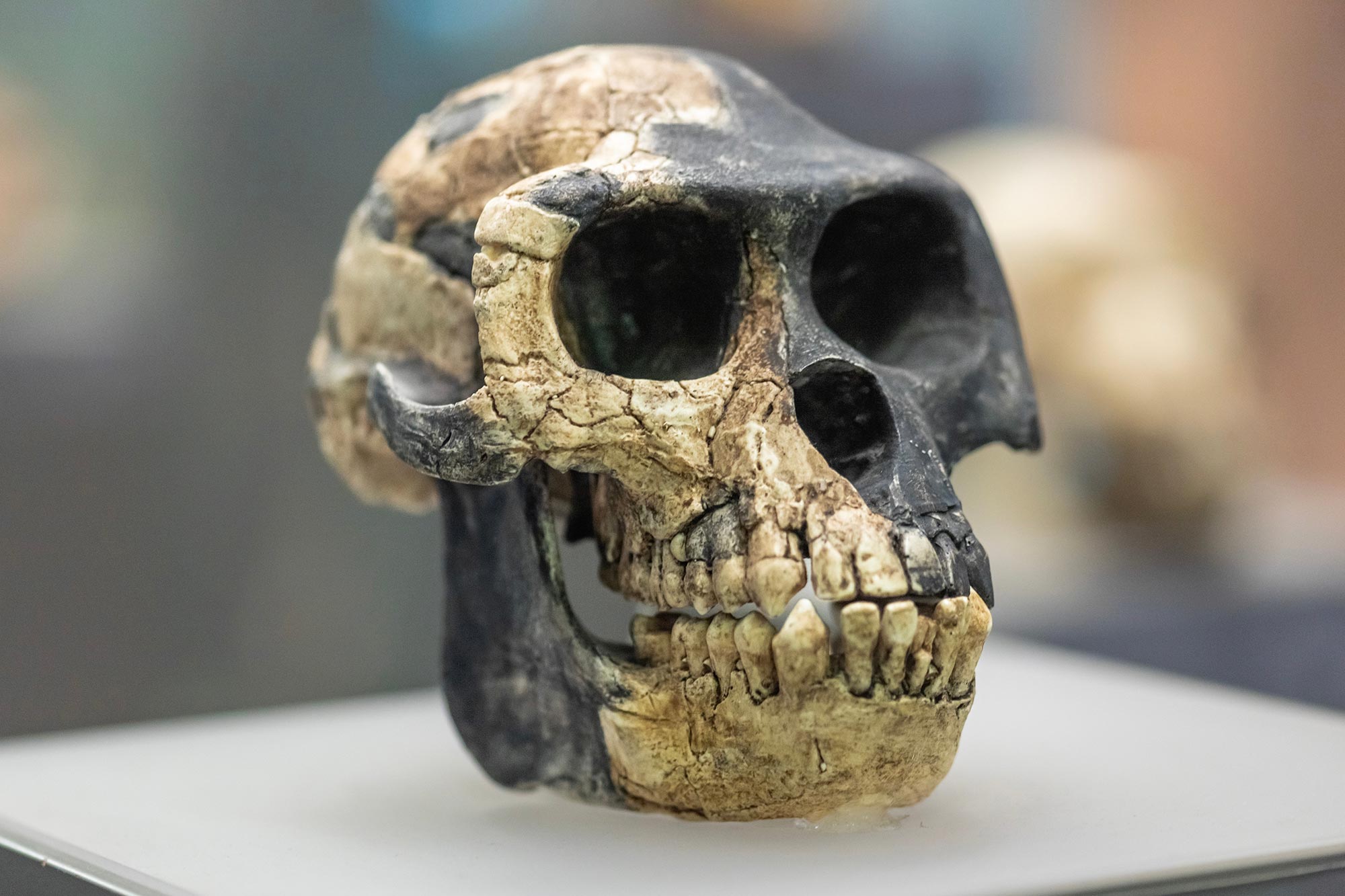
New findings reveal the geological age, context, and anatomy of hominin fossils discovered at the Ledi-Geraru Research Project in Ethiopia.
Although scientists have uncovered much of the story of human evolution, several key chapters are still missing. One major gap lies between 2 and 3 million years ago, a period for which fossil evidence remains scarce. This absence is especially significant because it marks the era when the branch of the hominin family tree that includes modern humans, or Homo sapiens, first appears in the fossil record.
Today, Homo sapiens (commonly referred to by anthropologists as Homo) is the only surviving member of the hominin lineage. In earlier times, however, our ancestors shared the Earth with other related species, sometimes competing and coexisting with them. Recent research supported by the National Science Foundation and the Leakey Foundation, and published in Nature, helps close one of these evolutionary gaps by revealing two early hominin species that lived side by side.
At the Ledi-Geraru site in Ethiopia’s Afar Region, an international research team discovered hominin fossils dated between 2.6 and 3.0 million years old. Lucas Delezene, an associate professor of anthropology at the University of Arkansas, served as the study’s second author, contributing alongside more than 20 scientists from North America, Africa, and Europe.
The findings include fossils of Homo that establish the oldest confirmed evidence of our lineage at 2.8 million years ago, with additional remains dating to 2.6 million years ago. These discoveries strengthen the case for Homo’s deep evolutionary roots. Even more surprising, the team found that Homo lived in the same region at the same time as another hominin, Australopithecus, around 2.6 million years ago.
This overlap challenges long-held assumptions, as Australopithecus was believed to have vanished from the area roughly 3 million years ago. The famous Australopithecus specimen known as Lucy was discovered nearby, yet her species was thought to have disappeared from the fossil record by that point.
Rethinking Evolution’s “Linear” Model
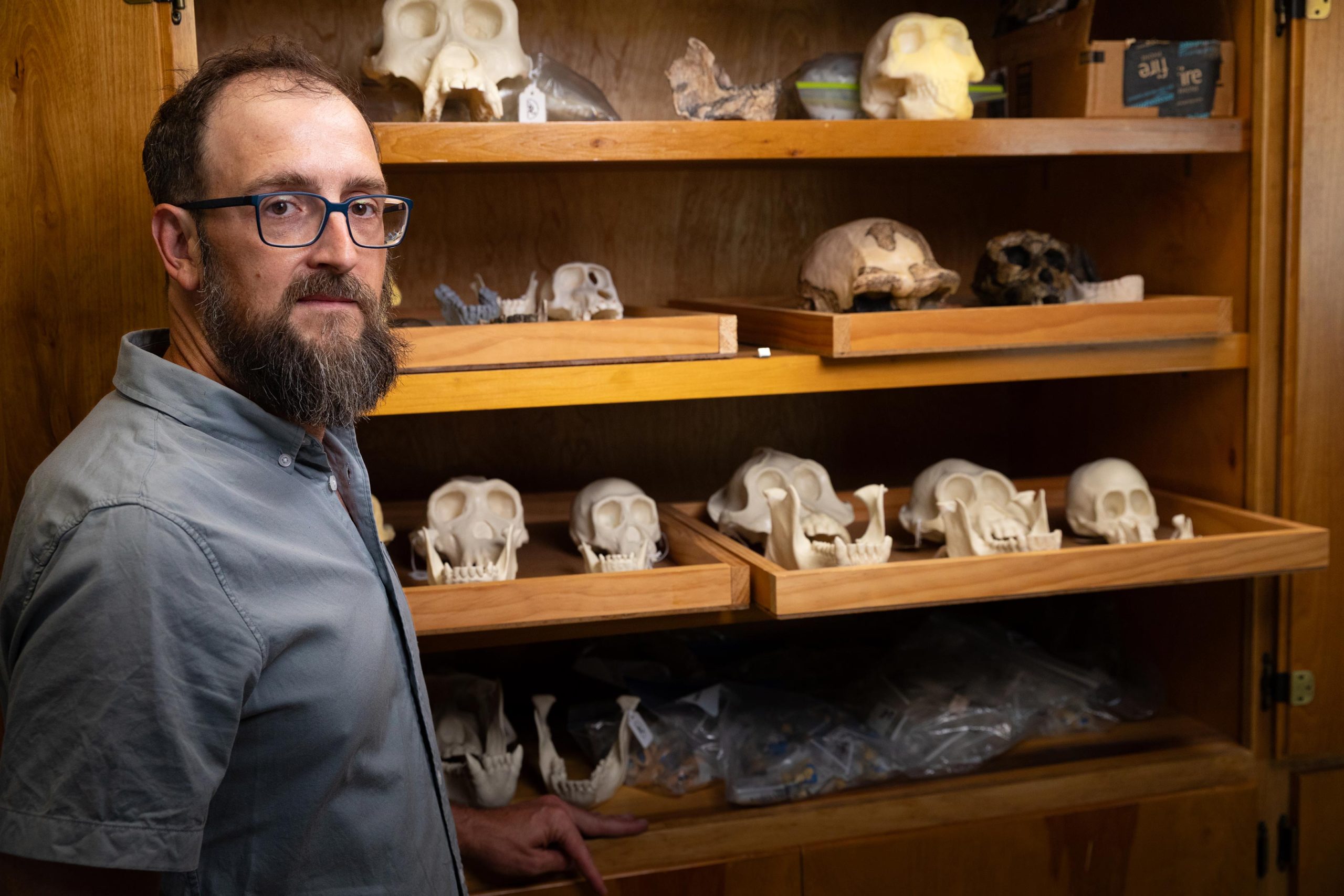
“People often think evolution is a linear progression,” explains Delezene, “like the March of Progress, but in reality humans are only one species that make up a twig of a bigger family tree — it’s quite bushy and what we found is another twig that was previously unknown. The idea that Homo appears and immediately spreads around the planet and replaces all other hominin species is not accurate. Homo lived side-by-side with many other hominin species throughout Africa. What’s neat is that Homo overlaps with different hominin species in different places.”
For example, from southern Ethiopia to southern Africa, the earliest species of Homo overlapped with a hominin known as Paranthropus, which is well known for its massive teeth and chewing muscles and a diet reliant on grass in some parts of its range. However, in the Afar Region of Ethiopia, no Paranthropus fossils have ever been found.
Instead, the team working at Ledi-Geraru found that Homo overlap with a different type of hominin, Australopithecus. How all of these hominin species divided up resources is the question of ongoing research. Did Homo nod to the other hominin species on their way to hunting and gathering in the morning, or did the various species consume similar resources? Did Homo eat the same things in Ethiopia, where it coexisted with Australopithecus as it did in the south where it coexisted with Paranthropus, or was its diet flexible?
We know that Homo eventually becomes a culturally reliant tool user and occasionally consumed meat. But the oldest Homo fossils at Ledi-Geraru predate any evidence of tool manufacture or meat consumption. Did Homo evolve those traits to avoid competing with other hominin species? Competition among these various hominin species likely set the stage for the evolution of the traits that ultimately made humans a globally widespread and successful species.
Fossils in Focus: The Teeth Tell the Story
The fossils published in the Nature paper are all teeth. Teeth are often the best-preserved fossils because their enamel coating provides better protection from the ravages of time and the elements.
Delezene, a hominin dental expert, says, “When we get down to the picky details, the teeth of Homo and Australopithecus look different. The differences are subtle, but once you see them, you can’t unsee them. They’re very consistent.”
While the new fossils fill in a piece of the puzzle, there is still a long way to go before we have a complete picture of human evolution. While there is evidence for the teeth of early Homo and the new Australopithecus, the team doesn’t know what their heads or the rest of their bodies looked like. The multi-national collaboration, done in partnership with the local community of Afar people, will continue its work looking for more fossils, ideally with continued funding.
Reference: “New discoveries of Australopithecus and Homo from Ledi-Geraru, Ethiopia” by Brian Villmoare, Lucas K. Delezene, Amy L. Rector, Erin N. DiMaggio, Christopher J. Campisano, David A. Feary, Baro’o Mohammed Ali, Daniel Chupik, Alan L. Deino, Dominique I. Garello, Mohammed Ahmeddin Hayidara, Ellis M. Locke, Omar Abdulla Omar, Joshua R. Robinson, Eric Scott, Irene E. Smail, Kebede Geleta Terefe, Lars Werdelin, William H. Kimbel, J. Ramón Arrowsmith and Kaye E. Reed, 13 August 2025, Nature.
DOI: 10.1038/s41586-025-09390-4
Funding: U.S. National Science Foundation
Never miss a breakthrough: Join the SciTechDaily newsletter.
Follow us on Google and Google News.
15 Comments
thanks
I’m really interested in this stuff it just amazes me. I just I just can’t imagine it but I know it’s true. I enjoy reading about it.
No surprise. We live alongside more remote ancestors like gorillas and chimps and dolphins and who knows what. 3 million years is a short span of evolutionary time. The part that no one can investigate is when and how we acquired sentience. The evolution of sentience may never be discovered. But seeker-to-seeker podcast has a very provocative suggestion based on the work of three notable humans whose name I can’t remember, like Wilber is one of them and their book has the word ‘everything’ in it. Another author sounds like Kazantikis. Their summary is ‘evolution is the waking up of God’. For some this statement is revolutionary; for others it is heretical. To some it is extremely accurate.
Thank you for this elaboration.
I can’t belive how poorly written this article is, by someone who doesn’t know the subject. Using the wrong photo is the least of it (although unprofessional). They start out the article with a ridiculous claim. Quote: “Although scientists have uncovered much of the story of human evolution, several key chapters are still missing.” Absolutely no one who studies or has an interest in human evolution would ever claim that scientists have uncovered much of this subject. Most would claim the opposite — that we know close to nothing. We have a few fossils with gaps that allow each new discovery to rewrite human evolution. We have nothing from Homo Erectus, about 1 million ya, to Homo Sapiens on our line, some 200 million ya. We have close to nothing from the split with chimps until Australopithecines. Only sahalensis, ororin and ardi. Less than a handful of fossils covering millions and millions of years. It’s a crazy claim. And then they make it seem like this was the only time two human species coexisted. Before Homo Sapiens spread around the world, we shared the planet with at least another 4 species, likely more (Neanderthals, Denisovans, hobbits, etc.). We interbred with Neanderthals and Denisovans, for crying out loud. And the constant reference to Homo without naming which Homo is confusing. The only reason Homo Habilis (first Homo) is included in the Homo line is because of tool use. Otherwise we’re talking about Australopithecines, not the Homo line. And I never heard Homo Sapiens referred to as Homo. If this we’re true, every reference here would be totally wrong since Sapiens took another 2 million years to evolve. This article is a mess, no offense.
It is a fact that the press department of a university rarely contains expert, but this article is based in an interview of a scientist. (And perhaps, perhaps not, a review by that very scientist.) That anthropologists shorten to “Homo” smells correct.
We don’t need the split to know from, e.g. genetics, that chimps/bonobos are our sister lineages, and the gaps you deride are not essential to that. We know much more of human evolution than of chimp evolution, since by luck our ancestors started to inhabit environments that fossilize better than forests and our population grew to become a fantastic source of historical information. I wouldn’t worry about scarcity of fossils or genomes for humans especially.
The new data places Homo as splitting within Australopithecines, making us the latter. See e.g. anthropologist John Hawk’s blog article “New hominin teeth from Ledi-Geraru, Ethiopia”. The graphic titled Hominin phylogeny after Dembo 2016 has Homo as twin lineages to Australopithecus africanus, in turn splitting from the Australopithecine branch that has Australopithecus afarensis and the rest of the early australopithecines. This is one of several possible phylogenies, but data suggest it and doesn’t reject it.
That evolution like all other processes is entirely natural and is only controversial among magic-agency-botherers. Placing the magic in anthropo-centric evolution of “sentience” doesn’t help since many animals have evolved sentience.
All primates are sentient. It is our intelligence that seperates us from other primates. Not sure what nonsense you are trying to push, but I ain’t buying it.
As of 2025.11.2, the leading photo is of Ardipithecus ramidus, which is almost 2 million years older than the fossils discussed in the article. It is not only a different species, but a completely different genus. If you can’t be bothered to use photos of the actual fossils the article is discussing, at least have enough journalistic integrity to use photos of the correct species.
Good to know. Finding images which can be used without special permission a.k.a. money can be challenging, but you should always label any stock imagery explicitly else it is deceptive.
Ardipithecus ramidus is not two million year older than the Australopithecine lineage. Also here anthropologist John Hawk’s blog article “New hominin teeth from Ledi-Geraru, Ethiopia” is informative.
I’ve always considered every continent to have given rise to several bipedal, upright, posable thumbs, omnivorous, hominid groups coexisting, competing, in parallel and even commingling to merge DNA as part of the evolutionary chain. The modern man, the Homo sapiens we see today are the result of millions of years of evolutionary pressures from the ever changing environments and climate changes.
Makes sense. My anatomy professor back in the day stated stated that “no living species ever evolved from another living species. True then, truer now. Great information!
Well, your professor is observably wrong, since we have observed hundreds of speciations with the ancestral population still around. The subway mosquitoes of London is a famous example.
And how else would evolution work?
Blah, blah, blah.
Not science. Conjecture and speculation at best. I seriously question the methods and accuracy of dating. If you really have enough faith to believe in evolution, you have my utmost respect. Even Darwin himself pointed out gaping holes in the theory. Yes, THEORY.
True science is observation and comparison. Empirical data. Were you there? Why are there no “transitional forms”? Hint- there are none. Every “species” is exactly how it was created