
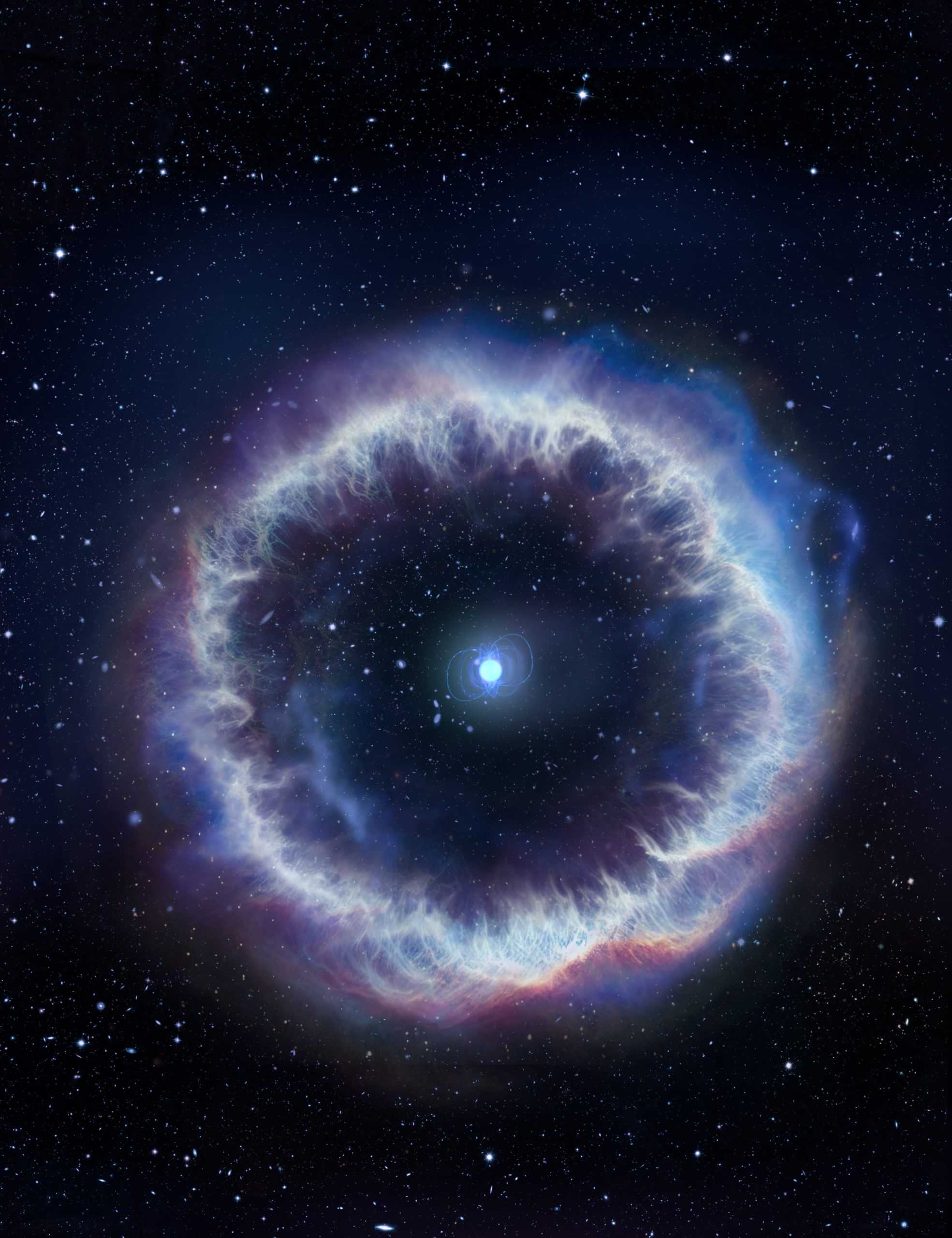
A recent INAF-led study utilizing the VLA telescope has advanced our understanding of Fast Radio Bursts (FRBs) by confirming that a plasma bubble, possibly driven by a magnetar or a binary star system, causes persistent radio emissions. This discovery helps elucidate the physical processes behind FRBs and their origin.
Fast Radio Bursts (FRBs) are one of the most recent open mysteries of modern astrophysics. Within a few milliseconds, these powerful events release an immense amount of energy, among the highest observable in cosmic phenomena. FRBs were discovered just over ten years ago and mostly arise from extragalactic sources. Their origin, however, is still uncertain and there are huge ongoing efforts by the astrophysics community around the world to understand the physical processes behind them.
In very few cases, the rapid flash that characterizes FRBs coincides with a persistent emission, which is also observed in the radio band. A new study led by the Italian National Institute for Astrophysics (INAF) has recorded the weakest persistent radio emission ever detected for an FRB so far.
The subject of the study is FRB20201124A, a fast radio burst discovered in 2020, whose source is located about 1.3 billion light-years away from us. Along with INAF researchers, the collaboration involves the Universities of Bologna, Trieste, and Calabria, in Italy, and the international participation of research institutes and universities in China, the United States, Spain, and Germany.
Advanced Observational Techniques
The observations were performed with the most sensitive radio telescope in the world, the Very Large Array (VLA) in the United States. The data enabled scientists to verify the theoretical prediction that a plasma bubble is at the origin of the persistent radio emission of fast radio bursts. The results are published today in the journal Nature.
“We were able to demonstrate through observations that the persistent emission observed along with some fast radio bursts behaves as expected from the nebular emission model, i.e. a ‘bubble’ of ionized gas that surrounds the central engine” explains Gabriele Bruni, INAF researcher in Rome and lead author of the new paper. “In particular, through radio observations of one of the bursts that is nearest to us, we were able to measure the weak persistent emission coming from the same location as the FRB, extending the radio flux range explored so far for these objects by two orders of magnitude”.
This research also helps narrow down the nature of the engine powering these mysterious radio flashes. According to the new data, the phenomenon is based on a magnetar (a strongly magnetized neutron star) or a high-accretion X-ray binary, i.e. a binary system consisting of a neutron star or black hole, accreting material from a companion star at very intense rates. In fact, winds produced by the magnetar or the X-ray binary would be able to “blow” the plasma bubble giving rise to the persistent radio emission. There is therefore a direct physical relationship between the engine of FRBs and the bubble, which is located in its immediate vicinity.
Additional Observations and Confirmations
The motivation for this observing campaign came from another work led by Luigi Piro of INAF, who is also a co-author of the new paper. In their earlier work, the researchers had identified the persistent emission in this FRB’s host galaxy, but they had not yet measured the position with sufficient precision to associate the two phenomena.
“In this new work, we conducted a campaign at higher spatial resolution with the VLA, along with observations in different bands with the NOEMA interferometer and the Gran Telescopio Canarias (GranTeCan), which allowed us to reconstruct the general picture of the galaxy and discover the presence of a compact radio source – the FRB plasma bubble – immersed in the star-forming region” adds Piro. “In the meantime, the theoretical model on the nebula had also been published, allowing us to test its validity and, finally, to confirm the model itself.”
Verification and Theoretical Validation
Most of the work focussed on excluding that the persistent radio emission comes from a star-forming region, and is therefore not physically linked to the FRB source. For this purpose, the NOEMA observations in the millimeter band measured the amount of dust, which is a tracer of “obscured” star-forming regions, whereas GranTeCan optical observations measured emission from ionized hydrogen, which is also a tracer of the star formation rate.
“Optical observations were an important element to study the FRB region at a spatial resolution similar to that of radio observations” notes co-author Eliana Palazzi from INAF in Bologna. “Mapping hydrogen emission at such a great level of detail allowed us to derive the local star formation rate, which we found to be too low to justify continuous radio emission.”
Most FRBs do not exhibit persistent emissions. Until now, this type of emission had only been associated with two FRBs – both, however, with such a low brightness that did not allow to verify the proposed model. FRB20201124A, instead, is located at a large but not excessive distance, which made it possible to measure the persistent emission despite its low brightness. Understanding the nature of the persistent emission allows researchers to add a piece to the puzzle about the nature of these mysterious cosmic sources.
Reference: “A nebular origin for the persistent radio emission of fast radio bursts” by Gabriele Bruni, Luigi Piro, Yuan-Pei Yang, Salvatore Quai, Bing Zhang, Eliana Palazzi, Luciano Nicastro, Chiara Feruglio, Roberta Tripodi, Brendan O’Connor, Angela Gardini, Sandra Savaglio, Andrea Rossi, Ana M. Nicuesa Guelbenzu and Rosita Paladino, 7 August 2024, Nature.
DOI: 10.1038/s41586-024-07782-6
Never miss a breakthrough: Join the SciTechDaily newsletter.
Follow us on Google and Google News.