
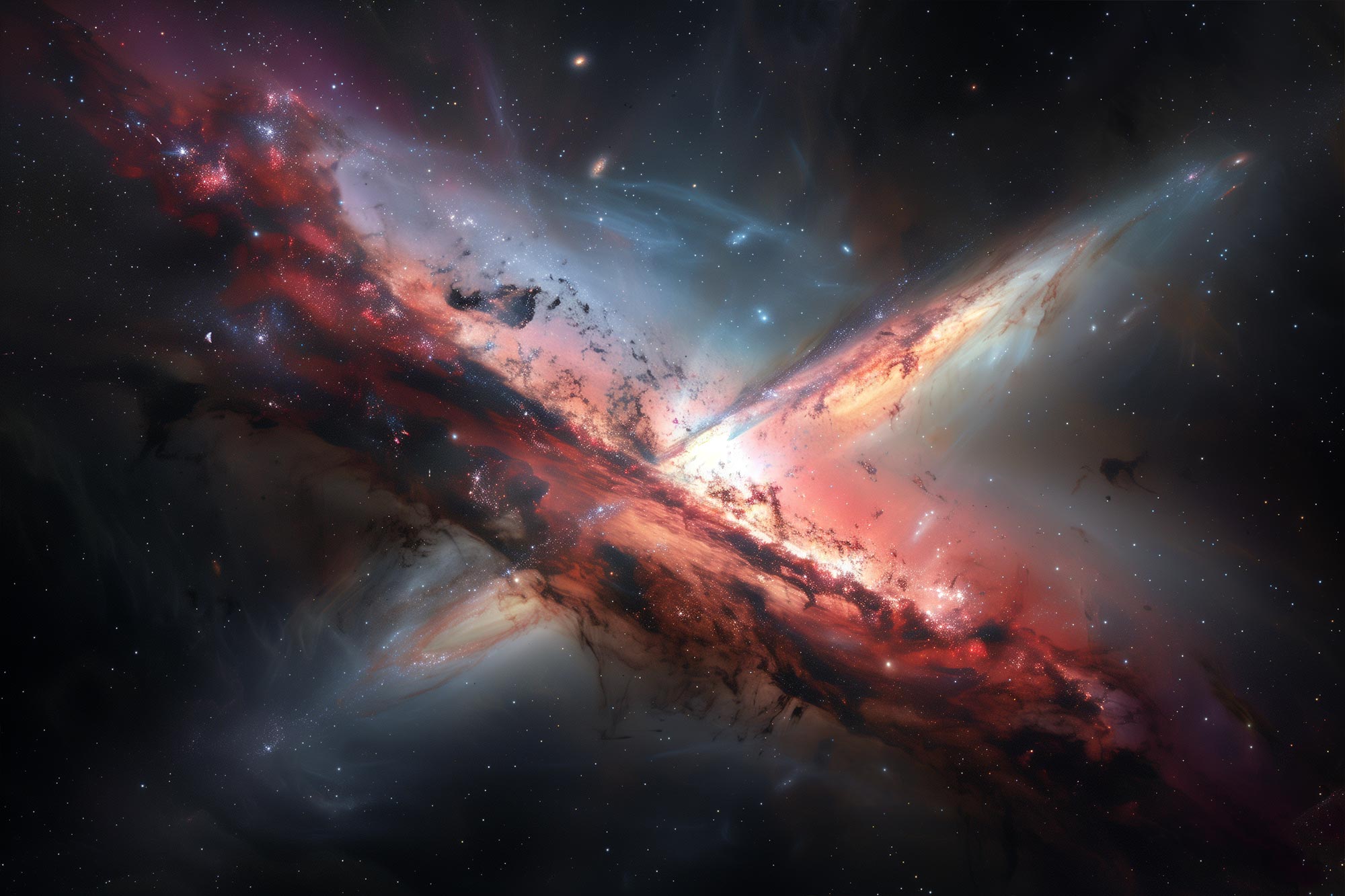
An international research group utilized the James Webb Space Telescope to witness the dramatic interaction between a quasar inside the PJ308–21 system and two massive satellite galaxies in the distant universe
This research has revealed significant details about galaxy formation, the mass and growth of supermassive black holes, and the chemical properties of these celestial bodies, marking a major step in understanding cosmic history.
A global team led by the Italian National Institute for Astrophysics (INAF) and comprising 34 research institutes and universities worldwide utilized the Near-Infrared Spectrograph (NIRSpec) on board the James Webb Space Telescope (JWST) to witness the dramatic interaction between a quasar inside the PJ308–21 system and two massive satellite galaxies in the distant universe. The observations, conducted in September 2022, unveiled unprecedented and awe-inspiring details, providing new insights into the growth of galaxies in the early universe. The results were presented during the 2024 European Astronomical Society (EAS) meeting in Padua (Italy) and published on July 5 in Astronomy & Astrophysics.
Unveiling the Quasar and Galaxy Dynamics
Observations of this quasar (already described by the same authors in another study published last May), one of the first studied with NIRSpec when the universe was less than a billion years old (redshift z = 6.2342), have revealed data of sensational quality: the instrument “captured” the quasar’s spectrum with an uncertainty of less than 1% per pixel. The host galaxy of PJ308–21 shows high metallicity and photoionization conditions typical of an active galactic nucleus (AGN), whereas one of the satellite galaxies exhibits low metallicity (which refers to the abundance of chemical elements heavier than hydrogen and helium) and photoionization induced by star formation; a higher metallicity characterizes the second satellite galaxy, which is partially photoionized by the quasar.

Insights Into Cosmic Evolution
The discovery has enabled astronomers to determine the mass of the supermassive black hole at the center of the system (about 2 billion solar masses). It also confirmed that both the quasar and the surrounding galaxies are highly evolved in mass and metal enrichment, and in constant growth. This has profound implications for our understanding of cosmic history and galaxies’ chemical evolution, highlighting this research’s transformative impact.
Technical Advancements in Space Observations
Roberto Decarli, a researcher at INAF in Bologna and first author of the article, explains: “Our study reveals that both the black holes at the center of high-redshift quasars and the galaxies that host them undergo extremely efficient and tumultuous growth already in the first billion years of cosmic history, aided by the rich galactic environment in which these sources form.”
The data were obtained in September 2022 as part of Program 1554, one of the nine Italian-led projects of the first observation cycle of JWST. Decarli leads this program to observe the merger between the galaxy hosting the quasar (PJ308-21) and two of its satellite galaxies.

Advancing Astrophysics With the James Webb Space Telescope
The observations were carried out in integral field spectroscopy mode: for each image pixel, the spectrum of the entire optical band (in the source rest frame) can be observed, shifted towards the infrared by the universe’s expansion. This allows for the study of various gas tracers (emission lines) using a 3D approach. Thanks to this technique, the team led by INAF detected spatially extended emissions from different elements, which were used to study the properties of the ionized interstellar medium, including the source and hardness of the photoionizing radiation field, metallicity, dust obscuration, electron density and temperature, and star formation rate. Furthermore, the researchers marginally detected the starlight emission associated with companion sources.
Federica Loiacono, astrophysicist, research fellow and postdoc working at INAF, enthusiastically comments on the results: “Thanks to NIRSpec, for the first time we can study in the PJ308-21 system the optical band, rich in precious diagnostic data on properties of the gas near the black hole in the galaxy hosting the quasar and in the surrounding galaxies. We can see, for example, the emission of hydrogen atoms and compare it with the chemical elements produced by the stars to establish how rich the gas in galaxies is in metals. The experience in reducing and calibrating these data, some of the first collected with NIRSpec in integral field spectroscopy mode, has ensured a strategic advantage for the Italian community in managing similar data from other programs.” Federica Loiacono is the Italian contact person for NIRSpec data reduction at the INAF JWST Support Center.
Future Directions and Implications
She adds: “Thanks to the sensitivity of the James Webb Space Telescope in the near and medium infrared, it was possible to study the spectrum of the quasar and companion galaxies with unprecedented precision in the distant universe. Only the excellent ‘view’ offered by JWST, with its unparalleled capabilities, can ensure these observations.” The work represented a real “emotional rollercoaster,” Decarli continues, “with the need to develop innovative solutions to overcome the initial difficulties in data reduction.”
This transformative impact of the James Webb Space Telescope’s onboard instruments underscores its crucial role in advancing astrophysical research: “Until a couple of years ago, data on the enrichment of metals (essential for understanding the chemical evolution of galaxies) were almost beyond our reach, especially at these distances. Now we can map them in detail with just a few hours of observation, even in galaxies observed when the universe was in its infancy,” Decarli concludes.
Reference: “A quasar-galaxy merger at z~6.2: Rapid host growth via the accretion of two massive satellite galaxies” by Roberto Decarli, Federica Loiacono, Emanuele Paolo Farina, Massimo Dotti, Alessandro Lupi, A. Romain Meyer, Marco Mignoli, Antonio Pensabene, A. Michael Strauss, Bram Venemans, Jinyi Yang, Fabian Walter and Julien Wolf, 2 July 2024, Astronomy & Astrophysics.
DOI: 10.1051/0004-6361/202449239
Never miss a breakthrough: Join the SciTechDaily newsletter.
Follow us on Google and Google News.