
Close Menu
    Facebook X (Twitter) Instagram
    SciTechDaily
    • Biology
    • Chemistry
    • Earth
    • Health
    • Physics
    • Science
    • Space
    • Technology
    Facebook X (Twitter) Pinterest YouTube RSS
    SciTechDaily
    Home»Space»Webb Space Telescope Mirror Alignment Continues Successfully
    Space

    Webb Space Telescope Mirror Alignment Continues Successfully

    By NASAFebruary 27, 20226 Comments3 Mins Read
    Facebook Twitter Pinterest Telegram LinkedIn WhatsApp Email Reddit
    Share
    Facebook Twitter LinkedIn Pinterest Telegram Email Reddit
    Webb Space Telescope Mirror Alignment
    Webb Space Telescope Mirror Alignment 

    Webb continues on its path to becoming a focused observatory. The team has successfully worked through the second and third out of seven total phases of mirror alignment. With the completion of these phases, called Segment Alignment and Image Stacking, the team will now begin making smaller adjustments to the positions of Webb’s mirrors.

    Webb Completed Segment Alignment
    This hexagonal image array captured by the NIRCam instrument shows the progress made during the Segment Alignment phase, further aligning Webb’s 18 primary mirror segments and secondary mirror using precise movements commanded from the ground. Credit: NASA/STScI

    After moving what were 18 scattered dots of starlight into Webb’s signature hexagonal formation, the team refined each mirror segment’s image by making minor adjustments, while also changing the alignment of Webb’s secondary mirror. The completion of this process, known as Segment Alignment, was a key step prior to overlapping the light from all the mirrors so that they can work in unison.
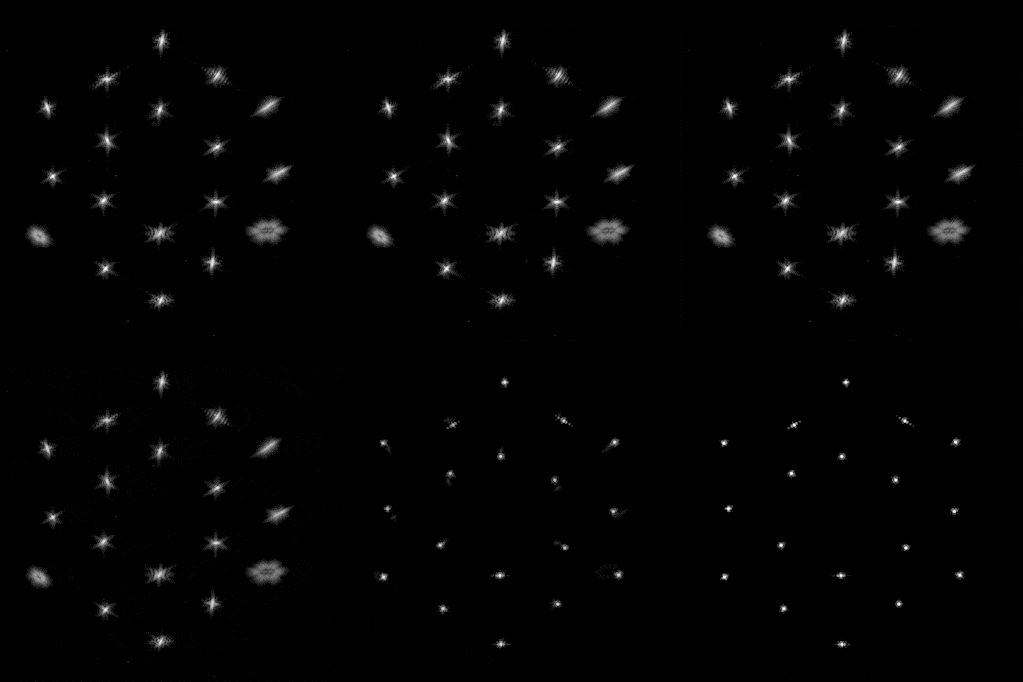
    Before and After Webb Segment Alignment
    This gif shows the “before” and “after” images from Segment Alignment, when the team corrected large positioning errors of its primary mirror segments and updated the alignment of the secondary mirror. Credit: NASA/STScI

    Once Segment Alignment was achieved, the focused dots reflected by each mirror were then stacked on top of each other, delivering photons of light from each segment to the same location on NIRCam’s sensor. During this process, called Image Stacking, the team activated sets of six mirrors at a time and commanded them to repoint their light to overlap, until all dots of starlight overlapped with each other.
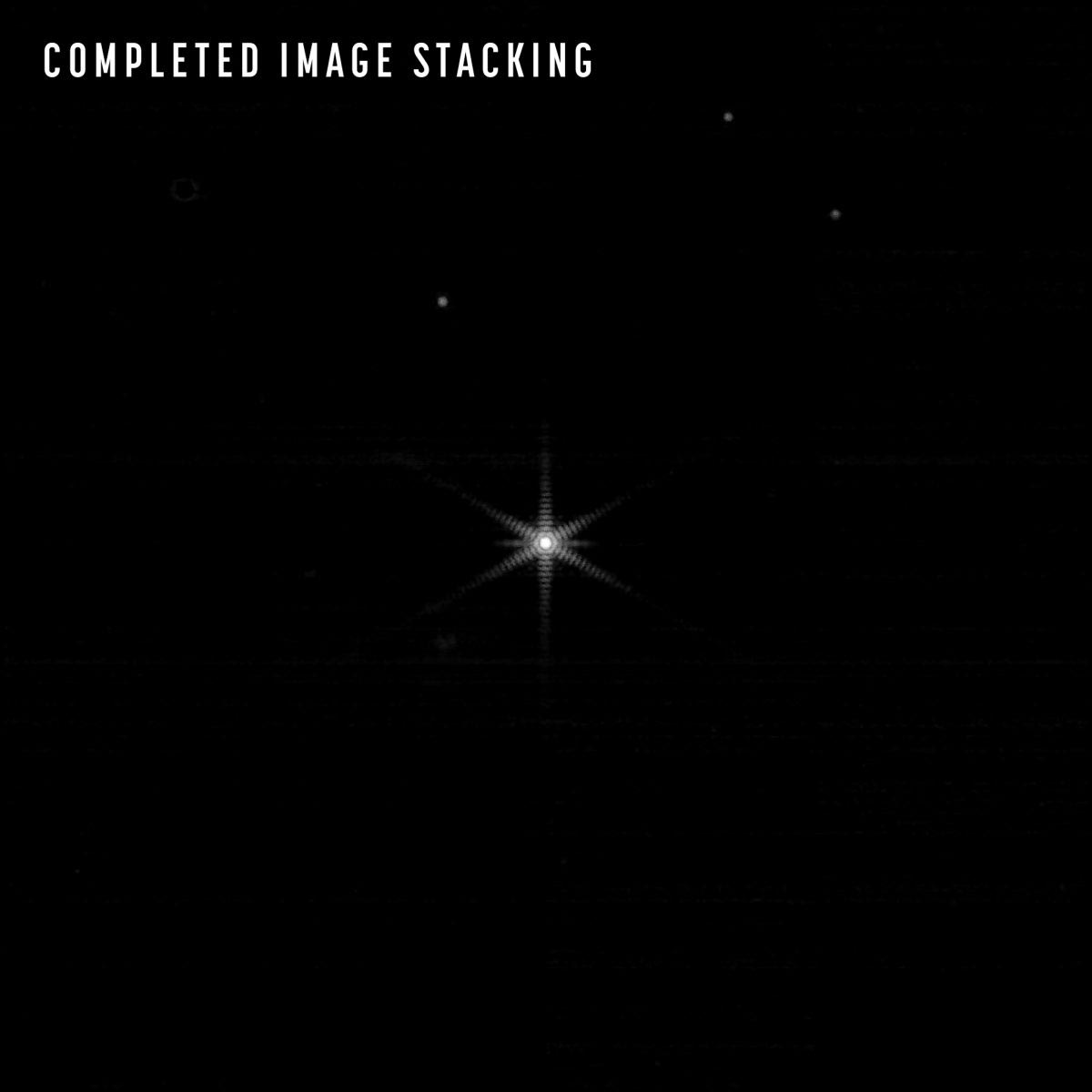
    Webb Completed Image Stacking
    During this phase of alignment known as Image Stacking, individual segment images are moved so they fall precisely at the center of the field to produce one unified image instead of 18. In this image, all 18 segments are on top of each other. After future alignment steps, the image will be even sharper. Credit: NASA/STScI

    “We still have work to do, but we are increasingly pleased with the results we’re seeing,” said Lee Feinberg, optical telescope element manager for Webb at NASA’s Goddard Space Flight Center. “Years of planning and testing are paying dividends, and the team could not be more excited to see what the next few weeks and months bring.”

    Although Image Stacking put all the light from a star in one place on NIRCam’s detector, the mirror segments are still acting as 18 small telescopes rather than one big one. The segments now need to be lined up to each other with an accuracy smaller than the wavelength of the light.

    The team is now starting the fourth phase of mirror alignment, known as Coarse Phasing, where NIRCam is used to capture light spectra from 20 separate pairings of mirror segments. This helps the team identify and correct vertical displacement between the mirror segments, or small differences in their heights. This will make the single dot of starlight progressively sharper and more focused in the coming weeks.

    Never miss a breakthrough: Join the SciTechDaily newsletter.
    Follow us on Google and Google News.

    Astronomy Astrophysics James Webb Space Telescope NASA Popular
    Share. Facebook Twitter Pinterest LinkedIn Email Reddit

    Related Articles

    Webb’s Infrared Eye Uncovers Bizarre “Cat’s Tail” Dust Structure in Beta Pictoris

    Redshift Riddles: Decoding Distance With Space Telescopes

    From IRAS to Webb: The Incredible Evolution of NASA’s Infrared Telescopes

    NASA’s Webb Telescope Discovers Record-Breaking Miniature Brown Dwarf

    Webb’s Galactic Surprise: Reveals Rocky Planet Secrets in Cosmic Extremes

    Webb’s Cosmic Coup: Sniffing Out Methane on a Distant World

    Hidden Wonders: Webb Space Telescope Detects Unexplained Structures in Heart of Milky Way

    Webb’s Window Into Cosmic Birth: Ice Pebble Drift Sparks Planetary Life

    Galactic Collision Captured in Stunning Detail: NASA’s Webb & Hubble Unite To Create Most Colorful View of Universe

    6 Comments

    1. Douglas W Lipp on February 27, 2022 6:29 pm

      Is it possible that the magnification and point focusing of even distant star light will be too hot on what is supposed to be an extremely cold environment of the telescope.

      Reply
      • Richard d Dozier on February 27, 2022 10:30 pm

        No, the heat represented by the infrared light landing on the sensor will be exactly what is needed to produce an image within the sensor’s dynamic operational range. In the case of an infrared sensor, it is heat, itself, that is being observed.

        Reply
    2. Sekar on February 27, 2022 6:53 pm

      Very Good.
      Very Interesting.
      Here is a Thought on the day before Shivraatri , a festival widely celebreated in India.

      Once we have the Light from Distant Objects, thanks to the 18 Telescopes {(Looks like to reach the Son of Lord Shiva, we have to climb the eighteen steps0, before reaching the abode of Lord Ayyapa}. how about splitting the same with a Prism to see the spectrum which constitues that object!

      From that spectrum a great deal of information can be gleaned about the object of interest.

      Views expressed are personal and not binding on anyone.

      Reply
      • TheHeck on February 28, 2022 1:59 am

        The mumbo-jumbo shiva babble aside, yeah, splitting the light in to the constituent spectrum is one of the very basic things an observatory is capable of doing. The NIRSpec instrument on the JWST is designed exactly for this.

        Reply
    3. rd on February 28, 2022 3:01 am

      keep up the excellent work gals and guys!
      your average working person who desperately needs more cosmology,
      rd

      Reply
    4. Chris on March 5, 2022 4:13 pm

      Infrared light. The Red Kachina, The Red Dragon, Nibiru, The great Destroyer, Wormwood….Father has returned. Soon everything will be right as rain.

      Reply
    Leave A Reply Cancel Reply

    • Facebook
    • Twitter
    • Pinterest
    • YouTube

    Don't Miss a Discovery

    Subscribe for the Latest in Science & Tech!

    Trending News

    Scientists May Have Found the Key to Jupiter and Saturn’s Moon Mystery

    Scientists Uncover Brain Changes That Link Pain to Depression

    Saunas May Do More Than Raise Body Temperature – They Activate Your Immune System

    Exercise in a Pill? Metformin Shows Surprising Effects in Cancer Patients

    Hidden Oceans of Magma Could Be Protecting Alien Life

    New Study Challenges Alzheimer’s Theories: It’s Not Just About Plaques

    Artificial Sweeteners May Harm Future Generations, Study Suggests

    Splashdown! NASA Artemis II Returns From Record-Breaking Moon Mission

    Follow SciTechDaily
    • Facebook
    • Twitter
    • YouTube
    • Pinterest
    • Newsletter
    • RSS
    SciTech News
    • Biology News
    • Chemistry News
    • Earth News
    • Health News
    • Physics News
    • Science News
    • Space News
    • Technology News
    Recent Posts
    • Ancient DNA Reveals Irish Goats Have a 3,000-Year-Old Lineage Still Alive Today
    • Historians Reveal Secrets of the Strange Hat Wars That Shook Early Modern England
    • “A Plague Is Upon Us”: The Mass Death That Changed an Ancient City Forever
    • This Strange Material Can Turn Superconductivity on and off Like a Switch
    • Scientists Discover Game-Changing New Way To Treat High Cholesterol
    Copyright © 1998 - 2026 SciTechDaily. All Rights Reserved.
    • Science News
    • About
    • Contact
    • Editorial Board
    • Privacy Policy
    • Terms of Use

    Type above and press Enter to search. Press Esc to cancel.