
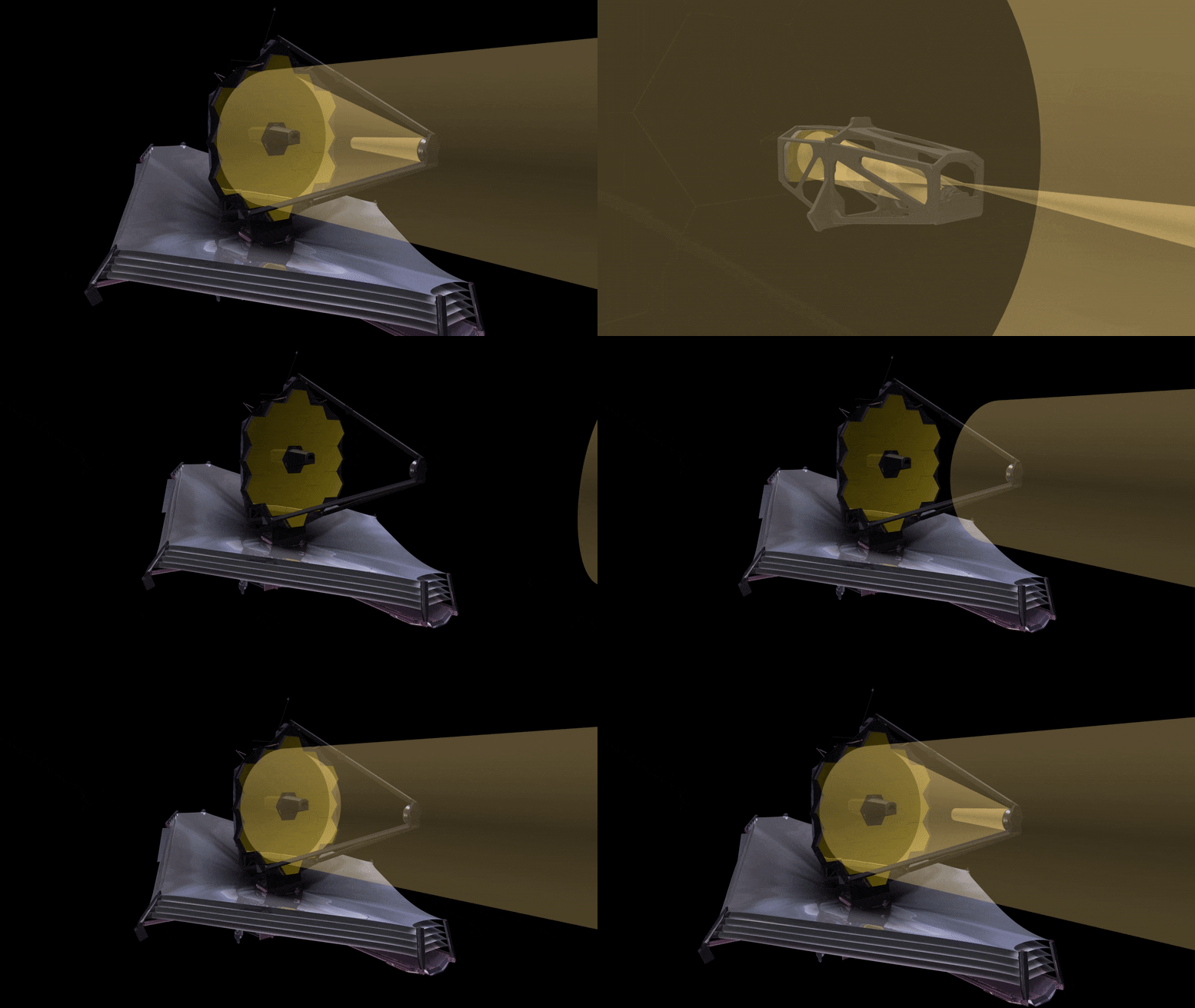
This week the Webb team continued to make progress in aligning the telescope to the NIRCam instrument. Between taking the data to understand the optical components, we continue to check out the science instruments. The NIRSpec instrument includes a microshutter array of a quarter-million miniature movable windows, each 0.1 by 0.2 millimeters in size. The microshutter array allows scientists to target specific galaxies in fields they are studying, while closing the windows on the background or other objects which would contaminate the spectra. We have begun testing the mechanism and electronics that control and actuate the microshutters.
In recent weeks, we shared a technique for theoretically modeling the early universe. Today, we will discuss an observational program to help us answer some of those questions. Massimo Stiavelli, the Webb Mission Office head at the Space Telescope Science Institute, tells us about his planned investigations of the first stars and galaxies:
“The chemical composition of the early universe, just after the big bang, is the product of the nuclear processes that took place in the first few minutes of the universe’s existence. These processes are known as ‘primordial nucleosynthesis.’ One of the predictions of this model is that the chemical composition of the early universe is largely hydrogen and helium. There were only traces of heavier elements, which formed later in stars. These predictions are compatible with observations, and are in fact one of the key pieces of evidence that support the hot big bang model.
“The earliest stars formed out of material with this primordial composition. Finding these stars, commonly dubbed as the ‘First Stars’ or ‘Population III stars,’ is an important verification of our cosmological model, and it is within reach of the James Webb Space Telescope. Webb might not be able to detect individual stars from the beginning of the universe, but it can detect some of the first galaxies containing these stars.
“One way to confirm whether we are finding the first stars is to accurately measure metallicities of very distant galaxies. The astronomical term, metallicity, is a measurement of the amount of material heavier than hydrogen and helium – so a low metallicity galaxy would indicate it was made up of these ‘First Stars.’ One of the most distant galaxies discovered so far, known as MACS1149-JD1, is confirmed to be at redshift 9.1 and emitted the light we see when the universe was only 600 million years old. The light from this distant galaxy has been traveling ever since then and is just reaching us now.
“In the first year of Webb science, I have an observing program to study this galaxy and determine its metallicity. I will do this by attempting to measure the ratio in the strength of two spectroscopic lines emitted by oxygen ions, originally emitted at violet-blue and blue-green visible light (rest frame wavelengths at 4,363 angstroms and 5,007 angstroms). Thanks to cosmological redshift, these lines are now detectable at the infrared wavelengths that Webb can see. The use of a ratio of two lines of the same ion can provide an exquisite measurement of the gas temperature in this galaxy and, through relatively simple theoretical modeling, will provide a robust measurement of its metallicity.
“The challenge is that one of these lines is usually extremely weak. However, this line tends to get stronger at lower metallicity. So if we failed to detect the line and measure metallicity for MACS1149-JD1, that would likely mean that it has already been enriched by the heavier elements, and we need to look further and harder. Whether using my data or with future programs, I fully expect that during its operational lifetime Webb will be able to find objects with metallicity sufficiently low to hold keys for understanding the first generation of stars.”
Massimo Stiavelli, Webb Mission Office head, Space Telescope Science Institute
Written by:
- Jonathan Gardner, Webb deputy senior project scientist, NASA’s Goddard Space Flight Center
- Alexandra Lockwood, project scientist for Webb science communications, Space Telescope Science Institute
Never miss a breakthrough: Join the SciTechDaily newsletter.
Follow us on Google and Google News.
1 Comment
I’m concerned that the comments appear to infer a significant amount of ‘confirmation bias’, in particular assuming ‘confirmation’ of a cosmological model increasingly shown inconsistent, no less by the WMAP and Planck CMB analyses. Some alternative ‘cyclic’ cosmological models appear able to resolve these issues, but if not admitted and studied in data analysis will be wrongly ‘excluded’ as options!