
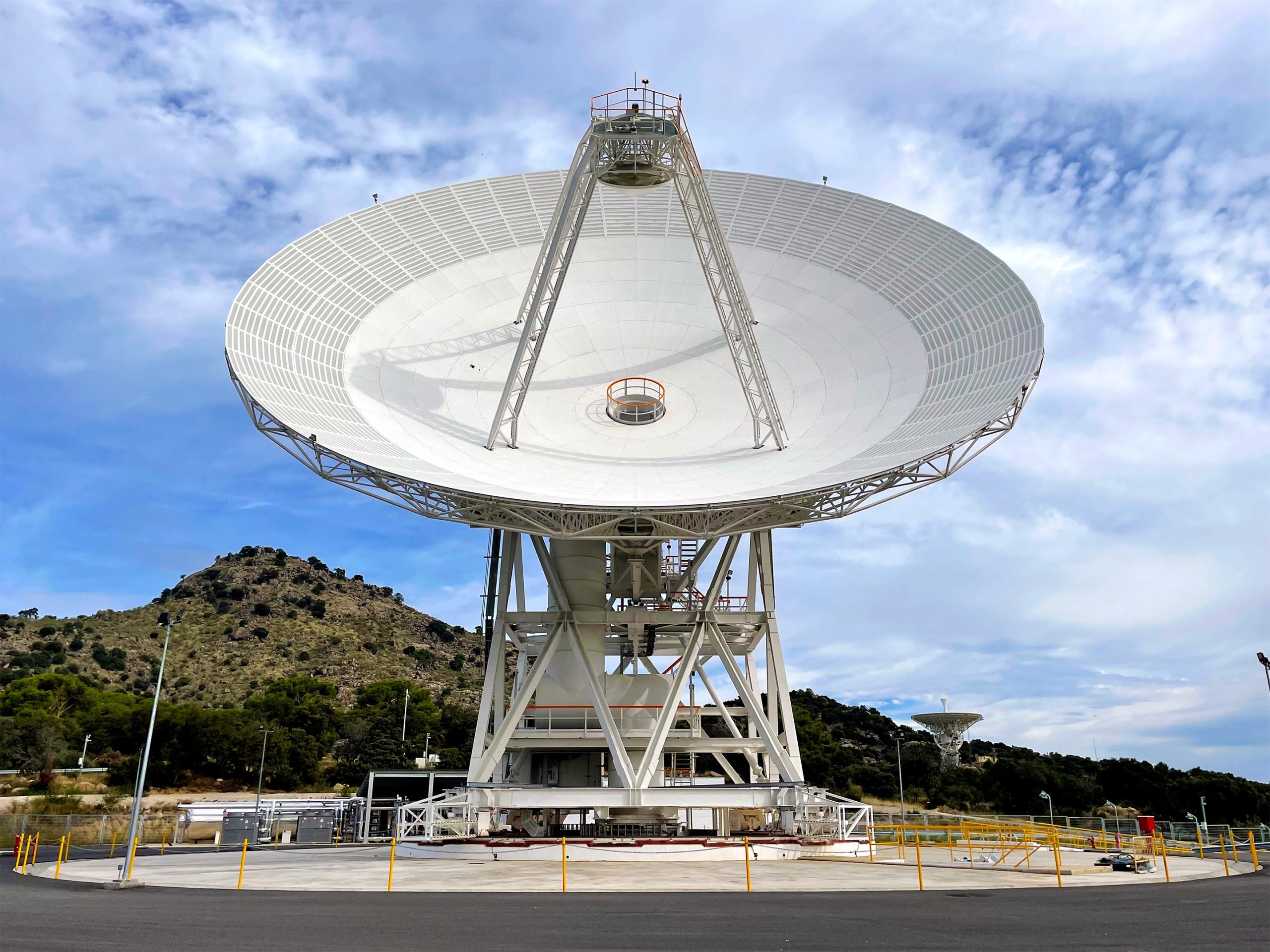
NASA’s Deep Space Network (DSN) serves as a crucial communication link, managing, tracking, and controlling spacecraft in deep space.
It plays a key role in gathering telemetry, executing commands, and conducting scientific research via radio signals that probe distant cosmic bodies. A novel operational strategy, “Follow the Sun,” has optimized network management across three global stations, enhancing support for missions like TESS, Insight, and Parker Solar Probe.
Deep Space Network
NASA’s Deep Space Network, or DSN, is much more than a collection of big antennas. It is a powerful system for commanding, tracking and monitoring the health and safety of spacecraft at many distant planetary locales. The DSN also enables powerful science investigations that probe the nature of asteroids and the interiors of planets and moons.

Telemetry
Telemetry data is made up of crucial science and engineering information transmitted to Earth via radio signals from spacecraft as they explore the far reaches of our solar system. The Deep Space Network, or DSN acquires, processes, decodes and distributes this data.
When scientists and engineers want to send commands to a spacecraft in deep space, they turn to the Deep Space Network, NASA’s international array of giant radio antennas used to communicate with spacecraft at the Moon and beyond. Operators at the Deep Space Network take commands, break them into digital bits, precisely aim these big antennas at the spacecraft, and send the commands to the spacecraft using radio waves. Credit: NASA
Spacecraft Command
Space mission operations teams use the DSN Command System to control the activities of their spacecraft. Commands are sent to robotic probes as coded computer files that the craft execute as a series of actions.
NASA has dozens of robotic spacecraft exploring our solar system – and beyond. So how exactly do we navigate spacecraft that are so far away? Scientists and engineers on Earth can use precise measurements to know where faraway spacecraft are by using the Deep Space Network, NASA’s international collection of giant radio antennas used to communicate with spacecraft at the Moon and beyond. Credit: NASA
Tracking
The DSN Tracking System provides two-way communication between Earth-based equipment and a spacecraft, making measurements that allow flight controllers to determine the position and velocity of spacecraft with great precision.
Radio Science
DSN antennas are used by some space missions to perform science experiments using the radio signals sent between a spacecraft and Earth. Changes in radio signals between their transmission and receipt can provide lots of useful information about far-off places in the solar system. Examples include probing the rings of Saturn, revealing the interior structure of planets and moons, and testing the theory of relativity.
Science
In addition its vital role as the communications hub for deep space exploration, the DSN is also used as an advanced instrument for scientific research, including radio astronomy and radar mapping of passing asteroids.
Follow the Sun Operations
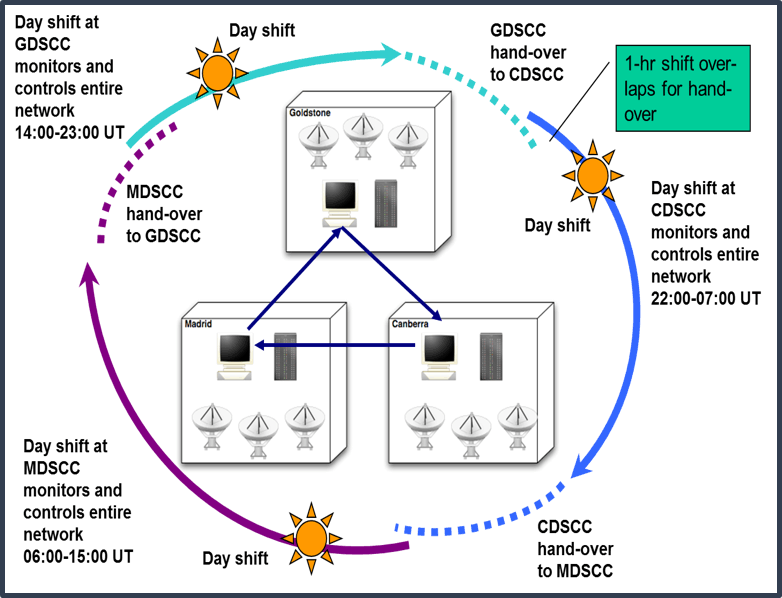
The DSN consists of three complexes located approximately 120 degrees apart (Canberra, Australia; Madrid, Spain; Goldstone, California) tracking NASA and non-NASA missions that explore the furthest points of our solar system. Historically, the complexes operated concurrently with three shifts per day, one operator per antenna, 24 hours a day, seven days a week. A new paradigm called Follow the Sun allows each of the three DSN sites to operate the entire network during their day shift.
Starting on November 6, 2017 at midnight GMT (November 5, 7 p.m. EST), Follow the Sun operations became a reality. The Canberra team operated the network from midnight GMT through 6 a.m. GMT. The Madrid team took over at 6 a.m. GMT through 2 p.m. GMT. The Goldstone team rounded out the first day from 2 p.m. GMT through 10 p.m. GMT and then Canberra took over for the next day. Data delivery performance has been nominal since Follow the Sun has been operational. This initiative has supported missions such as TESS, Insight, and Parker Solar Probe.
What Is NASA’s Deep Space Network?
- What Does NASA’s Deep Space Network Do?
- Where Is NASA’s Deep Space Network Located?
- The Antennas of NASA’s Deep Space Network
Never miss a breakthrough: Join the SciTechDaily newsletter.
Follow us on Google and Google News.
1 Comment
What did it do? It wastes taxpayers’ money, that’s what it does.