
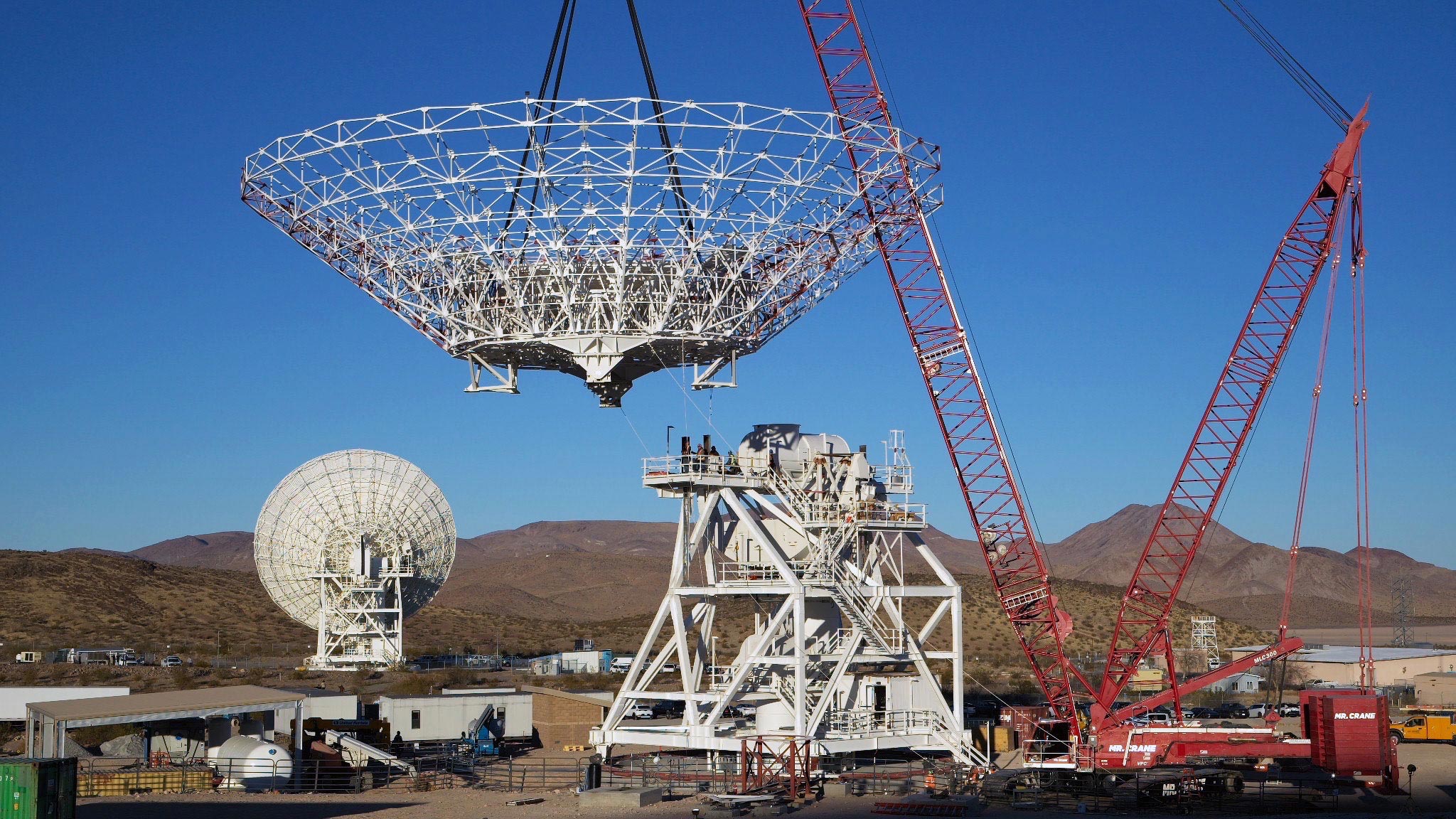
Deep Space Station 23, NASA’s latest addition to its Deep Space Network, recently reached a major milestone with the installation of its 133-ton reflector dish.
This cutting-edge antenna, located at the Goldstone Deep Space Communications Complex in California, will enhance communication with missions like Perseverance, Voyager 1, and the upcoming Europa Clipper. Once operational in 2026, it will bolster the world’s most advanced space communication system, enabling NASA to support an increasing number of human and robotic explorers venturing to the Moon, Mars, and beyond.
NASA’s Expanding Deep Space Network
NASA’s Deep Space Network (DSN), a global system of massive radio antennas, plays a critical role in space exploration by tracking spacecraft, sending commands, and receiving scientific data from missions exploring the Moon, Mars, and beyond. To meet growing demands, NASA is expanding the network by adding a new antenna, bringing the total to 15. This upgrade will bolster the capabilities of the world’s most advanced radio frequency telecommunication system.
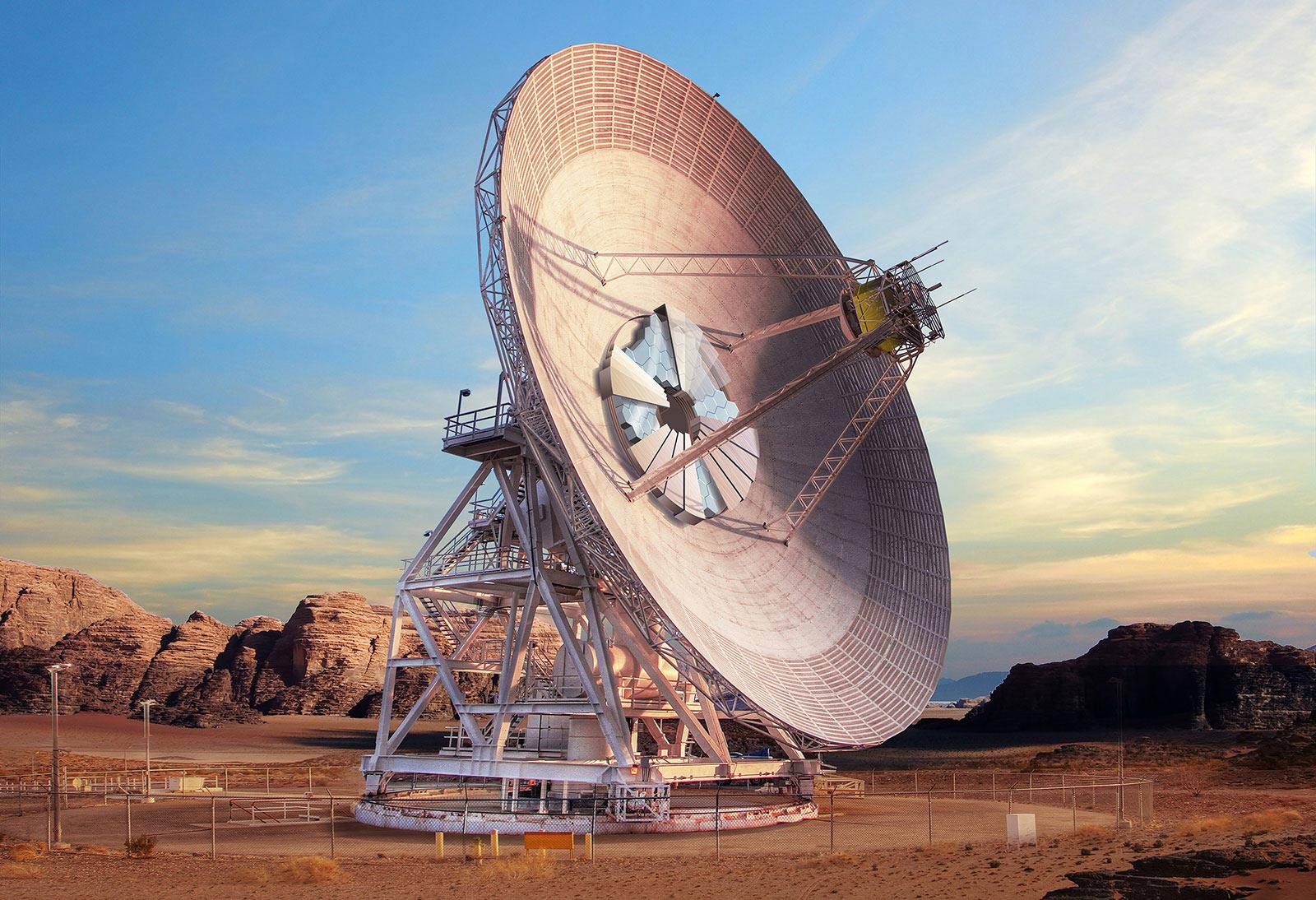
A New Antenna for Future Missions
On December 18, a major milestone was achieved with the installation of the metal reflector framework for Deep Space Station 23 at NASA’s Goldstone Deep Space Communications Complex near Barstow, California. This new multifrequency beam-waveguide antenna is set to become operational in 2026. Once online, it will support a wide range of missions, including Perseverance, Psyche, Europa Clipper, Voyager 1, and an expanding fleet of human and robotic explorers venturing deeper into space.
“This addition to the Deep Space Network represents a crucial communication upgrade for the agency,” said Kevin Coggins, deputy associate administrator of NASA’s SCaN (Space Communications and Navigation) program. “The communications infrastructure has been in continuous operation since its creation in 1963, and with this upgrade we are ensuring NASA is ready to support the growing number of missions exploring the Moon, Mars, and beyond.”
This time-lapse video shows the entire day of construction activities for the Deep Space Station 23 antenna at the NASA Deep Space Network’s Goldstone Space Communications Complex near Barstow, California, on December 18. Credit: NASA/JPL-Caltech
Engineering Challenges and Construction Details
Construction of the new antenna has been underway for more than four years, and during the installation, teams used a crawler crane to lower the 133-ton metal skeleton of the 112-foot-wide (34-meter-wide) parabolic reflector before it was bolted to a 65-foot-high (20-meter-high) alidade, a platform above the antenna’s pedestal that will steer the reflector during operations.
“One of the biggest challenges facing us during the lift was to ensure that 40 bolt-holes were perfectly aligned between the structure and alidade,” said Germaine Aziz, systems engineer, Deep Space Network Aperture Enhancement Program of NASA’s Jet Propulsion Laboratory in Southern California. “This required a meticulous emphasis on alignment prior to the lift to guarantee everything went smoothly on the day.”

Following the main lift, engineers carried out a lighter lift to place a quadripod, a four-legged support structure weighing 16 1/2 tons, onto the center of the upward-facing reflector. The quadripod features a curved subreflector that will direct radio frequency signals from deep space that bounce off the main reflector into the antenna’s pedestal, where the antenna’s receivers are housed.
Engineers will now work to fit panels onto the steel skeleton to create a curved surface to reflect radio frequency signals. Once complete, Deep Space Station 23 will be the fifth of six new beam-waveguide antennas to join the network, following Deep Space Station 53, which was added at the Deep Space Network’s Madrid complex in 2022.

Supporting Groundbreaking Space Exploration
“With the Deep Space Network, we are able to explore the Martian landscape with our rovers, see the James Webb Space Telescope’s stunning cosmic observations, and so much more,” said Laurie Leshin, director of JPL. “The network enables over 40 deep space missions, including the farthest human-made objects in the universe, Voyager 1 and 2. With upgrades like these, the network will continue to support humanity’s exploration of our solar system and beyond, enabling groundbreaking science and discovery far into the future.”
NASA’s Deep Space Network is managed by JPL, with the oversight of NASA’s SCaN Program. More than 100 NASA and non-NASA missions rely on the Deep Space Network and Near Space Network, including supporting astronauts aboard the International Space Station and future Artemis missions, monitoring Earth’s weather and the effects of climate change, supporting lunar exploration, and uncovering the solar system and beyond.
Never miss a breakthrough: Join the SciTechDaily newsletter.
Follow us on Google and Google News.
1 Comment
Communication with whom?