
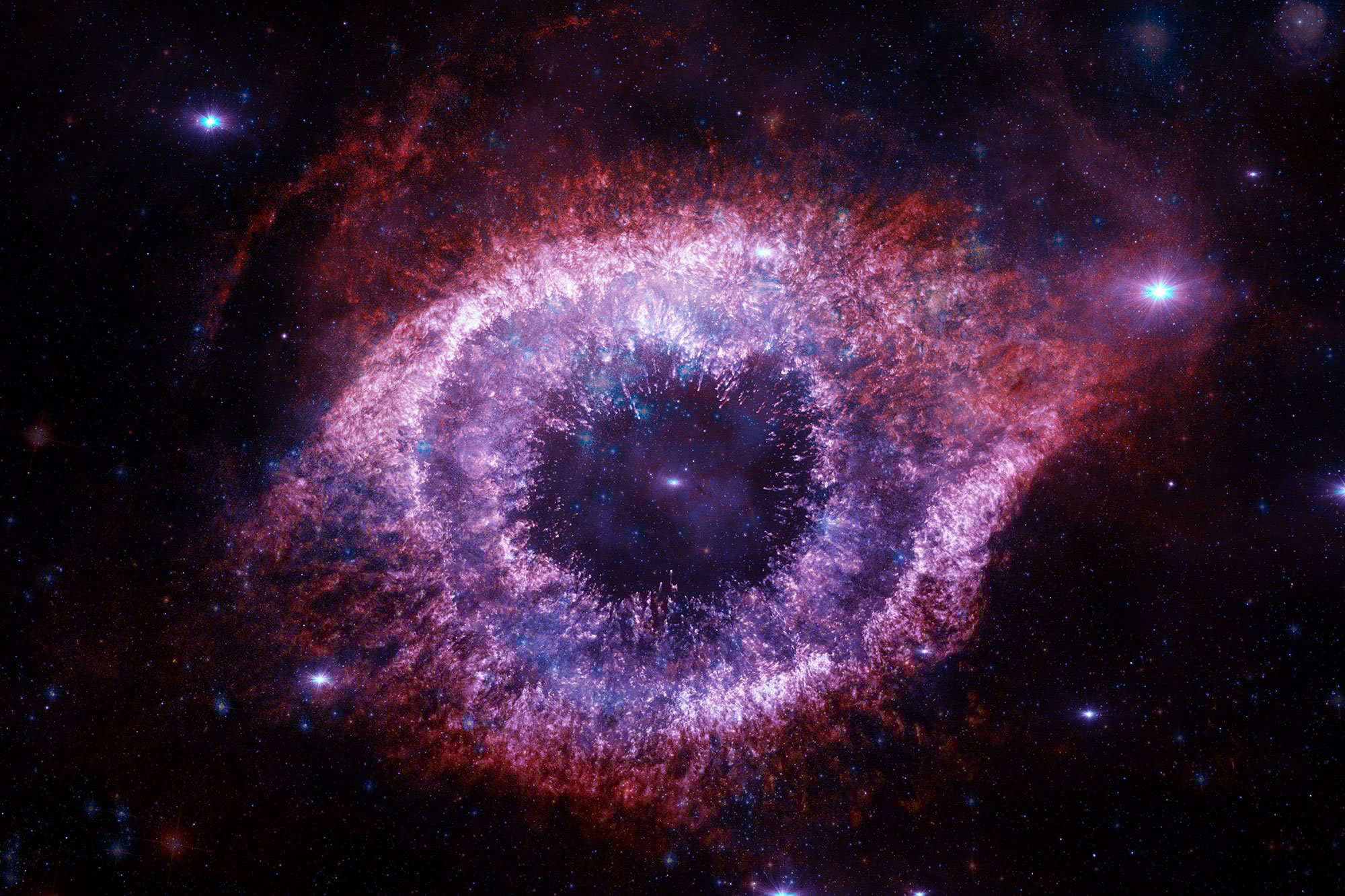
What if the universe remembers? A bold new framework proposes that spacetime acts as a quantum memory.
For over a hundred years, physics has rested on two foundational theories. Einstein’s general relativity describes gravity as the curvature of space and time, while quantum mechanics governs the behavior of particles and fields.
Each theory is highly successful within its own domain, yet combining them leads to contradictions, particularly in relation to black holes, dark matter, dark energy, and the origins of the universe.
My colleagues and I have been exploring a new way to bridge that divide. The idea is to treat information – not matter, not energy, not even spacetime itself – as the most fundamental ingredient of reality. We call this framework the quantum memory matrix (QMM).
Spacetime as discrete memory cells
At its core is a simple but powerful claim: spacetime is not smooth, but discrete – made of tiny “cells”, which is what quantum mechanics suggests. Each cell can store a quantum imprint of every interaction, like the passage of a particle or even the influence of a force such as electromagnetism or nuclear interactions, that passes through. Each event leaves behind a tiny change in the local quantum state of the spacetime cell.
In other words, the universe does not just evolve. It remembers.
The story begins with the black hole information paradox. According to relativity, anything that falls into a black hole is gone forever. According to quantum theory, that is impossible. Information cannot be ever destroyed.
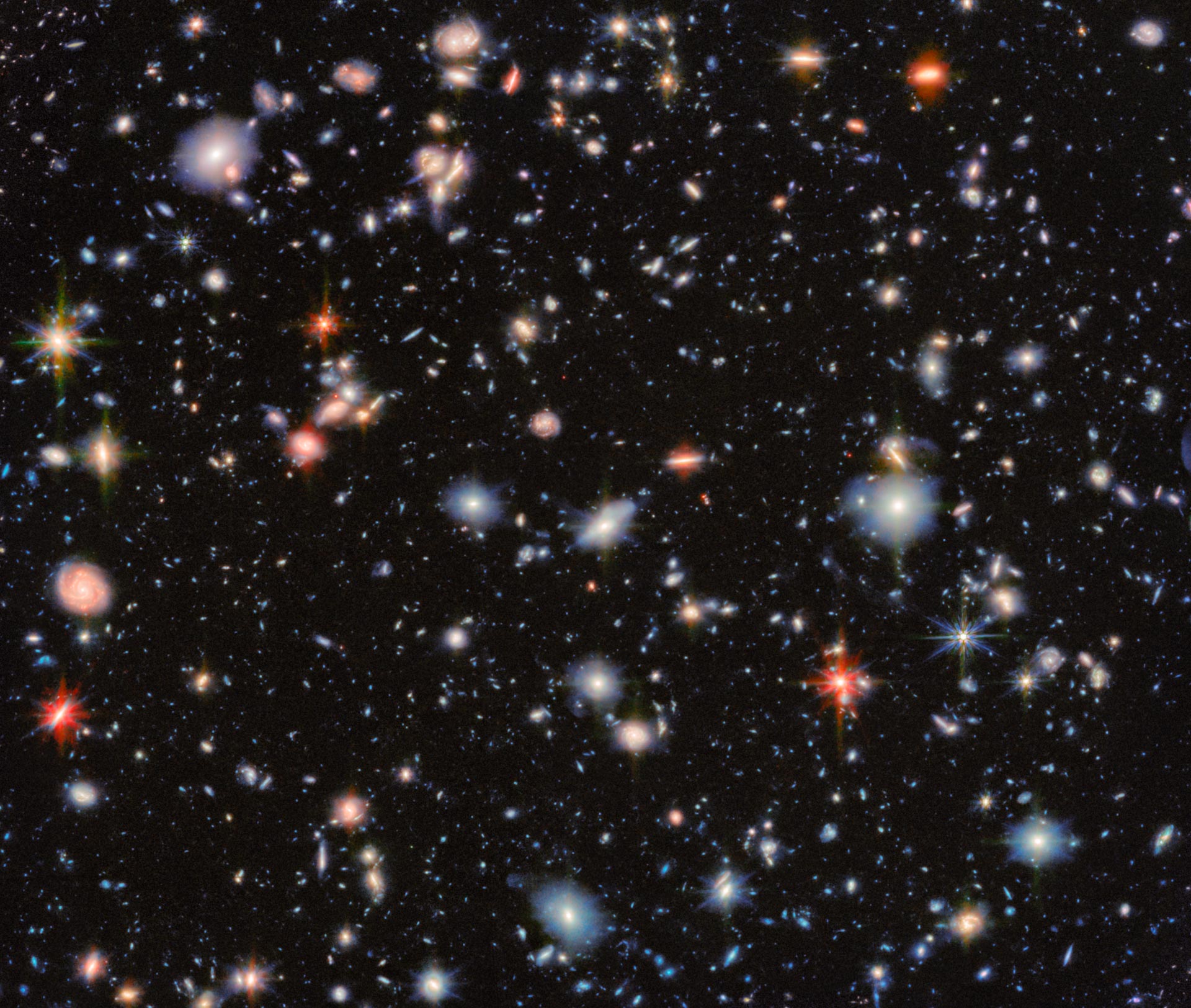
QMM offers a way out. As matter falls in, the surrounding spacetime cells record its imprint. When the black hole eventually evaporates, the information is not lost. It has already been written into spacetime’s memory.
This mechanism is captured mathematically by what we call the imprint operator, a reversible rule that makes information conservation work out. At first, we applied this to gravity. But then we asked: what about the other forces of nature? It turns out they fit the same picture.
In our models assuming that spacetime cells exist, the strong and weak nuclear forces, which hold atomic nuclei together, also leave traces in spacetime. Later, we extended the framework to electromagnetism (although this paper is currently being peer reviewed). Even a simple electric field changes the memory state of spacetime cells.
Explaining dark matter and dark energy
That led us to a broader principle that we call the geometry-information duality. In this view, the shape of spacetime is influenced not just by mass and energy, as Einstein taught us, but also by how quantum information is distributed, especially through entanglement. Entanglement is a quantum feature in which two particles, for example, can be spookily connected, meaning that if you change the state of one, you automatically and immediately also change the other – even if it’s light years away.
This shift in perspective has dramatic consequences. In one study, currently under peer review, we found that clumps of imprints behave just like dark matter, an unknown substance that makes up most of the matter in the universe. They cluster under gravity and explain the motion of galaxies – which appear to orbit at unexpectedly high speeds – without needing any exotic new particles.
In another, we showed how dark energy might emerge too. When spacetime cells are saturated, they cannot record new, independent information. Instead, they contribute to a residual energy of spacetime. Interestingly, this leftover contribution has the same mathematical form as the “cosmological constant”, or dark energy, which is making the universe expand at an accelerated rate.
Its size matches the observed dark energy that drives cosmic acceleration. Together, these results suggest that dark matter and dark energy may be two sides of the same informational coin.
A cyclic universe?
But if spacetime has finite memory, what happens when it fills up? Our latest cosmological paper, accepted for publication in The Journal of Cosmology and Astroparticle Physics, points to a cyclic universe – being born and dying over and over. Each cycle of expansion and contraction deposits more entropy – a measure of disorder – into the ledger. When the bound is reached, the universe “bounces” into a new cycle.
Reaching the bound means spacetime’s information capacity (entropy) is maxed out. At that point, contraction cannot continue smoothly. The equations show that instead of collapsing to a singularity, the stored entropy drives a reversal, leading to a new phase of expansion. This is what we describe as a “bounce”.
A finite informational age
By comparing the model to observational data, we estimate that the universe has already gone through three or four cycles of expansion and contraction, with fewer than ten remaining. After the remaining cycles are completed, the informational capacity of spacetime would be fully saturated. At that point, no further bounces occur. Instead, the universe would enter a final phase of slowing expansion.
That makes the true “informational age” of the cosmos about 62 billion years, not just the 13.8 billion years of our current expansion.
So far, this might sound purely theoretical. But we have already tested parts of QMM on today’s quantum computers. We treated qubits, the basic units of quantum computers, as tiny spacetime cells. Using imprint and retrieval protocols based on the QMM equations, we recovered the original quantum states with over 90% accuracy.
Practical tests on quantum computers
This showed us two things. First, that the imprint operator works on real quantum systems. Second, it has practical benefits. By combining imprinting with conventional error-correction codes, we significantly reduced logical errors. That means QMM might not only explain the cosmos, but also help us build better quantum computers.
QMM reframes the universe as both a cosmic memory bank and a quantum computer. Every event, every force, every particle leaves an imprint that shapes the evolution of the cosmos. It ties together some of the deepest puzzles in physics, from the information paradox to dark matter and dark energy, from cosmic cycles to the arrow of time.
And it does so in a way that can already be simulated and tested in the lab. Whether QMM proves to be the final word or a stepping stone, it opens a startling possibility: the universe may not only be geometry and energy. It is also memory. And in that memory, every moment of cosmic history may still be written.
Reference: “Information Wells and the Emergence of Primordial Black Holes in a Cyclic Quantum Universe” by Florian Neukart, Eike Marx and Valerii Vinokur, 14 June 2025, arXiv.
DOI: 10.48550/arXiv.2506.13816
Adapted from an article originally published in The Conversation.
Never miss a breakthrough: Join the SciTechDaily newsletter.
Follow us on Google and Google News.
38 Comments
B note 2510040152_Source1.Reinterpreting【
Source 1.
https://scitechdaily.com/what-if-the-universe-remembers-everything-new-theory-rewrites-the-rules-of-physics/
1.
What if the universe remembers everything? A new theory rewrites the laws of physics
Florian Neukart, Leiden University Oct. 3, 2025 No Comment 6 mins Read
-For over a century, physics has been divided between the elegance of Einstein’s theory of relativity and the strangeness of quantum mechanics.
1-1.
_A new framework, the quantum memory matrix, argues that spacetime itself consists of individual “cells” that remember all the interactions. Source:
-What if the universe remembered? A new bold framework suggests that spacetime acts like quantum memory.
_For over 100 years, physics has been based on two basic theories. Einstein’s general theory of relativity describes gravity as the curvature of space and time, while quantum mechanics governs the motion of particles and fields.
_While each theory has had great success in its own domain, combining the theories leads to contradictions, especially with respect to black holes, dark matter, dark energy, and the origin of the universe.
_My colleagues and I have been exploring new ways to bridge these gaps. The idea is to treat information as the most fundamental element of reality, not matter, energy, not even spacetime itself. We call this framework a quantum memory matrix (QMM).
【>>>
>>>>>The framework is that the quantum memory matrix (QMM) is the quantum unit of my cosmology, qpeoms (q_uasi.p_rime odd.e_mpty 0.o>>qpeoms.galaxy.unit=QMM can make enough (msbase.msoss).galaxy. Uh-huh.
<<<<>>>
>>msbase.nk2 means that the entropy maximum has been reached. He lifted the 3rd law of thermodynamics. The universe has become a complete puzzle, and the disordered universe has now become a world of order with complete memories.
<<<<】
_At that point, the contraction cannot be sustained smoothly.
Interesting, provocative even. But rather jumping the gun before the peer review process is completed and there is at least a preliminary examination for errors in reasoning, assumption and calculation.
More “fundamental” a necessary “ingredient” for any matrix or reality, virtual or otherwise, and, for all we yet know, for such as we cannot begin to imagine, may be Consciousness, which we cannot possibly overlook, so to speak…and which may be – ironically enough given that Einstein said that imagination encircles the world! – that into which all our cosmoses and, with them, all our physics is expanding?!
Seen from a standpoint, so to speak, of Consciousness, could there be any division between Newtonian and quantum physics, at all, and could works not come into being as we imagine them to be?
Long before Everett, Deutsch or Wheeler et al, Greek philosophers and Jesus surely already pointed to a “Father’s House” – Pure Formless Consciousness – THAT Realm – with “many mansions.”
Sometimes the Obvious is so obvious that even the einstein’s among us miss it, although young children might not.
“The world is full of obvious things which nobody by any chance ever observes.” – Sherlock Holmes, and Conan Doyle, and nothing like a brazen fact hiding in plain sight, is there?
Thank you for another absolutely superb article!
Tom.
If you knew how peer reviews are done, you wouldn’t be so hung up on them.
What do you mean? Are peer reviews not useful in any way?
Interesting, but not enough?
The universe may be a computer simulation, possibly created by an unknown number of higher level simulations. See Nick Bostrom paper 2003.
The universe murders my brain because I think very deeply about it, and it leaves me with a burning curiosity. I just want to know all of the answers, but we don’t have them. The question that murders my brain the most is: How did it all start?
Topological spin creates all things and shapes the world. Topological phase transition is a mathematical principle underlying the evolution of the universe from space to spacetime.
Not to get too metaphysical, but this could also point to some of the theories world religions have had about God, the soul, and life after death.
My brain as well, and has been for at least 70 of my years. It pokes and teases, and each time I read something that seems to provide some answers, years later something else comes up to shake it up again. At this point, I suspect my cat actually knows the answers to these questions, but she’s mum on the subject.
It sounds like not precisely the same idea but I’ve thought for some time that the physical universe evolved in a more literal sense than many might allow. That it self designs, invents through trial and error, and learns. Such as the fact that stars happen to produce life supporting elements and environments from hydrogen, and would seem to have been doing so since before what is defined as life. To evolve, and, in a physical sense, to learn, would require memory.
It knows if you’ve been bad or good so be good for goodness sake…
Your insightful comment will be imprinted and stored until our black hole evaporates away through Hawking radiation.
That is precisely the self-organization and interaction of spacetime vortices. The rotation of spacetime vortices is spin. Topological spin creates all things and shapes the world. Topological phase transition is a mathematical principle underlying the evolution of the universe from space to spacetime.
This would explain pretty much everything that paranormal investigators find/record/observe/experience.
This makes me sad, though. I considered the field of paranormal investigation to be the best evidence of an afterlife. If all that is happening is residual memories/imprints that somehow replay themselves, then there most likely is no afterlife. Depressing.
This theory does not explain everything, though. Intelligent responses by unknown/unseen entities, psychic abilities, the many many examples of children who have memories of a previous life, people who feel like they are in the wrong body …so I’m going to cling to hope that there is still a way for our consciousness to go on, even if it’s just for a while before dissipating into nothingness.
“QMM reframes the universe as both a cosmic memory bank and a quantum computer. Every event, every force, every particle leaves an imprint that shapes the evolution of the cosmos.”
This sounds cool but is not realistic. Information loss is the rule, not the exception. It provides the arrow of time. Yes, a quantum system is reversible and can be exploited to evade irreversibility. But the collection of universal quantum information cannot be sequestered into an “imprint entropy” density, modeled as a scalar field that acts as pressureless dust. The authors’ papers make little sense, and they rely on “saturation and stable primordial black hole formation” which we have no evidence of. Not clear how these series of papers got published.
It isn’t published. It has merely been left on arXiv for curious onlookers to ponder. I can’t think of any high-impact theoretical physics journals picking this mess up; it belongs on viXra.
Before people were conceived we did not have any knowledge, understanding, intuition, or inkling of our coming existence whatsoever. Yet the hubris, arrogance, and inability to reconcile the fear of death, frightens us into all sorts of irrational claims, such as “religion” and “reincarnation”. All anthropomorphically based.
What makes anyone think that our existence will “continue” in some sort of way when we die? Not one shred of evidence has ever been provided in recorded history, and never will be.
I always wondered why people asked for “religious” or “spiritual” advice from murderers and child molesters…?! Strange world.
This “Quantum Memory Matrix” idea is fascinating — yet it seems to describe only a local manifestation of a much deeper structural principle already outlined in the Quantum Dual Symmetry Model (KDS).
According to KDS (Dragan Škondrić, 2024–2025), the Universe does not “store” information inside spacetime cells, but maintains continuous informational resonance between two complementary domains:
the R-domain, a nonlocal, pre-phenomenal substrate, and
the L-domain, the temporal projection we perceive as physical reality.
In this dual framework, information never needs to be “remembered,” because it is never lost — it simply reverses through the hyper-quantum layer connecting R and L.
What QMM calls “memory saturation” appears, in KDS terms, as phase resonance reversal between these domains, naturally producing cycles of expansion and contraction without invoking spacetime memory.
In short, the Universe doesn’t remember — it resonates.
More on this framework can be found in the Quantum Dual Symmetry Model (KDS) monograph on Zenodo (DOI: 10.5281/zenodo.16980664).
Perhaps, speculating, the “bounce” is equivalent to syntropy, and “space time cells” are dynamic quantum holographic Gabor logons? Then, a connection needs to be established between them. Your resonance theory might be the connecting mechanism? Between the R-domain and L-domain, perhaps analysis could further specify the quantum holographic version of the Fourier transforms, as well as phase conjugation?
Dragan
Dragan Milovanovic
This is looking like copied from Hindu scriptures but portraying using quantum mechanics. i.e. Cyclic nature of universe, universe remember everything and everyone and thus we get different experiences based on past karmas(acts) etc
Try another (similar but better) framework:
https://h3oklabs.wordpress.com/
May give you additional ideas of how to deal with a new paradigm.
The idea reminds us of some fundamentals in some religious philosophies.
I’m with ==== > Sir Roger Penrose & his Conformal Cyclic Cosmology model on this subject!
The correct cosmology was given by Dewey B. Larson.
My theory DDMT suggests the same but in a different way. The ideas aline with mine but with different functions and processes
“Theories” do not rewrite rules. Cummon…
Math are squiggles squiggled by ape-people. My bunnie figured out I was watching through the security cams – she’d go to the blind-spots. But when I looked through a different cam, she’d move out of that view.
She didn’t make squiggles and then believe they were reality. But then, she really was smart.
So, the universe is basically Santa?
This “Quantum Memory Matrix” idea is fascinating — yet it seems to describe only a local manifestation of a much deeper structural principle already outlined in the Quantum Dual Symmetry Model (KDS).
According to KDS (Dragan Škondrić, 2024–2025), the Universe does not “store” information inside spacetime cells, but maintains continuous informational resonance between two complementary domains:
the R-domain, a nonlocal, pre-phenomenal substrate, and
the L-domain, the temporal projection we perceive as physical reality.
In this dual framework, information never needs to be “remembered,” because it is never lost — it simply reverses through the hyper-quantum layer connecting R and L.
What QMM calls “memory saturation” appears, in KDS terms, as phase resonance reversal between these domains, naturally producing cycles of expansion and contraction without invoking spacetime memory.
In short, the Universe doesn’t remember — it resonates.
More on this framework can be found in the Quantum Dual Symmetry Model (KDS) monograph on Zenodo (DOI: 10.5281/zenodo.16980664).
If the universe was some kind of computer then it must adhere to laws of information.technology. You feed in the data and in the end it comes up with an answer but even in a digital computer the intermediate states are lost and can never be retrieved except by running the program again regenerating each step with the exactly same rules and data inputs. If you wish to make a case for remembering everything then you have to hypothesize an infinite number of universes being created at every moment just to save something that will certainly fill your limited number of memory cells in no time and give no joy in the absence of salvation. Maybe you did get the girl in any number of alternate universes but your kids will never know the details there either .
‘Ever’ is an adverb that usually comes before the main verb in a sentence. It is not “be ever”.
Great piece. In the Millar Cosmological Model (MCM) we call this the Memory Fabric—spacetime as a cumulative record, not a passive stage. Not a metaphor, a mechanism.
#MCM #MemoryFabric #QuantumMemory #Cosmology
Core idea: Space is built event-by-event. Each quantum appearance brings a tiny space allowance; when it vanishes, the allowance remains. That leftover is what we read as time.
#Spacetime #Quantum #Emergence
I invite all curious people to check out my theory and the Millar Cosmological Model.
I’m on X AKA Twitter @stillpoint0828
I hope this is allowed I love your articles.
if you can turn yourself into a neutrino, you can go back in time? Is that what time understanding? But only as that neutrino right?
Fascinating to see the Quantum Memory Matrix approach.
My collaborators and I have been exploring a closely related direction—what we call Critical Holographic Code Cosmology (CHCC)—where spacetime and matter arise from a boundary quantum code poised at a continuous phase transition.
In this framework, the “memory cells” of spacetime correspond to qubits coupled by a Hamiltonian whose critical behavior (ν ≈ 0.63, gc/J → 2) reproduces general-relativistic geometry in the long-wavelength limit and predicts observable signatures such as an ultralight dark-matter mass (~10⁻²² eV) and a millihertz gravitational-wave feature testable by LISA.
Where QMM describes storage, CHCC focuses on criticality—the moment when informational order becomes physical law.
I’m glad to see convergent ideas emerging; perhaps these frameworks will together define a new, testable class of informational cosmologies.
Not only getting warm, getting hot! Yogi’s have written of this millenia ago.