
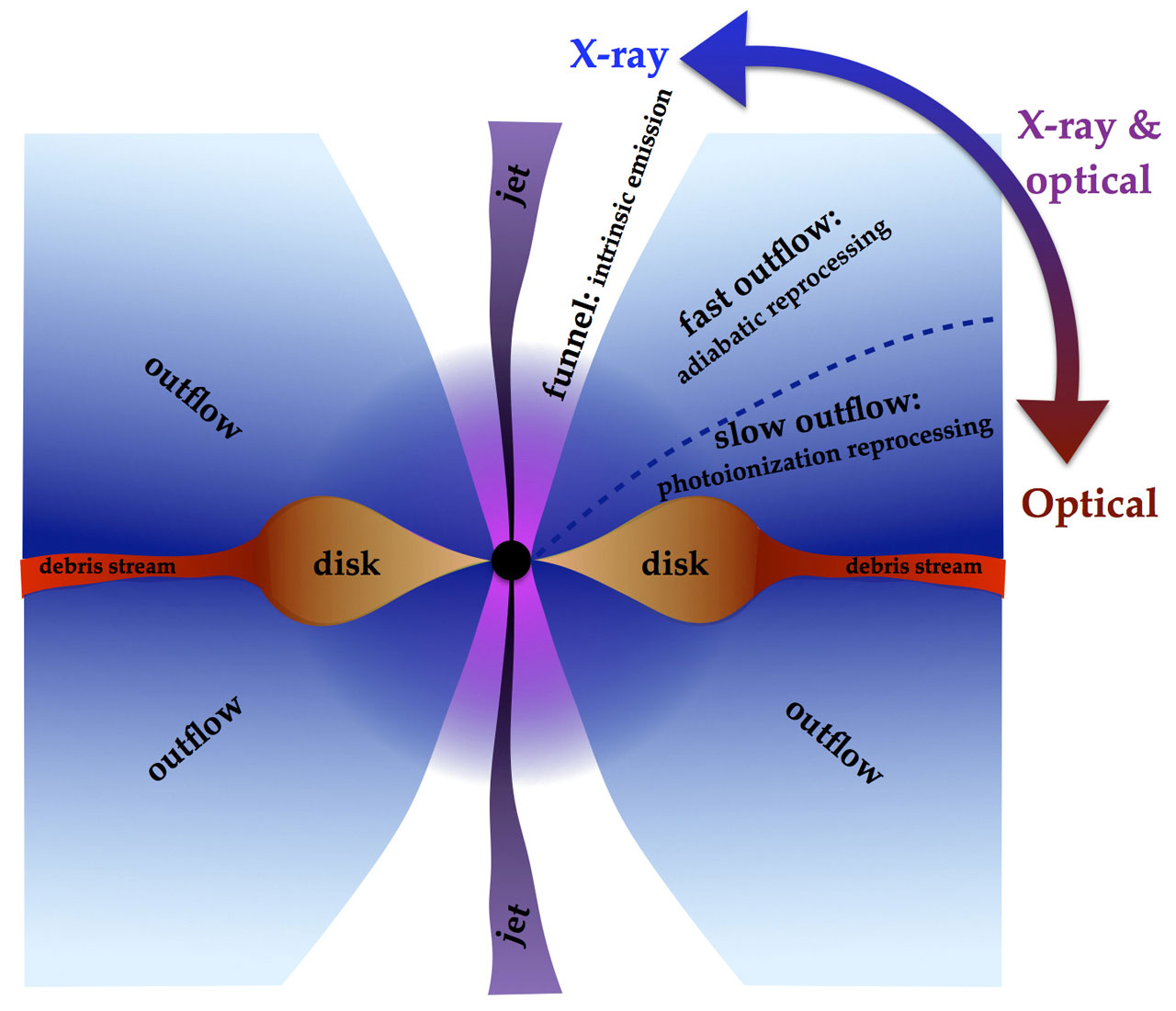
Dr. Jane Lixin Dai, theoretical astrophysicist and assistant professor, and Prof. Enrico Ramirez-Ruiz, both from the DARK Cosmology Center at the Niels Bohr Institute, University of Copenhagen, have recently provided the scientific community with a much-needed computer model. It is necessary for the investigation of Tidal Disruption Events – rare, but extremely forceful events taking place in the center of galaxies.
Tidal disruption events
In the center of every big galaxy, there is a supermassive black hole, millions to billions times heavier than the Sun. However, it is difficult to observe the majority of them, as they don’t emit any light or radiation. This only happens, when some form of material is pulled into the extremely strong gravitational field of the black hole. On rare occasions, actually as rare as once in every 10.000 years for one galaxy, a star passes very close by the supermassive black hole, and the gravity of the black hole tears it apart. This type of fatal event is called a tidal disruption event.
When a tidal disruption event happens, the black hole will be “overfed” with stellar debris for a while. “It is interesting to see how materials get their way into the black hole under such extreme conditions,” says Dr. Jane Dai who has led the study. “As the black hole is eating the stellar gas, a vast amount of radiation is emitted. The radiation is what we can observe, and using it we can understand the physics and calculate the black hole properties. This makes it extremely interesting to go hunting for tidal disruption events.”
A unification model
While the same physics is expected to happen in all tidal disruption events, the observed properties of these events have shown great variation: Some emitting mostly X-ray emissions, while others mainly emitting visible light and UV. It has been in high demand to understand this diversity and assemble these very different pieces of the puzzle. In the model, it is the viewing angle of the observer that has set the difference. Astronomers observe everything from Earth, but the galaxies are oriented randomly across the universe. “It is like there is a veil that covers part of a beast. From some angles, we see an exposed beast, but from other angles, we see a covered beast. The beast is the same, but our perceptions are different,” said Prof. Enrico Ramirez-Ruiz, a co-author on the study.
With the model Dr. Dai and her collaborators put together, combining elements from general relativity, magnetic field, radiation and gas, we now have a measure of what we expect to see when we are viewing tidal disruption events from different angles. This also allows us to put different events into a coherent framework. “We will observe hundreds to thousands of tidal disruption events in a few years. This will give us a lot of “laboratories” to test our model and use it to understand more about black holes,” said Dr. Dai.
Collaboration and perspectives
This work has been made possible by the collaboration between Dr. Jane Dai from the DARK Cosmology Center at the Niels Bohr Institute (NBI), Prof. Enrico Ramirez-Ruiz from both NBI and the University of California at Santa Cruz (UCSC), The Niels Bohr Academy as well as researchers from the University of Maryland: Prof. Jonathan McKinney, Dr. Nathaniel Roth, and Prof. Cole Miller. In particular, state-of-the-art computational tools were employed to solve the puzzle. These simulations were carried out by Dr. Dai and Dr. Roth, on the recently acquired large computer cluster made possible by the Villum Grant from Professor Jens Hjorth, head of DARK Cosmology Center, as well as clusters funded by NSF and NASA.
This breakthrough has provided a new perspective to the fast-growing research field. “Only in the last decade or so have we been able to distinguish TDEs from other galactic phenomena, and the model by Dr. Dai will provide us with the basic framework for understanding these rare events,” says Prof. Enrico Ramirez-Ruiz.
In coming years, the Young Supernova Experiment (YSE) transient survey, led by DARK and UCSC, together with other telescopes such as the Large Synoptic Survey Telescopes being built in Chile, will give us access to much more data, and help greatly to expand this field of research.
Reference: “A Unified Model for Tidal Disruption Events” by Lixin Dai, Jonathan C. McKinney, Nathaniel Roth, Enrico Ramirez-Ruiz and M. Coleman Miller, 29 May 2018, The Astrophysical Journal Letters.
DOI: 10.3847/2041-8213/aab429
Never miss a breakthrough: Join the SciTechDaily newsletter.
Follow us on Google and Google News.
2 Comments
Outflows are ubiquitous in astrophysics. Despite different sizes, velocity and amount of transported energy, luminosity and degree of collimation, they have obvious morphological similarities. However, what is important for us, there is the picture of the outflows from everywhere and none of inflows into somewhere. That is an obvious asymmetry.
https://www.academia.edu/14194346/A_Gradient_Character_of_the_Outflows_and_Jets
This “new” model is a half-surprise. In 1982 and 1983 and later, Jean-Pierre Luminet and Brandon carter from CNRS already developped this idea of TDE. Mme Dai should refer to early studies… 🙁
read
https://www.nature.com/articles/296211a0 (1982)
http://adsabs.harvard.edu/abs/1983A&A…121…97C (1983)
http://adsabs.harvard.edu/abs/1986ApJS…61..219L (1986).