
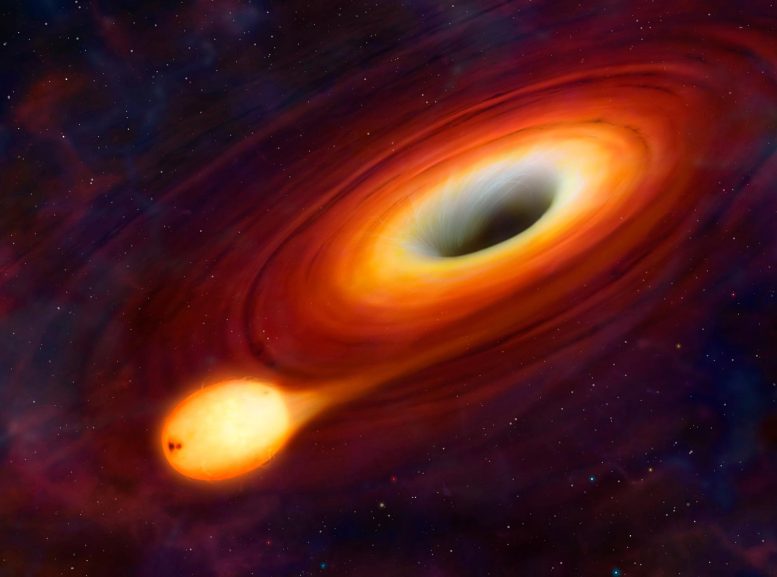
While many Tidal Disruption Events (TDE) were expected to emit X-rays, recent observations reveal that some only produce optical and ultraviolet light. A study of the TDE event AT 2020mot suggests that tidal shocks—where stellar gas collides with itself—are responsible for this unexpected emission. High polarization levels in the optical light provide evidence for this theory, challenging previous models.
The Universe is a violent place where here even a star’s life can be cut short. This happens when a star finds itself in a “bad” neighborhood, specifically in the proximity of a supermassive black hole.
These black holes, boasting mass that is millions or even billions of times greater than our Sun, are typically found nestled in the centers of quiet galaxies. As a star strays nearer to the black hole, it is subjected to an escalating gravitational tug from the supermassive black hole, which eventually overpowers the forces that maintain the star’s integrity. This results in the star being disrupted or destroyed, an event known as a Tidal Disruption Event (TDE).
“After the star has been ripped apart, its gas forms an accretion disk around the black hole. The bright outbursts from the disk can be observed in nearly every wavelength, especially with optical telescopes and satellites that detect X-rays,” says Postdoctoral Researcher Yannis Liodakis from the University of Turku and the Finnish Centre for Astronomy with ESO (FINCA).
Until recently, researchers knew only of a few TDEs, as there were not many experiments capable of detecting them. In recent years, however, scientists have developed the necessary tools to observe more TDEs. Interestingly, but perhaps not too surprisingly, these observations have led to new mysteries that the researchers are currently studying.
“Observations from large-scale experiments with optical telescopes have revealed that a large number of TDEs do not produce X-rays even though the bursts of visible light can be clearly detected. This discovery contradicts our basic understanding of the evolution of the disrupted stellar matter in TDEs,” Liodakis notes.
A study published in the journal Science by an international team of astronomers led by the Finnish Centre for Astronomy with ESO suggests that the polarised light coming from TDEs might hold the key to solving this mystery.
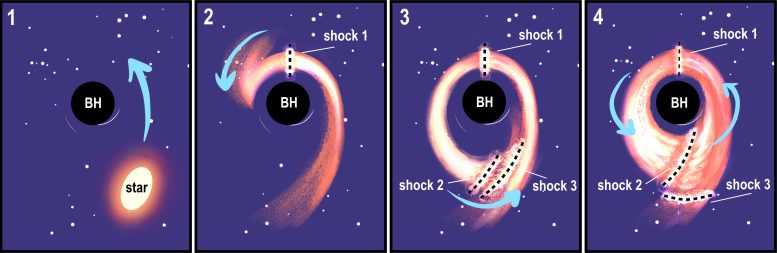
Instead of the formation of an X-ray bright accretion disk around the black hole, the observed outburst in the optical and ultraviolet light detected in many TDEs can arise from tidal shocks. These shocks form far away from the black hole as the gas from the destroyed star hits itself on its way back after circling the black hole. The X-ray bright accretion disk would form much later in these events.
“Polarisation of light can provide unique information about the underlying processes in astrophysical systems. The polarised light we measured from the TDE could only be explained by these tidal shocks,” says Liodakis, who is the lead author of the study.
Polarised Light Helped Researchers To Understand the Destruction of Stars
The team received a public alert in late 2020 from the Gaia satellite of a nuclear transient event in a nearby galaxy designated as AT 2020mot. The researchers then observed AT 2020mot in a wide range of wavelengths including optical polarisation and spectroscopy observations conducted at the Nordic Optical Telescope (NOT), which is owned by the University of Turku. The observations conducted at the NOT were particularly instrumental in making this discovery possible. In addition, the polarisation observations were done as part of the observational astronomy course for high school students.
“The Nordic Optical Telescope and the polarimeter we use in the study have been instrumental in our efforts to understand supermassive black holes and their environments,” says Doctoral Researcher Jenni Jormanainen from FINCA and the University of Turku who led the polarisation observations and analysis with the NOT.
The researchers found that the optical light coming from AT 2020mot was highly polarised and was varying with time. Despite several attempts, none of the radio or X-ray telescopes were able to detect radiation from the event before, during, or even months after the peak of the outburst.
“When we saw how polarised AT2020mot was, we immediately thought of a jet shooting out from the black hole, as we often observe around supermassive black holes that accrete the surrounding gas. However, no jet was there to be found,” says Elina Lindfors, an Academy Research Fellow at the University of Turku and FINCA.
Tidal Shocks as the Leading Explanation
The team of astronomers realized that the data most closely matched a scenario where the stream of stellar gas collides with itself and forms shocks near the pericenter and apocenter of its orbit around the black hole. The shocks then amplify and order the magnetic field in the stellar stream which will naturally lead to highly polarised light. The level of the optical polarisation was too high to be explained by most models, and the fact that it was changing over time made it even harder.
“All models we looked at could not explain the observations, except the tidal shock model,” notes Karri Koljonen, who was an astronomer at FINCA at the time of the observations and is now working at the Norwegian University of Science and Technology (NTNU).
The researchers will continue to observe the polarised light coming from TDEs and may soon discover more about what happens after a star is disrupted.
Reference: “Optical polarization from colliding stellar stream shocks in a tidal disruption event” by I. Liodakis, K. I. I. Koljonen, D. Blinov, E. Lindfors, K. D. Alexander, T. Hovatta, M. Berton, A. Hajela, J. Jormanainen, K. Kouroumpatzakis, N. Mandarakas and K. Nilsson, 11 May 2023, Science.
DOI: 10.1126/science.abj9570
Never miss a breakthrough: Join the SciTechDaily newsletter.
Follow us on Google and Google News.
1 Comment
So you HAD to do the flying penis head rocket illustration – that Did the trick – thanks so much!