
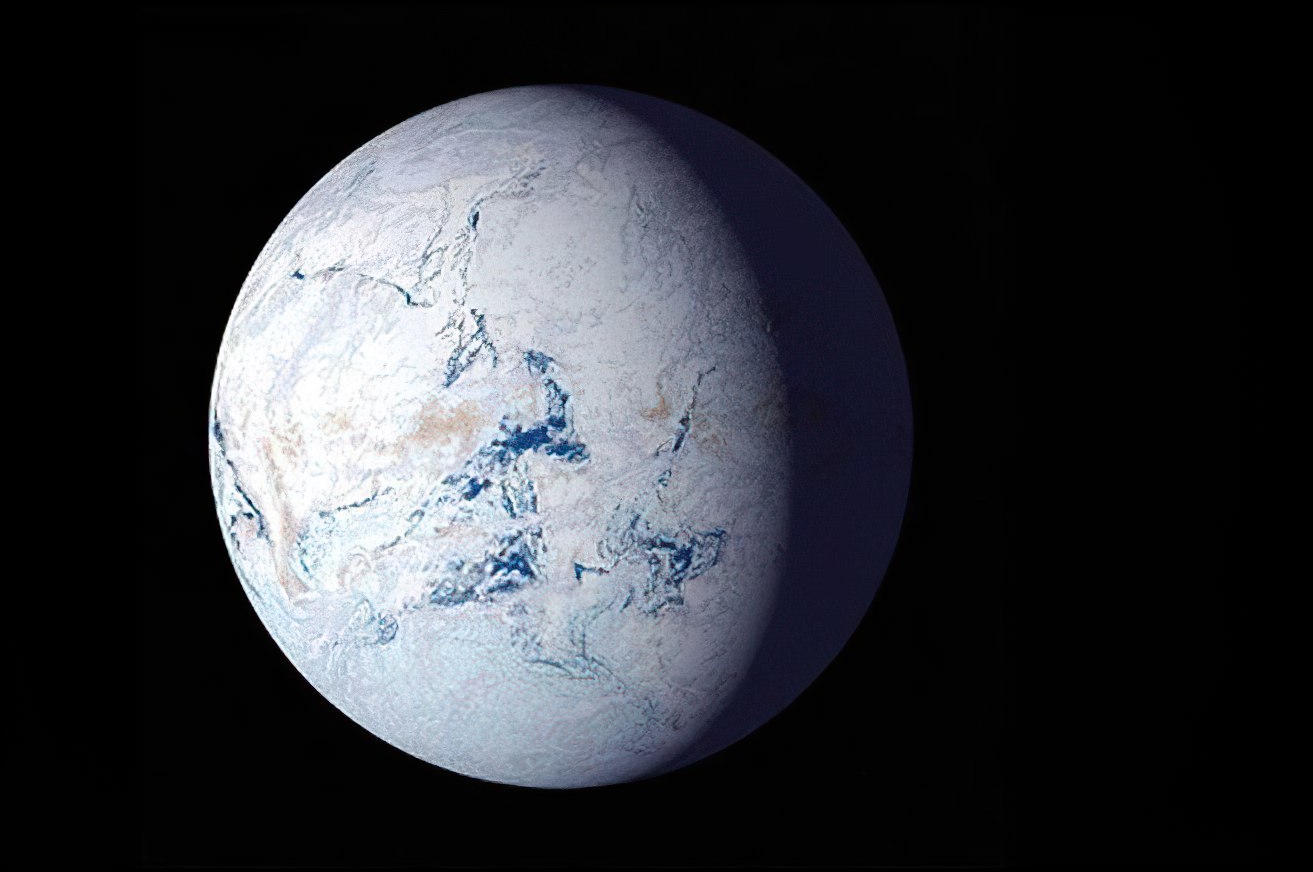
A University of Washington study offers new insights into the end of the last Snowball Earth event, explaining how melting ice and atmospheric changes may have paved the way for the emergence of more complex life forms on Earth.
Some of the most extreme climate events in Earth’s history are the “Snowball Earth” periods, which occurred hundreds of millions of years ago, when nearly the entire planet was covered in ice up to 1 kilometer (0.6 miles) thick.
These “Snowball Earth” events have happened only a handful of times and do not occur on regular cycles. Each lasts for millions of years or tens of millions of years and is followed by dramatic warming, but the details of these transitions are poorly understood.
New research from the University of Washington provides a more complete picture of how the last Snowball Earth ended, and suggests why it preceded a dramatic expansion of life on Earth, including the emergence of the first animals.

The study recently published in Nature Communications focuses on ancient rocks known as “cap carbonates,” thought to have formed as the glacial ice thawed. These rocks preserve clues to Earth’s atmosphere and oceans about 640 million years ago, far earlier than what ice cores or tree rings can record.
“Cap carbonates contain information about key properties of Earth’s atmosphere and ocean, such as changing levels of carbon dioxide in the air, or the acidity of the ocean,” said lead author Trent Thomas, a UW doctoral student in Earth and space sciences. “Our theory now shows how these properties changed during and after Snowball Earth.”
Formation of Cap Carbonates
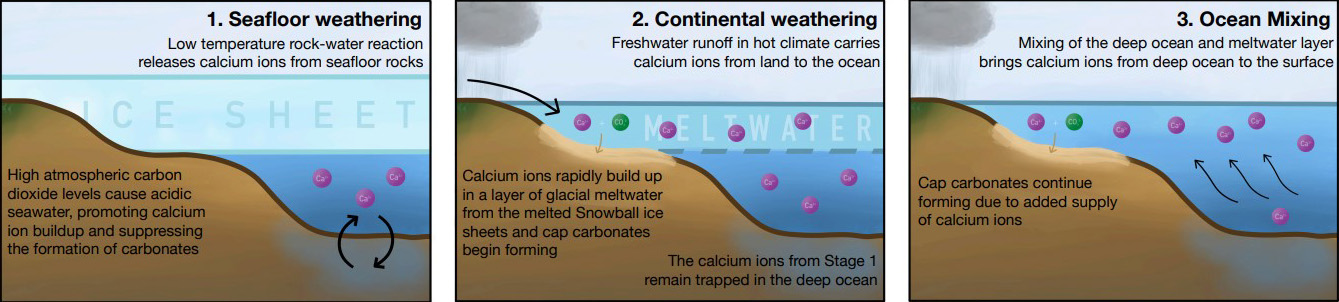
Cap carbonates are layered limestone or dolomite rocks that have a distinct chemical makeup and today are found in over 50 global locations, including Death Valley, Namibia, Siberia, Ireland and Australia. These rocks are thought to have formed as the Earth-encircling ice sheets melted, causing dramatic changes in atmospheric and ocean chemistry and depositing this unique type of sediment onto the ocean floor.
They are called “caps” because they are the caps above glacial deposits left after Snowball Earth, and “carbonates” because both limestone and dolomite are carbon-containing rocks. Understanding their formation helps explain the carbon cycle during periods of dramatic climate change. The new study, which models the environmental changes, also provides hints about the evolution of life on Earth and why more complex lifeforms followed the last Snowball Earth.
“Life on Earth was simple — in the form of microbes, algae or other tiny aquatic organisms — for over 2 billion years leading up to Snowball Earth,” said senior author David Catling, a UW professor of Earth and space sciences. “In fact, the billion years leading up to Snowball Earth are called the ‘boring billion’ because so little happened. Then two Snowball Earth events occurred. And soon after, animals appear in the fossil record.”
The new paper provides a framework for how the last two facts may be connected.
Modeling Snowball Earth’s Environmental Phases
The study modeled chemistry and geology during three phases of Snowball Earth. First, during Snowball Earth’s peak, thick ice encircling the planet reflected sunlight, but some areas of open water allowed exchange between the ocean and atmosphere. Meanwhile frigid seawater continued to react with the ocean floor.
Eventually, carbon dioxide built up in the atmosphere to the point where it trapped enough solar energy to raise global temperatures and melt the ice. This let rainfall reach the Earth, and let freshwater flow into the ocean to join a layer of glacial meltwater that floated over the denser, salty ocean water. This layered ocean slowed down ocean circulation. Later, ocean churning picked up, and mixing between the atmosphere, upper ocean, and deep ocean resumed.
“We predict important changes in the environment as Earth recovered from the Snowball period, some of which affected the temperature, acidity and circulation of the ocean. Now that we know these changes, we can more confidently figure out how they affected Earth’s life,” Thomas said.
Future research will explore how pockets of life that may have survived the tumult of the Snowball Earth and its aftermath could have evolved into the more complex lifeforms that followed soon after.
Reference: “Three-stage formation of cap carbonates after Marinoan snowball glaciation consistent with depositional timescales and geochemistry” by Trent B. Thomas, and David C. Catling, 15 August 2024, Nature Communications.
DOI: 10.1038/s41467-024-51412-8
The research was funded by the National Science Foundation and NASA, in part by a NASA Astrobiology Program grant to the UW’s Virtual Planetary Laboratory.
Never miss a breakthrough: Join the SciTechDaily newsletter.
Follow us on Google and Google News.
2 Comments
The emergence of complex life required much more than some changes in the environment or deposition of carbonates. The biochemical evolution in the transition from small microbes to larger animals (Metazoa) was the key. Of course free oxygen was needed but it was the evolution of connective tissues..collagens that paved the way. Two new amino acids, not in the 20 of the genetic code were required. Read my paper: “Biochemical Keys to the Emergence of Complex life”, 1981 for the details.
Uniformitarian conclusions, Unsubstantiated by observation or replication, theory posited as fact.
In absolute opposition to a young earth and a cosmos from creation.
Observed was in place after bringing order from chos..not
this artificial claimed wisdom of man. Nothing is artificial that was, is and remains. Evolution=Lie.