
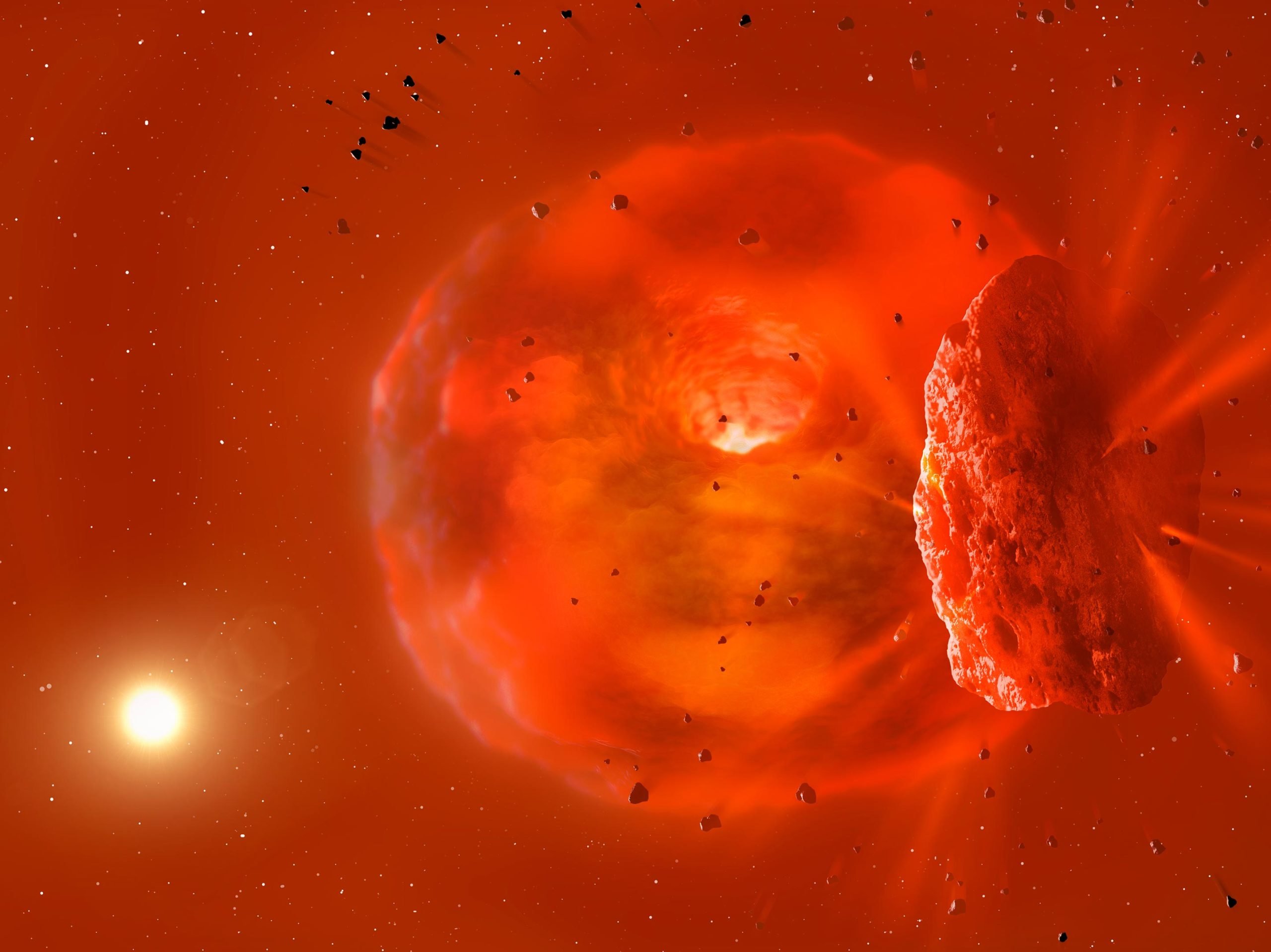
Researchers have discovered evidence of a colossal exoplanet collision, marked by a glowing cloud of gas and dust, through observations of a young star’s unusual brightness fluctuations.
A cosmic cloud, glowing with an unusual luminosity, has unveiled the aftermath of a cataclysmic collision in the cosmos. This discovery provides compelling evidence of the dynamic and sometimes violent nature of our universe.
Key Facts
Even within our own solar system, scientists have seen evidence of giant, planetary collisions from long ago. Remaining clues like Uranus’ tilt and the existence of Earth’s moon point to times in our distant history when the planets in our stellar neighborhood slammed together, forever changing their shape and place in orbit. Scientists looking outside our solar system to far-off exoplanets can spot similar evidence that, across the universe, planets sometimes crash. In this new study, the evidence of such an impact comes from a cloud of dust and gas with a strange, fluctuating luminosity.
Observational Details
Scientists were observing a young (300-million-year-old) Sun-like star when they noticed something odd: the star suddenly and significantly dipped in brightness. A team of researchers looked a little closer and they found that, just before this dip, the star displayed a sudden spike in infrared luminosity.
In studying the star, the team found that this luminosity lasted for 1,000 days. But 2.5 years into this bright event, the star was unexpectedly eclipsed by something, causing the sudden dip in brightness. This eclipse endured for 500 days.
The team investigated further and found that the culprit behind both the spike in luminosity and the eclipse was a giant, glowing cloud of gas and dust. And the most likely reason for the sudden, eclipse-causing cloud? A cosmic collision between two exoplanets, one of which likely contained ice, the researchers think.
In a new study detailing these events, scientists suggest that two giant exoplanets anywhere from several to tens of Earth masses crashed into one another, creating both the infrared spike and the cloud. A crash like this would completely liquify the two planets, leaving behind a single molten core surrounded by a cloud of gas, hot rock, and dust.
After the crash, this cloud, still holding the hot, glowing remnant of the collision, continued to orbit the star, eventually moving in front of and eclipsing the star.
Fun Facts and Future Research
This study was conducted using archival data from NASA’s now-retired WISE mission – the spacecraft continues to operate under the name NEOWISE. This star was first detected
in 2021 by the ground-based robotic survey ASAS-SN (All-Sky Automated Survey for Supernovae).
While this data revealed remnants of this planetary collision, the glow of this crash should still be visible to telescopes like NASA’s James Webb Space Telescope. In fact, the research team behind this study is already putting together proposals to observe the system with Webb.
The study, “A planetary collision afterglow and transit of the resultant debris cloud,” was published in Nature by lead author Matthew Kenworthy alongside 21 co-authors.
Reference: “A planetary collision afterglow and transit of the resultant debris cloud” by Matthew Kenworthy, Simon Lock, Grant Kennedy, Richelle van Capelleveen, Eric Mamajek, Ludmila Carone, Franz-Josef Hambsch, Joseph Masiero, Amy Mainzer, J. Davy Kirkpatrick, Edward Gomez, Zoë Leinhardt, Jingyao Dou, Pavan Tanna, Arttu Sainio, Hamish Barker, Stéphane Charbonnel, Olivier Garde, Pascal Le Dû, Lionel Mulato, Thomas Petit and Michael Rizzo Smith, 11 October 2023, Nature.
DOI: 10.1038/s41586-023-06573-9
Never miss a breakthrough: Join the SciTechDaily newsletter.
Follow us on Google and Google News.
1 Comment
Good Info