

Close Menu
    Facebook X (Twitter) Instagram
    SciTechDaily
    • Biology
    • Chemistry
    • Earth
    • Health
    • Physics
    • Science
    • Space
    • Technology
    Facebook X (Twitter) Pinterest YouTube RSS
    SciTechDaily
    Home»Technology»Chinese Scientists Unveil Secrets of Bright-Dark Exciton Transition in a Semiconductor Material
    Technology

    Chinese Scientists Unveil Secrets of Bright-Dark Exciton Transition in a Semiconductor Material

    By University of Science and Technology of ChinaFebruary 19, 2024No Comments3 Mins Read
    Facebook Twitter Pinterest Telegram LinkedIn WhatsApp Email Reddit
    Share
    Facebook Twitter LinkedIn Pinterest Telegram Email Reddit
    2D Semiconductor Circuit Concept Art
    Researchers have discovered a faster-than-expected transition from bright to dark excitons in anatase TiO2, providing new insights into semiconductor excitonic dynamics that could inform the design of future light-based devices and energy materials.

    A collaborative study conducted by Prof. Zhao Jin, Associate Prof. Zheng Qijing from the University of Science and Technology of China (USTC), and Prof. Hrvoje Petek from the University of Pittsburgh, has revealed the mechanisms behind the transition of bright-dark excitons in anatase TiO2. Their findings have been published in Proceedings of the National Academy of Sciences.

    Understanding Excitons

    Excitons, quasi-particles formed by the binding of electrons and holes in condensed matter systems via Coulomb interaction, exhibit distinct properties as bright and dark excitons. While bright excitons directly couple with light and play a pivotal role in light absorption, dark excitons, with their relatively longer lifetimes, hold significance in quantum information processing, Bose-Einstein condensation, and light-energy harvesting.

    Insights into Exciton Dynamics

    This study, with the help of GW plus the real-time Bethe–Salpeter equation combined with the nonadiabatic molecular dynamics (GW + rtBSE- NAMD), explored the formation dynamics on how the optically excited bright to the strongly bound momentum-forbidden dark excitons in anatase TiO2, a semiconductor material renowned for its exceptional light absorption capabilities and its ability to activate bright excitons under light excitation. In the meantime, due to the material’s indirect band gap nature, bright excitons ultimately relax to the band edges, forming dark excitons.
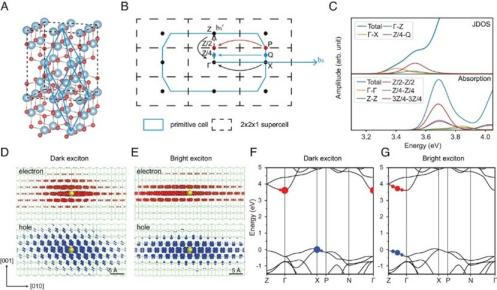
    The Atomic Structure, Brillouin Zone, Absorption Spectrum, and Wave Function Distributions of Direct and Indirect Excitons
    The atomic structure, Brillouin zone, absorption spectrum, and wave function distributions of direct and indirect excitons in a 2 × 2 × 1 supercell of anatase TiO2. Credit: USTC

    The bright-dark exciton transition exhibited a novel pathway upon considering many-body effects within the excitons—the interaction between electrons and holes. This revelation unveiled an extended timescale for the transition process, where bright excitons transform into dark excitons within approximately 100 femtoseconds, several times faster than previously understood. Crucially, the many-body effects within excitons played a pivotal role during this transition.

    This study sheds light on how semiconductor materials’ excitonic dynamics are affected by many-body interactions, offering crucial insights for designing light-based devices and energy materials. It also exemplifies the collaborative efforts and innovative computational approaches in unraveling the intricate dynamics of excitons, paving the way for advancements in material science and technology.

    Reference: “Ultrafast many-body bright–dark exciton transition in anatase TiO2” by Aolei Wang, Xiang Jiang, Qijing Zheng, Hrvoje Petek and Jin Zhao, 13 November 2023, Proceedings of the National Academy of Sciences.
    DOI: 10.1073/pnas.2307671120

    Never miss a breakthrough: Join the SciTechDaily newsletter.
    Follow us on Google and Google News.

    Semiconductors University of Science and Technology of China
    Share. Facebook Twitter Pinterest LinkedIn Email Reddit

    Related Articles

    Light-Emitting Diode and Photodetector for Silicon CMOS Chips

    Gallium Nitride Electronics Poised to Drastically Cut Energy Usage

    Researchers Create World’s Fastest Organic Transistor

    Printing Innovation Improves Organic Semiconductor Efficiency 10-Fold

    Producing Semiconductors From Graphene

    Designing Circuits Containing CNTs for Highly Energy-Efficient Computing

    Bismuth-Antimony Material Shares Graphene’s Unusual Properties

    Analyzing the Environmental Costs and Impacts of Technology

    Using Lasers to Cool Semiconductors

    Leave A Reply Cancel Reply

    • Facebook
    • Twitter
    • Pinterest
    • YouTube

    Don't Miss a Discovery

    Subscribe for the Latest in Science & Tech!

    Trending News

    Popular Supplement Ingredient Linked to Shorter Lifespan in Men

    Scientists May Have Found a Way To Repair Nerve Damage in Multiple Sclerosis

    “Totally Unexpected” – Scientists Discover Pancreatic Cancer’s Fatal Addiction

    A Strange Quantum Effect May Explain One of Biology’s Greatest Mysteries

    James Webb Telescope Reveals the Universe’s Hidden Cosmic Web in Stunning Detail

    Scientists Identify Simple Supplement That Greatly Reduces Alzheimer’s Damage

    You May Have a Dangerous Type of Cholesterol Even if Your Tests Look Normal

    Your Blood Pressure Reading Could Be Wrong Because of One Simple Mistake

    Follow SciTechDaily
    • Facebook
    • Twitter
    • YouTube
    • Pinterest
    • Newsletter
    • RSS
    SciTech News
    • Biology News
    • Chemistry News
    • Earth News
    • Health News
    • Physics News
    • Science News
    • Space News
    • Technology News
    Recent Posts
    • NASA’s New AI Processor Is 500x Faster Than Current Space Computers
    • Scientists Find Evidence Earth Is Drifting Through the Ashes of an Exploded Star
    • This Strange Molecular Signature May Be the Best Clue Yet to Alien Life
    • Scientists Say a 40-Year-Old Childhood Obesity Warning May Be Completely Wrong
    • Marijuana Use May Raise Lung Cancer Risk, Researchers Warn
    Copyright © 1998 - 2026 SciTechDaily. All Rights Reserved.
    • Science News
    • About
    • Contact
    • Editorial Board
    • Privacy Policy
    • Terms of Use

    Type above and press Enter to search. Press Esc to cancel.