
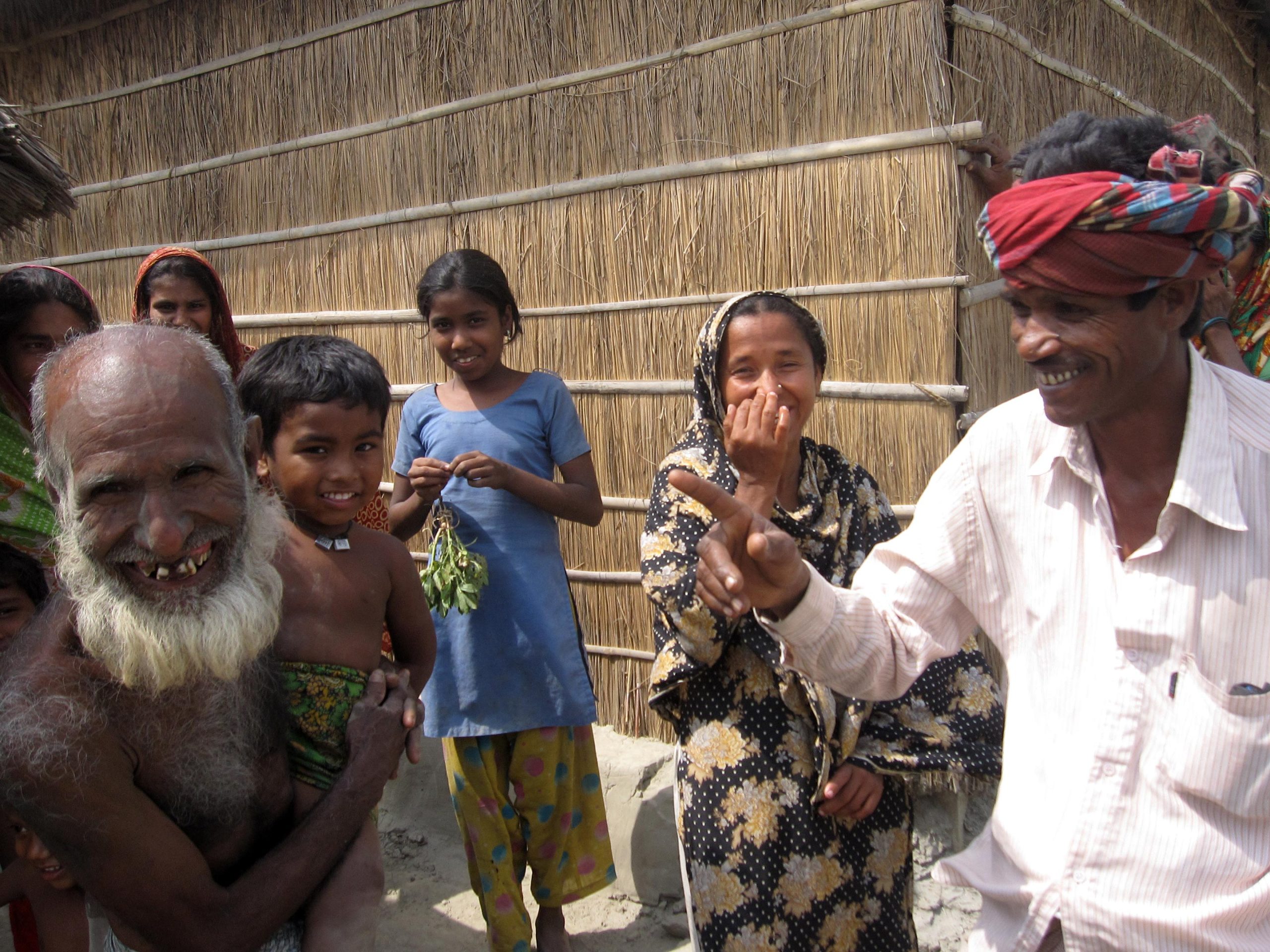
In 2020, mortality climbed worldwide, but dropped in rural Bangladesh.
Geochemist Lex van Geen works at the intersection of public health and environmental risks. His research on natural arsenic contamination in groundwater has alerted the world community to this insidious danger over two decades.
Van Geen, based at Columbia University’s Lamont-Doherty Earth Observatory, was continuing this work in Bangladesh in early 2020 in collaboration with economist Prabhat Barnwal of Michigan State University. The research was aimed at comparing the effectiveness of various ways of telling residents about the outcomes of well tests for arsenic, in order to reduce their exposure. Starting in January 2020, Van Geen worked with a team of professional enumerators assembled by Innovations for Poverty Action, Bangladesh, to survey 16,054 households across 135 rural villages.
On March 23, the team had to put the fieldwork on pause, when Bangladesh went on pandemic lockdown. But the wealth of already gathered demographic information gave Van Geen and his colleagues an idea. Instead of studying arsenic, they decided to leverage the data to mount an exhaustive study of COVID-19 mortality in the same 135 villages.
Van Geen and his colleagues wanted to find out if the relatively low number of officially reported COVID-19 deaths in rural Bangladesh in 2020 could have been the result of massive under-counting. To find out, his team, working remotely, called each home and family to ask a series of survey questions that allowed them to find out if and how the pandemic had touched these households. In order to contact so many households, the survey team ran the equivalent of a call center with 50-plus enumerators.
What they found, as just reported in the American Medical Association journal JAMA Network Open, was surprising.

“We anticipated a big increase in COVID mortality, like we learned to expect [from reports from the rest of the world]. For example, mortality in the United States was up on the order of 20 percent higher in 2020, which is huge,” said Van Geen.
That is not what they discovered. Instead, of the 11,256 households they were able to reach, there were 276 deaths between February and the end of October 2020 —slightly below the 289 deaths reported in these villages over the same pre-pandemic months in 2019.
“For reasons that deserve further study, it does not appear that COVID-19 had an impact on mortality in rural Bangladesh in 2020 anywhere close to that of the pandemic in many other countries,” concludes the study. In fact, according to separate Bangladesh government data, the death rate fell slightly, even as it shot up in urban Bangladesh by about 10 percent.
Jeffrey Shaman, a professor in the Department of Environmental Health Sciences and director of the Climate and Health Program at the Columbia University Mailman School of Public Health, studies the survival, transmission, and ecology of infectious agents. He said Van Geen’s study has significant lessons to teach about COVID’s ability to spread, and invites more study.
“The idea of an area of Bangladesh not having the 2020 outbreak is not exclusively a purview of Bangladesh. There are other places that managed to cap this,” he said. Shaman noted that Vietnam, a country with a population of 98 million people, reported just 35 COVID deaths and fewer than 3,000 cases in 2020.
“The question really is, what did they do right? Did they get lucky? Those are the things you’d want to know from a public health perspective to inform what to do next,” said Shaman. “Why has this area [of Bangladesh] been spared during this time period, so much so they even had the benefits of reduced mortality?”
“It’s not that people didn’t die of COVID. Mortality in rural Bangladesh has increased in 2021, according to anecdotal reports,” said Van Geen. “Maybe the Delta variant spread more in rural areas during that second year,” he said. “[We] were worried in 2020 that there might be massive under-reporting. If there was under-reporting, it wasn’t from the countryside, because we have the data.”
Shaman says the data open an opportunity to do further research, especially if the Delta variant has indeed caused a confirmed increase in COVID mortality in this region. “It would seem that either they were unable to maintain that level of control they managed in 2020, or Delta was just too aggressive to keep it out,” said Shaman.
Reference: “Assessment of Excess Mortality and Household Income in Rural Bangladesh During the COVID-19 Pandemic in 2020” by Prabhat Barnwal, Yuling Yao, Yiqian Wang, Nishat Akter Juy, Shabib Raihan, Mohammad Ashraful Haque and Alexander van Geen, 15 November 2021, JAMA Network Open.
DOI: 10.1001/jamanetworkopen.2021.32777
Never miss a breakthrough: Join the SciTechDaily newsletter.
Follow us on Google and Google News.
3 Comments
While the MSM condemns the use of ivermectin, the most populated state in India just declared they are officially COVID free after promoting widespread use of the safe, proven medicine. In addition to this, Ivermectin attaches to covid spikes and prevents them from binding to ACE2. Get Ivermectin while you still can https://ivmpharmacy.com
https://news.yahoo.com/scientists-mystified-wary-africa-avoids-074905034.html
Perhaps the prevalence of arsenic in the drinking water plays a role. It is interesting that there are so many claims of potentially toxic chemicals that, given in low doses, supposedly have a therapeutic effect. There are something like three-dozen drugs that have been approved for human use for a wide variety of pathologies, which have shown efficacy in vitro. There doesn’t seem to be any common mechanism for killing the virus.
There is a theory called hormesis that basically says that anything that is perceived by the body as a potential threat, challenges and strengthens the natural immune system. Also, living in an unhygienic environment, such as where poverty is rife and there are large numbers of livestock, will remove those with weak immune systems from the gene pool. That may be responsible for what is claimed to have happened in India.
https://en.wikipedia.org/wiki/Hormesis