
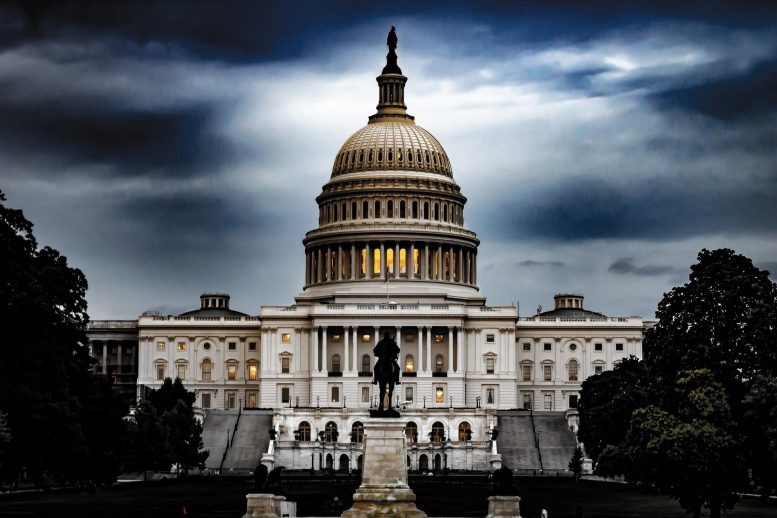
Researchers in Poland found that people’s political views, especially liberal stances, were more predictive of blaming the government for COVID-19 than mental health factors.
In a time of a global crisis such as the ongoing COVID-19 pandemic, it is easy to note how people move through different phases to buckle up for such unprecedented and arduous times.
At the very beginning of the pandemic last year, we observed “an epidemic of fear,” where it was all about the calamitous nature of a totally unknown virus and its worrying contagiousness and mortality rate. A few months later, with lockdown and restrictions already in place across the world, the fear was replaced by “an epidemic of explanations,” where people even in their naivety, started to seek a sense of comfort by placing the blame on someone or something out of their control.
This is why a research team at the SWPS University of Social Sciences and Humanities and the Polish Academy of Sciences sought to figure out whether the government was indeed the main culprit for the spread of the COVID-19 pandemic in the eyes of the public. After all, it fitted best the role of an actor of higher authority, allegedly powerful enough to protect the community and resolve the issue at hand and provide the necessary comfort. In the meantime, it comes as an easy target to point a finger at for “not doing enough.” On the other hand, the public could as well be explaining the situation with the virulence of the Coronavirus or with the irresponsible behavior of others in the society. Regardless of the answer, the team was interested in understanding what’s behind one’s reasoning: was it their political views, well-being, or emotions?
To test their hypotheses, the researchers chose to conduct their study in Poland: a country currently politically divided between Liberalism and Communitarianism, with the latter being the ruling party at the time of the survey, which took place between May and June 2020. A total of 850 Polish adults fully diversified in terms of gender, age, and education participated. The findings are now published in the open-access, peer-reviewed scientific journal Social Psychological Bulletin.
Politics Drives Perceptions
As a result, the study concluded that not only was it the government and the system that most of the participants attributed responsibility to for the COVID-19 incidence rates, but that the political views and party preferences of the participants played an incomparably more significant role in their responses than factors such as anxiety, stress, and depression levels or overall self-reported well-being. In fact, amongst the mental health symptoms, the study found that only increased anxiety was statistically significantly related to the tendency to blame the government and its decisions. This could be explained by the fact that people experiencing higher anxiety levels are more likely to exaggerate external responsibility, note the scientists. Curiously, the more educated participants were found to be more likely to emphasize governmental responsibility.
Furthermore, the people with liberal views who did not support the ruling communitarian party blamed the government to a higher degree than their counterparts, who would often place the responsibility for the spread of COVID-19 on non-governmental factors.
In their study, the research team uses several theories to explain this finding, including the Terror Management Theory, which notes that reminding people of their mortality induces an existential threat that also leads to an increased need for protection provided by worldview-based beliefs. On the other hand, the theories of attribution and social roles suggest that people see the ‘adequate protection against epidemic’ as part of the government’s duties.
A Universal Pattern in Crisis Response
In conclusion, the authors remind that their observations during the survey are consistent with previous reports as a result of natural disasters.
“Citizens observe governmental activities during the epidemic period and evaluate government responsibility. In light of the results of previous studies on the social perception of natural disasters, we think that this is a rather general phenomenon. Looking for an explanation of the epidemic effects, people tend to blame salient external causes,” say the researchers.
Reference: “Under or Out of Government Control? The Effects of Individual Mental Health and Political Views on the Attribution of Responsibility for COVID-19 Incidence Rates” by Krystyna Skarżyńska, Beata Urbańska and Piotr Radkiewicz, 30 March 2021, Social Psychological Bulletin.
DOI: 10.32872/spb.4395
Never miss a breakthrough: Join the SciTechDaily newsletter.
Follow us on Google and Google News.
2 Comments
A complicit 5th Estate; panic makes news and sells advertising.
And any medical professional who questioned “why are we not trying other forms of treatment” were ostracized and “cancelled”. Media lied and people died.
China