

Your chances of catching a cold—and how miserable it feels—may depend more on your body than on the virus itself.
When rhinovirus, the leading cause of the common cold, infects the lining of the nose, cells in the nasal passages immediately begin working together to defend against it. These cells activate a broad range of antiviral responses designed to limit infection. In a study published today (January 19) in the Cell Press journal Cell Press Blue, researchers show that this coordinated cellular defense plays a major role in whether a person gets sick at all and how severe their symptoms become. The findings suggest that the body’s reaction to rhinovirus, rather than the virus alone, is often what determines the outcome of infection.
“As the number one cause of common colds and a major cause of breathing problems in people with asthma and other chronic lung conditions, rhinoviruses are very important in human health,” says senior author Ellen Foxman of Yale School of Medicine. “This research allowed us to peer into the human nasal lining and see what is happening during rhinovirus infections at both the cellular and molecular levels.”
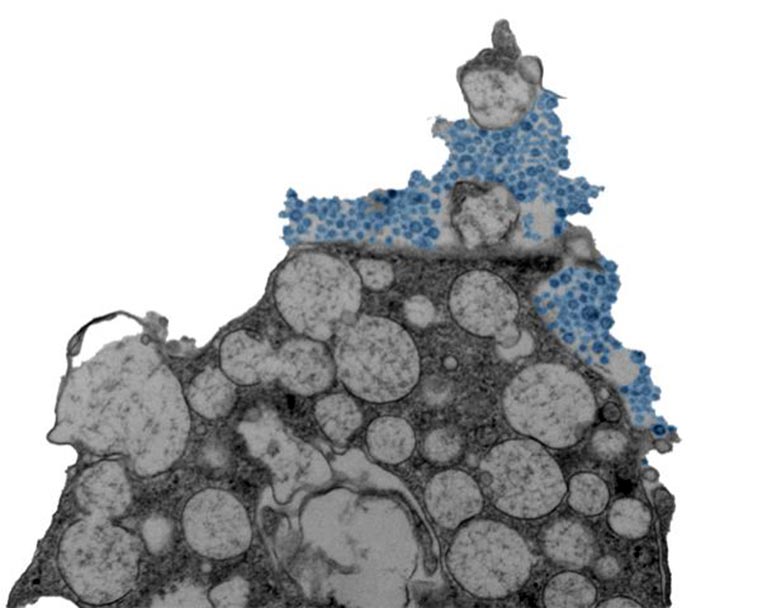
Building a Human Model of the Nasal Lining
To closely study these early defenses, the research team grew human nasal tissue in the lab. They cultured nasal stem cells for four weeks while exposing the upper surface to air. This process encouraged the cells to develop into a complex tissue that closely resembles the lining of human nasal passages and lung airways. The resulting tissue included mucus-producing cells as well as cells with cilia, which are tiny hair-like structures that help move mucus out of the lungs.
“This model reflects the responses of the human body much more accurately than the conventional cell lines used for virology research,” Foxman says. “Since rhinovirus causes illness in humans but not other animals, organotypic models of human tissues are particularly valuable for studying this virus.”
Interferons and Early Antiviral Defense
Using this lab-grown tissue, the scientists were able to observe how thousands of individual cells respond at the same time. They also tested what happens when the cellular sensors that recognize rhinovirus are blocked. These experiments revealed a powerful protective system driven by interferons, which are proteins that prevent viruses from entering cells and making copies of themselves.
When nasal cells detect rhinovirus, they release interferons that activate antiviral defenses both in infected cells and in nearby healthy cells. This coordinated response creates an environment that is hostile to viral spread. If interferon activity begins quickly, the virus is often stopped before it can spread further. When researchers experimentally shut down this response, rhinovirus spread rapidly through the tissue, damaging cells and, in some cases, killing the infected organoids.
“Our experiments show how critical and effective a rapid interferon response is in controlling rhinovirus infection, even without any cells of the immune system present,” says first author Bao Wang of Yale School of Medicine.

When the Defense Response Goes Too Far
The study also identified additional responses that emerge when viral replication increases. In these situations, rhinovirus can activate a separate sensing pathway that leads both infected and uninfected cells to collectively produce large amounts of mucus and inflammatory signals. This reaction can contribute to airway inflammation and, in some cases, breathing difficulties. According to the researchers, these pathways may offer promising targets for treatments that reduce harmful symptoms while preserving protective antiviral responses.
Limits of the Model and Next Steps
The researchers note that their organoid system does not include all the cell types found in the human body. During real infections, additional cells, including immune cells, are drawn to the site to help fight the virus. Understanding how these cells and other environmental factors in the nasal passages and airways influence the body’s response to rhinovirus will be an important focus of future studies.
“Our study advances the paradigm that the body’s responses to a virus, rather than the properties inherent to the virus itself, are hugely important in determining whether or not a virus will cause illness and how severe the illness will be,” Foxman says. “Targeting defense mechanisms is an exciting avenue for novel therapeutics.”
Reference: “Rhinovirus triggers distinct host responses through differential engagement of epithelial innate immune signaling” by Bao Wang, Julien A.R. Amat, Valia T. Mihaylova, Yong Kong, Guilin Wang and Ellen F. Foxman, 19 January 2026, Cell Press Blue.
DOI: 10.1016/j.cpblue.2025.100001
This study was supported by funding from the Yale Colton Center for Autoimmunity, the Rita Allen Foundation, and the China Scholarship Council Yale World Scholars Fellowship.
Never miss a breakthrough: Join the SciTechDaily newsletter.
Follow us on Google and Google News.
1 Comment
I’m so glad they did this research using lab grown tissue instead of animals! Yay! Good job, people.