
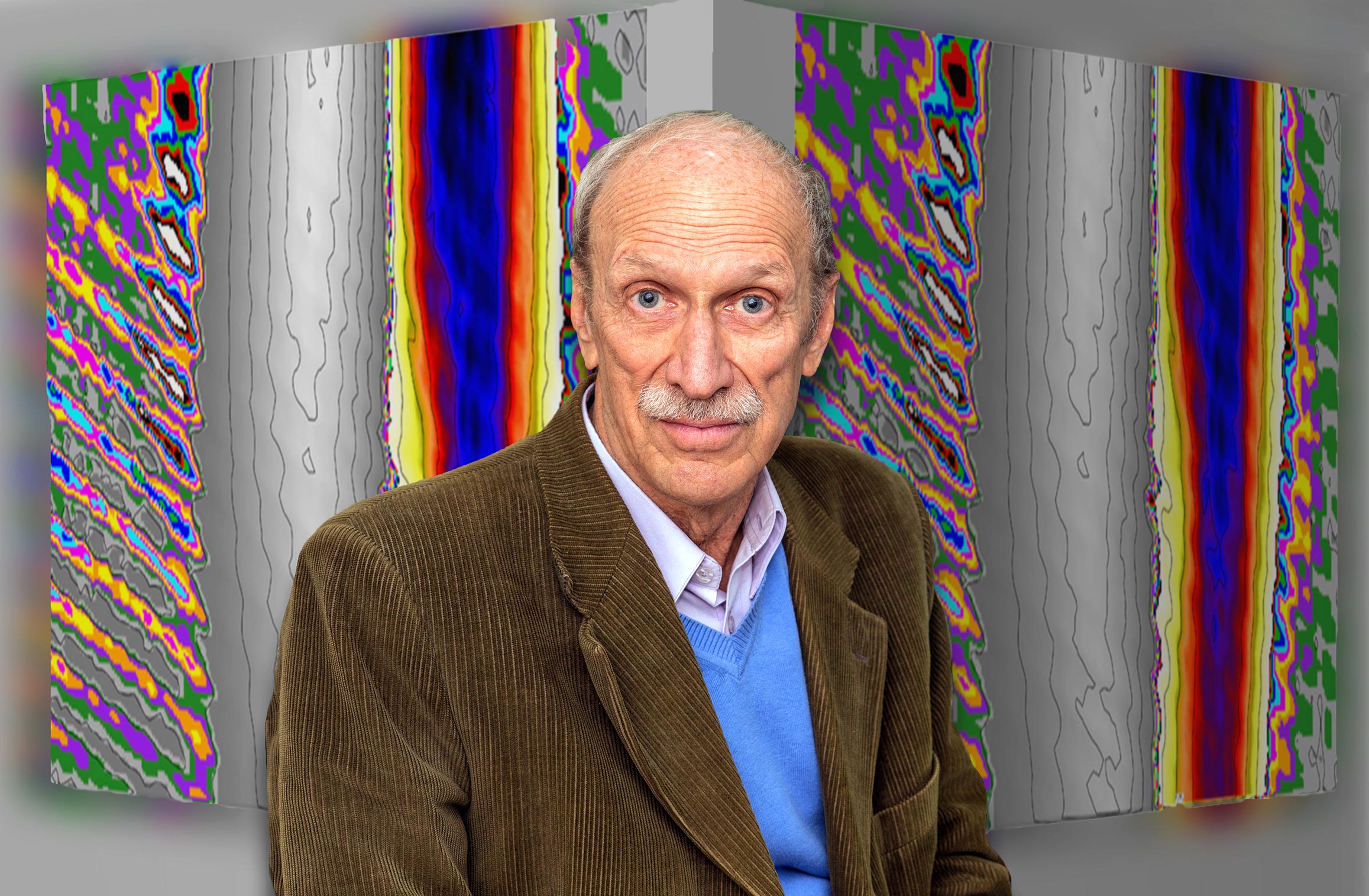
Scientists at the U.S. Department of Energy’s (DOE) Princeton Plasma Physics Laboratory (PPPL) have furthered understanding of a barrier that can prevent doughnut-shaped fusion facilities known as tokamaks from operating at high efficiency by causing vital heat to be lost from them.
Led by PPPL physicist Roscoe White, the research team used computers to simulate a type of plasma movement that can bump highly energetic particles from the core to the edge, a phenomenon that could occur in ITER, the multinational tokamak being built in France to demonstrate the feasibility of fusion as an energy source.
“For any fusion device to work, you need to make sure that the highly energetic particles within it are very well confined within the plasma core,” said PPPL physicist Vinícius Duarte, a member of the research team that reported the results in Physics of Plasmas. “If those particles drift to the edge of the plasma, you can’t sustain the steady-state burning plasma needed to make fusion-powered electricity a reality.”
Duarte refers to a phenomenon called “chirping” that occurs when the frequency of the waves of plasma that interact with highly energetic particles changes suddenly, ultimately causing energy to escape from the plasma core and produce rapidly changing tones. The new findings, which elucidate aspects of how chirping forms in a tokamak, could help researchers figure out how to thwart the chirps and keep in the vital heat. Preventing the sudden frequency changes could also protect the tokamak walls from the sudden release of concentrated and damaging bursts of energy.
Fusion combines light elements in the form of plasma — the hot, charged state of matter composed of free electrons and atomic nuclei — and generates massive amounts of energy in the stars. Scientists aim to replicate fusion in devices on Earth for a virtually inexhaustible supply of safe and clean power to generate electricity.
The researchers used computer simulations showing highly detailed views of the movement of plasma particle conglomerations to reveal some of the mechanisms responsible for chirping, giving hope that scientists can find ways to ameliorate its effects. Scientists used the PPPL code ORBIT to calculate how the position and velocity of plasma particles change over time in three dimensions. The simulations showed that chirping begins when fast-moving particles in the core interact with waves undulating through the plasma and spontaneously form clumps that migrate to the plasma edge. The findings confirm earlier results based on simplified tokamak configurations; they also reveal richer and more complex dynamics not seen before.
This interaction with plasma particles causes the frequency of the so-called plasma Alfvén waves to simultaneously rise and drop, catapulting the clumps out toward the plasma edge and sometimes into the wall. “The tools developed in this research have enabled a glimpse into the complicated, self-organized dynamics of the chirps in a tokamak,” Duarte said.
The scientists had to create new virtual tools to observe the movement of the simulated waves with the needed detail. “The hardest thing was inventing the diagnostics that would cleanly show what was going on,” said White. “In a certain sense, it’s like building a microscope that will let you view what you need to view.”
The new findings continue a long-standing effort by members of the PPPL Theory Department that focuses on understanding chirping, especially within PPPL’s National Spherical Tokamak Experiment-Upgrade (NSTX-U). “If you understand it,” says White, “you can find ways to operate fusion facilities without it.”
Reference: “Phase-space dynamics of Alfvén mode chirping” by R. B. White, V. N. Duarte, N. N. Gorelenkov, E. D. Fredrickson and M. Podesta, 28 May 2020, Physics of Plasmas.
DOI: 10.1063/5.0004610
This research was supported by the DOE’s Office of Science.
Never miss a breakthrough: Join the SciTechDaily newsletter.
Follow us on Google and Google News.