

The study analyzes the spatial distribution patterns of “grazing halos” surrounding coral reefs.
Around the world, coral reefs are often surrounded by noticeable bands of bare sand that appear clearly in satellite images, but the reason behind these patterns remains a mystery.
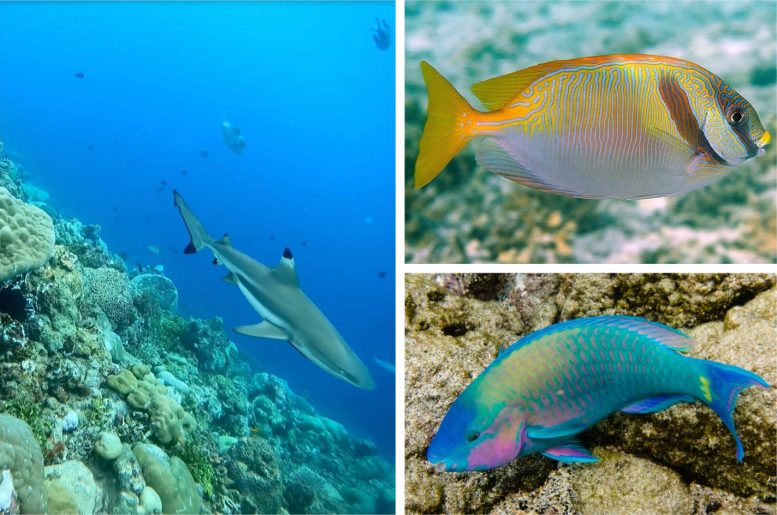
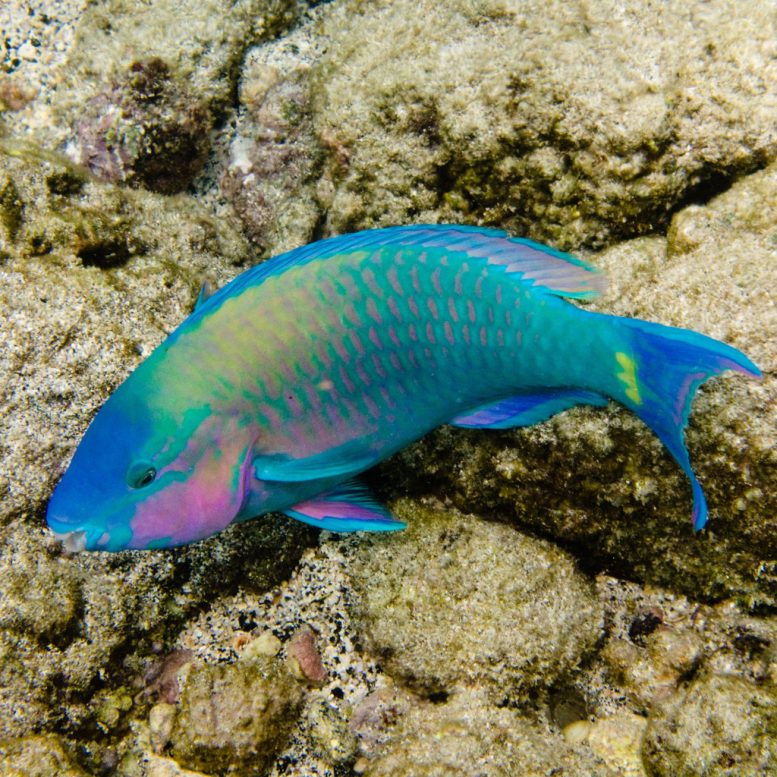
One hypothesis is fear. Herbivorous fish like parrotfish leave the safety of the reef to feed on algae and seagrass, but their fear of predators may prevent them from venturing too far. This cautious foraging behavior may create what are called “grazing halos”—circular bands where vegetation has been eaten away.
Previous research suggests that these halos may reflect the “landscape of fear” theory in ecology, where prey animals change their feeding behavior due to the threat of predation, resulting in distinct patterns where they feel safe enough to eat.
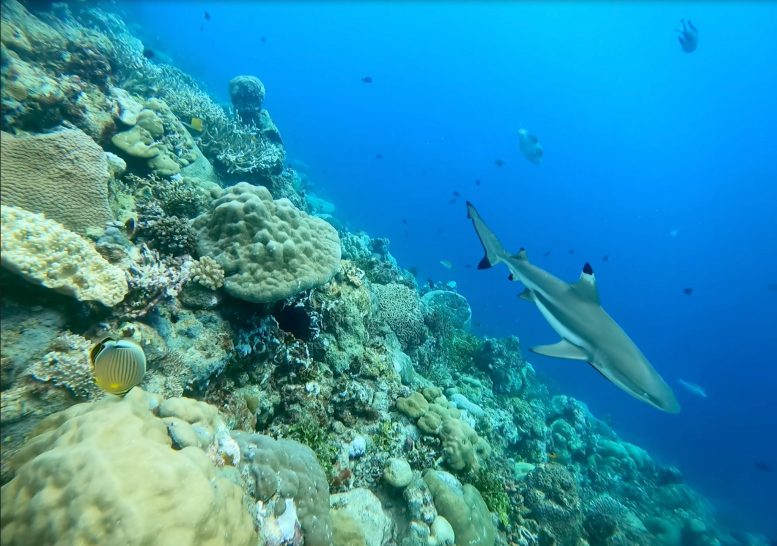
(This particular image of a blacktip reefshark is from the Western Solomon Islands). Credit: Emily Steele/iNaturalist
However, if fear alone causes halos, the researchers questioned why some predator-rich reefs have halos while others do not, and why halos are not wider in areas where overfishing has removed many top predators.
Modeling reef shelter and halo formation
A new study published in The American Naturalist, links grazing halo patterns in coral reefs, as well as those in other patchy habitats, to the spatial patterns of the shelter habitat itself. Given that halos only exist surrounding shelter habitat patches, the team wanted to examine how halos would look where coral are clustered versus dispersed across the seascape. As part of the analysis, the team also set out to determine if the halo patterns could be used to assess how healthy or stressed different reefs are.
They created two mathematical models to study the effect of shelter habitat clustering on halo patterns. Then, they used Heron Island in the Great Barrier Reef off Queensland, Australia, as a case study, applying satellite-imagery data from the coral reef system to test their model.
They selected Heron Island as it has been studied extensively. Plus, climate change is the biggest threat to the Great Barrier Reef due to coral bleaching events, ocean acidification, extreme weather events, and habitat changes.
Halo visibility depends on coral clustering
In the first model, the team demonstrated how simple geometric rules describing how circles overlap determine the amount of vegetation cover expected when habitat patches are clustered or dispersed.
“If the shelter habitat is tightly packed in one space, then there’s not much room for nervous prey to explore and less vegetation to eat,” says lead author Theresa Ong, an assistant professor of environmental studies at Dartmouth. “But if shelter is more evenly distributed, the halos carve out more empty space in the landscape and their distinctive patterns disappear into one another as they overlap.” In other words, it’s harder to see an individual halo if there are many overlapping halos and no vegetation surrounding it.
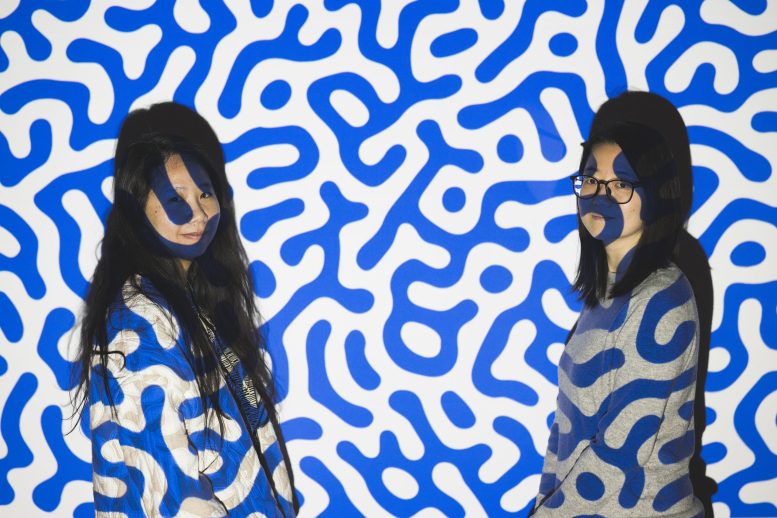
The researchers designed their model to be general, so that it could be applied to any ecosystem where organisms graze near their habitat, such as a herd of cattle that grazes near trees in a pasture.
But that model is static and assumes that grazing remains constant over time, so the researchers developed a second model to examine how the dynamics between herbivores and vegetation may impact the presence and size of the halos.
Dynamic modeling reveals cyclical patterns
The results revealed two scenarios. When the coral patches are dispersed, shelter from predators is also dispersed, which can lead to overgrazing. This, in turn, creates a cyclical system that oscillates between the presence and absence of vegetation. In other words, the halos in a reef may emerge and then disappear but reemerge again in due time.
When coral patches however, are densely clustered, resulting in limited shelter, the halos are more likely to remain stable.
In healthy reefs, predator populations tend to constrain herbivores from grazing but both stable and cyclic halo patterns are possible in these systems.
The authors say that tracking halo patterns over time may be more important than tracking sizes.
The team hypothesized that persistent halos should only really exist where herbivores are highly limited and shelter is clustered. “However, the presence of halos, and the phenomenon of halos appearing and disappearing over time is actually consistent with the landscape of fear theory,” says Ong. “And that could explain why the link between halo widths and reef community health is weak.”
Halos reflect predator-prey dynamics
According to the co-authors the herbivores have to be limited from consuming all of the vegetation by something for static halos to occur; otherwise, fluctuations are likely. They say that this is pretty typical predator-prey dynamics: when herbivores consume everything, there is no food left, and their population will crash, but then the vegetation and herbivores eventually recover, resulting in halos that grow, shrink, and disappear over time. “Oscillating halos are not necessarily a sign of overfishing or poor reef health,” says Ong. “What’s more concerning is if static halos suddenly start cycling or if cyclic halos suddenly become static, which could indicate a major shift in system health and resilience.”
Conducting field research, including in the ocean and at coral reefs, is quite difficult, especially across a large area. Use of the satellite imagery provides researchers with the ability to examine potential research sites at a glance and obtain a rough idea of what’s happening to the health of a reef, which could be really valuable for conservation purposes.
“There are a lot of endemic species on reefs, especially on the Great Barrier Reef, which we could easily lose due to the compounding effects of climate change and overfishing, so gaining a better understanding of how halo patterns reflect reef community dynamics may be useful in reef conservation efforts,” says Ong. “Tracking halos over time may help us keep track of whether predator populations are intact and the reef is healthy.”
Reference: “Seeing Halos: Spatial and Consumer-Resource Constraints to Landscapes of Fear” by Theresa W. Ong, Lisa C. McManus, Vítor V. Vasconcelos, Luojun Yang and Chenyang Su, 2 May 2025, The American Naturalist.
DOI: 10.1086/735688
Never miss a breakthrough: Join the SciTechDaily newsletter.
Follow us on Google and Google News.