
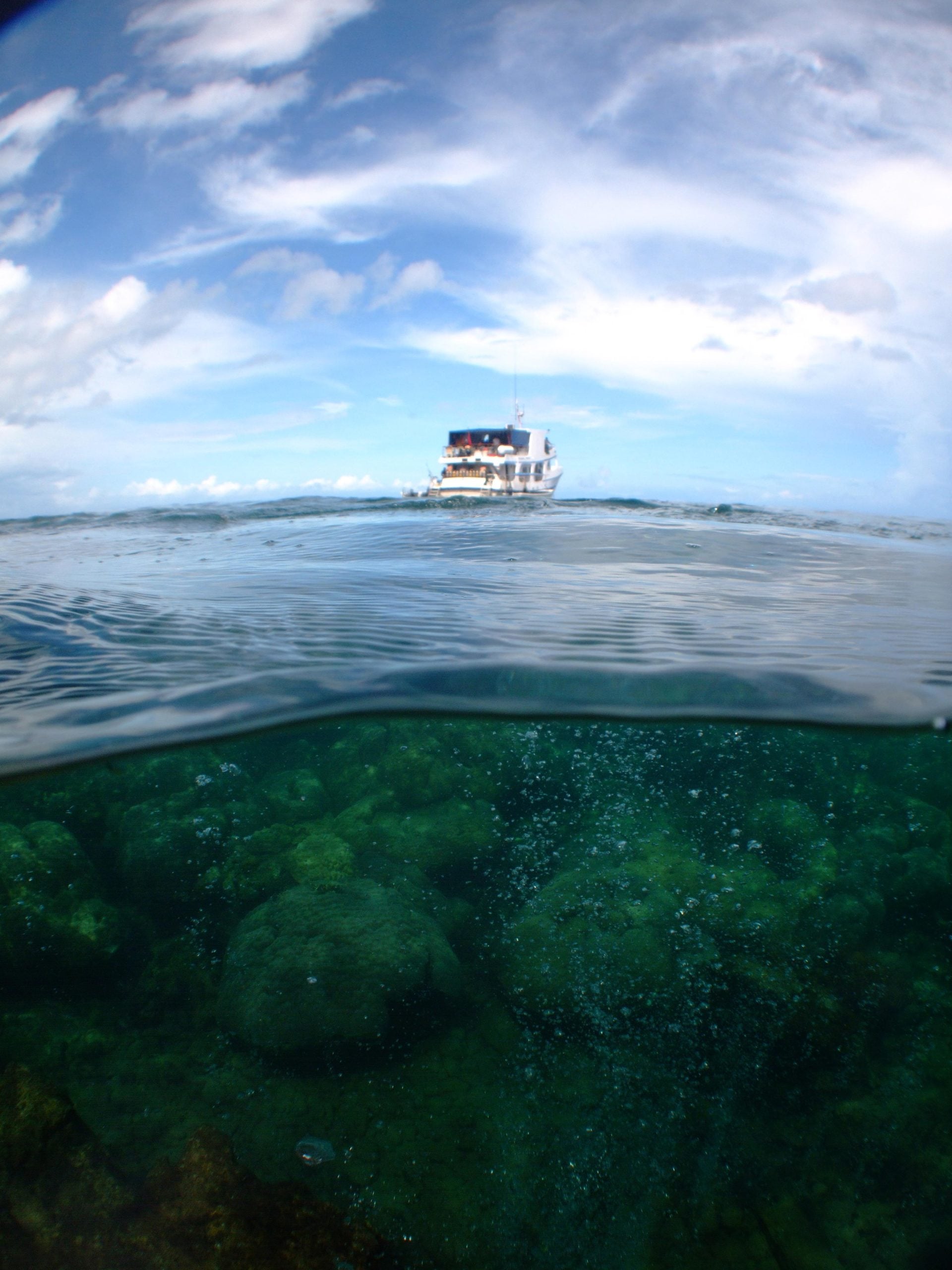
By the year 2100, rising carbon dioxide levels are expected to alter ocean chemistry so severely that coral reef communities in Australia and worldwide will recover more slowly, lose ecological complexity, and become increasingly dominated by fleshy algae.
A new international study released in Communications Biology has examined rare coral reef environments in Papua New Guinea to better understand how ocean acidification may affect coral ecosystems as the climate continues to warm.
As the ocean absorbs carbon dioxide from the air, seawater becomes increasingly acidic, which can slowly erode the limestone that forms coral skeletons. However, experiments in tanks or computer simulations offer only limited insight into how full reef systems might respond over time.
To address this gap, a team led by the Australian Institute of Marine Science (AIMS) investigated entire reef communities located near several of Papua New Guinea’s shallow submarine volcanoes. These sites are naturally exposed to higher CO2 levels because gas escapes from the sea floor, creating conditions similar to those expected in future oceans.
Dr. Katharina Fabricius, a coral researcher at AIMS in Townsville and senior author of the study, explained that the work has identified species capable of surviving long-term exposure to elevated CO2.
“These unique natural laboratories are like a time machine,” said Dr. Fabricius.
“The CO2 seeps have allowed us to study the reefs’ tolerance limits and make predictions. How will coral reefs cope if emissions are in line with the Paris Agreement level emissions? How will they respond to higher CO2 emissions scenarios?”
Origins of a Unique Research Site
In 2000, Dr. Fabricius came across bubbles of gas emerging through coral reefs while surveying species in Milne Bay, about 500 km east of Port Moresby. In 2009, as ocean acidification emerged as an issue, she thought back to that experience, had samples of the gas analyzed, and discovered it was nearly pure CO2.
The scene was set for the creation of a unique living laboratory and a decade-long research program to study how tropical marine ecosystems may adapt and how organisms acclimatize after generations of exposure to high CO2.
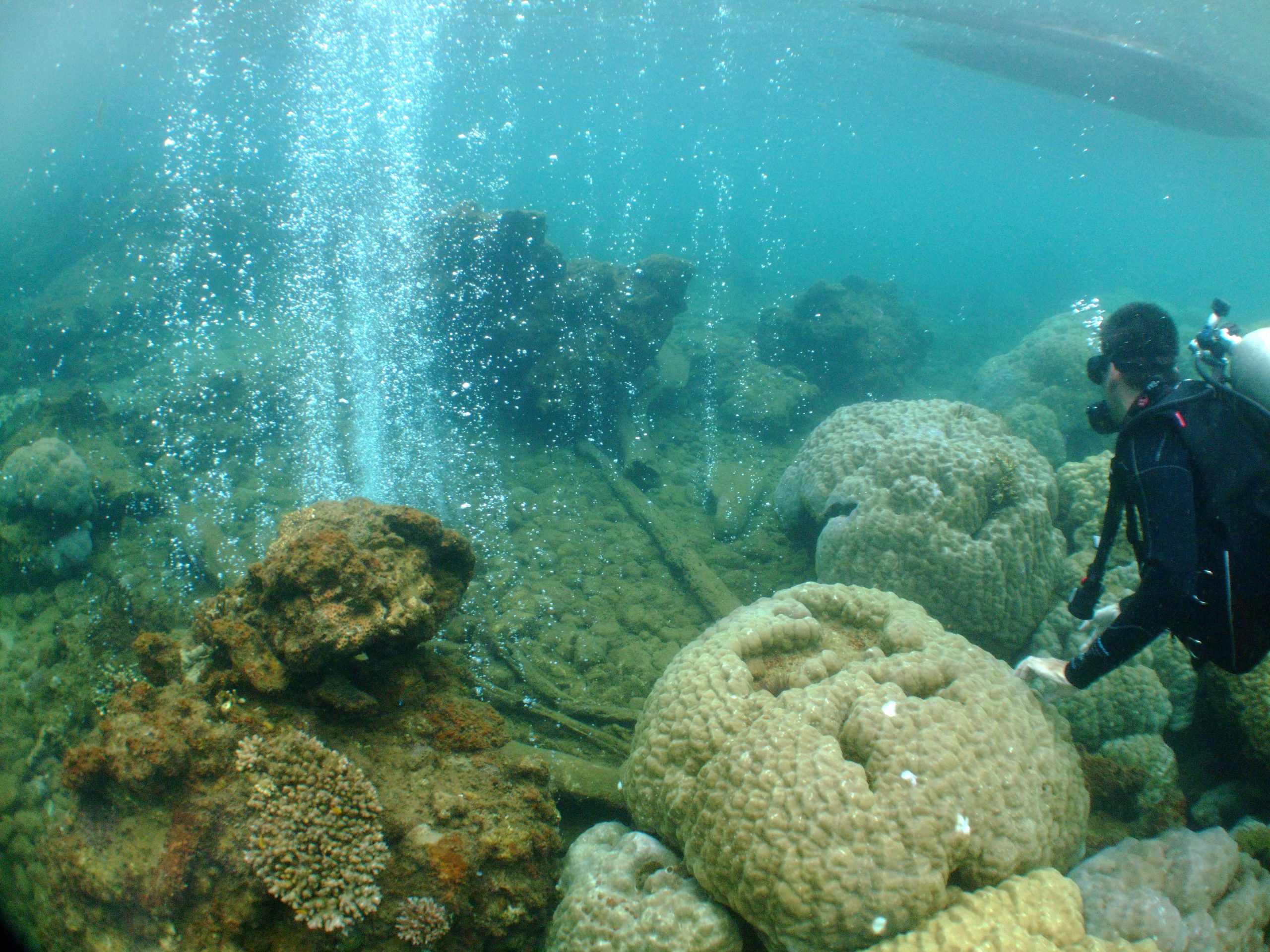
Dr. Sam Noonan, also from AIMS and first author on the paper, said: “These Papua New Guinea reefs are telling us that with every bit of increase in CO2, we will see fewer corals and more fleshy algae. Importantly, we also found far fewer baby corals, which means reefs won’t be able to grow and recover quickly. That has implications for all the species that depend on them, including humans. Many coastal communities depend on fish that start their lives using coral reefs for shelter and food.”
Oceans are slightly alkaline with a pH of 8.0, but their acidity has already increased by 30%. As CO2 emissions rise, the ocean pH is predicted to decline further down to a pH of 7.8 by the year 2100.
A Gradual but Profound Ecological Shift
“By studying organisms at 37 sites along a 500-metre gradient of CO2 exposure, we were able to see what happens as CO2 increases. There was no sudden collapse or tipping point, instead, as the CO2 increased, we saw fleshy algae became dominant, replacing and smothering coral and calciferous algae,” Dr. Fabricius said.
The reefs are hard to reach, requiring a flight into Papua New Guinea, a second to Milne Bay Province, then six hours in a boat.
“The coral reefs in Milne Bay are amazing, and the local people are so welcoming. It was a real privilege to work at their reefs with these volcanic CO2 seeps, which are globally unique,” Dr. Fabricius continued.
“Ocean acidification is a massive global problem, which has been understudied and underreported to date. This research is a first of its kind, presenting unique field data and allowing us to assess how whole communities change in the real world.
“We have observed coral reefs starting to change in response to CO2 gradients in the Great Barrier Reef. The Papua New Guinea reefs tell us what will happen next.
“The more CO2 we emit into the atmosphere, the greater the changes will be to coral reefs and the coastal communities that depend on them. This is on top of the impact of global warming and sea level rise.”
Reference: “Progressive changes in coral reef communities with increasing ocean acidification” by Sam H. C. Noonan, Chico Birrell, Rebecca Fisher and Katharina E. Fabricius, 24 November 2025, Communications Biology.
DOI: 10.1038/s42003-025-08889-w
Never miss a breakthrough: Join the SciTechDaily newsletter.
Follow us on Google and Google News.
3 Comments
This is not science. Science requires observational evidence. This is simply armchair hypothesizing. It’s a bad joke, it’s fear-mongering, and above all it’s nonsense.
“Oceans are slightly alkaline with a pH of 8.0, but their acidity has already increased by 30%. As CO2 emissions rise, the ocean pH is predicted to decline further down to a pH of 7.8 by the year 2100.”
The authors are playing loose with the facts. The last I heard, the average pH of the open oceans was pegged at 8.1, not 8.0. That may not seem like much difference, but on a logarithmic scale it is. That is where their claim of a 30% increase comes from, which incidentally is also inflated. Based on a computer model of questionable accuracy, it is assumed that during pre-industrial times the average pH of the open oceans was 8.2 and has declined 0.1 pH unit to 8.1, which is about a 25% increase (not 30%) in the hydronium ion concentration, which means the water is STILL alkaline! Contrary to what the authors imply, the pH scale is NOT a measure of acidity. It is defined as a metric of the concentration of the hydronium ions, which are inversely related to the hydroxyl ion concentration; if the hydroxyl ions had been used as the basis of the definition, would anybody be talking about ‘alkalinization’ of the seawater? See https://wattsupwiththat.com/2015/09/15/are-the-oceans-becoming-more-acidic/ for an expanded discussion of the issue.
The photograph and discussion above suggest the water column above the PNG seeps is saturated with CO2, meaning no more will go into solution, and it has a pH of ~7.7, which supports the claim by noted Stanford geochemist, who claims in his textbook that because of carbonate/borate buffering, which resists pH change, the oceans are unlikely to EVER reach even neutrality (pH 7) except in deep, anoxic, stagnant pools enriched in hydrogen sulfide. That means we don’t have to worry about the oceans ever becoming acidic, certainly not from anthropogenic emissions. The chemical buffering will resist the so-called ‘acidification’ and never arrive at the pH of an actual inorganic acid. I will be so bold as to suggest that as the concentration of dissolved CO2 increases, the rate of solution will decrease (because it is controlled by the partial pressure difference between the atmosphere and ocean) and the saturation level (~pH 7 .7) will be approached asymptotically. That means, the concentration will be increased so slowly that, like in Zeno’s Paradox, the arrow will never reach the target.
This article, like so many of its ilk, is scare mongering through playing fast and loose with the facts and leaving out inconvenient facts, presumably in the hope of convincing someone holding the strings to the purse that funds grants, to support research. That is a perversion of science where the goal should be expanding knowledge, not scaring bureaucrats into supporting what they think is essential research to avoid an existential crisis.
That should be “… noted Stanford geochemist, Konrad Krauskopf …”