
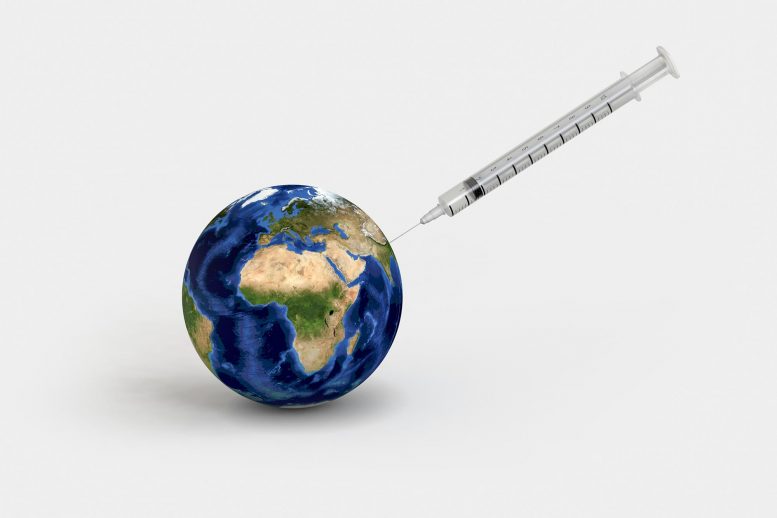
Fair vaccine distribution must prioritize individuals, consider all health impacts, and support global delivery.
Several proposals have emerged on how to distribute the COVID-19 vaccine, but they fall short in ensuring that the vaccine is distributed fairly. A team including Binghamton University professor Nicole Hassoun suggests three ways to more fairly and effectively distribute the vaccine so that people in poor countries get the vaccine as soon as possible.
“Although many people in rich countries will receive a vaccine for COVID-19 this year, many people in poor countries will likely have to wait years to get one,” said Hassoun. “Ethical vaccine allocation requires closing this gap and ensuring that everyone can access a vaccine as soon as possible. We should increase vaccine manufacturing, distribution, and uptake. Rich countries should not get to prioritize their populations first.”
Several proposals have emerged offering guidelines for how to distribute the COVID-19 vaccine fairly. These include the COVID-19 Vaccines Global Access (COVAX) facility, a collaboration that brings together governments, companies, international organizations, and others to accelerate the development and manufacture of COVID-19 vaccines. Currently, COVAX is set up so that in a first phase poor countries can vaccinate 3% of their populations, while rich countries can vaccinate up to 50%. Another sophisticated proposal, the “Fair Priority” model, suggests countries with vaccines contribute to global distribution once their COVID-19 transmission rates drop below 1.
Three Core Principles for Ethical Allocation
However, insofar as the aim is to have the greatest health impact, these proposals fall short, according to Hassoun and her team. They offer three suggestions:
- Proposals for fair distribution must address health problems for individuals. Moreover, since most individuals have little choice as to their country of origin or residence, we should not discriminate against them based on location. A fair proposal cannot allow rich countries to hoard vaccines or prioritize their own populations first. Nor can it give individuals’ less priority simply because they live in a country with less infrastructure, capacity, or willingness to distribute vaccines.
- Allocation principles must explicitly focus on both direct and indirect health effects of COVID-19. Direct health effects include death and disability caused (in full or in part) by the virus. Indirect health effects include death and disability caused (in full or in part) by the social response to the virus.
- Having greatest global health impact requires assisting countries in their vaccine distribution, production, and consumption. A fair allocation system must consider how vaccine distribution will determine the success of whatever strategy is adopted.
“Many proposals for equitable allocation let rich countries prioritize their populations,” said Hassoun. “We must combat this scarcity mindset and expand access rather than just shift resources around.”
Reference: “Just Allocation of COVID-19 Vaccines” by Anders Herlitz, Zohar Lederman, Jennifer Miller, Marc Fleurbaey, Sridhar Venkatapuram, Caesar Atuire, Lisa Eckenwiler and Nicole Hassoun, 15 February 2021, BMJ Global Health.
DOI: 10.1136/bmjgh-2020-004812
Never miss a breakthrough: Join the SciTechDaily newsletter.
Follow us on Google and Google News.
1 Comment
Should the “rich countries” (who developed, and produce; and who’s volunteer’s took the risk of the testing; and who’s people’s taxes funded the research and development of the vaccines) prioritize their own poorer people; or the rich (and often super-rich) elite 3% of the poorer countries?
And who should make that decision?
Ethically “fair” is a nice academic pipe dream; but the reality is that there is no way to fairly decide between two equally at-risk persons, one in a “rich” country and the other in a “poor” one.
Equally, there is no way to guarantee that doses sent third world countries targeted at the high-risk residence will reach the intended recipients and not be diverted to the local elite.