
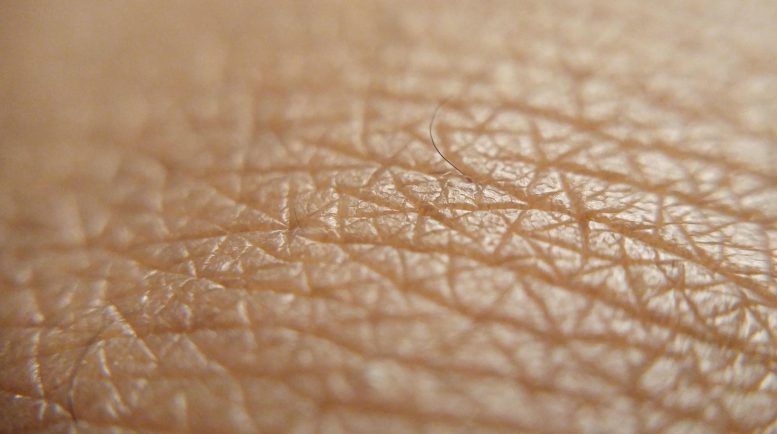
Researchers found that prolonged UV exposure makes skin stiffer by causing collagen fibers to pack more tightly, aligning with aging theories that suggest accumulated molecular bonds lead to dysfunction.
Common belief holds that prolonged exposure to the sun can eventually toughen your skin. Consider the “leathery” skin of farmers, road crew members, and others who spend extensive hours outdoors, or individuals who frequent tanning booths or beaches during the summer.
However, despite these observations, minimal research has been conducted to explain why this happens on a biological level — until now.
A study from Binghamton University researchers recently published in the Journal of the Mechanical Behavior of Biomedical Materials explores how ultraviolet radiation can alter the microstructure of human skin. Particularly affected is collagen, the fibrous protein that binds together tissue, tendon, cartilage, and bone throughout our bodies.
How UV Light Alters Collagen Structure
“We don’t want to put a fear factor in here saying ‘don’t go out in the sun,’” said Binghamton University Associate Professor of Biomedical Engineering Guy German. “But extended periods of time under UV light can toughen up your skin as well as lead to a higher risk of carcinogenic problems.”
Leading the research with German at the Thomas J. Watson College of Engineering and Applied Science’s Department of Biomedical Engineering are Ph.D. student Abraham Ittycheri, Zachary Lipsky, Ph.D. ’21, and Assistant Professor Tracy Hookway.
The new study builds on previous research from German and Lipsky that focused on the outer stratum corneum, which is the top layer of skin. This time, the Binghamton team compared full-thickness skin samples before and after various levels of UV exposure.
“One way to characterize the material characteristics of skin is by conducting a mechanical stretch test on it,” Ittycheri said. “If it stretches very easily, it’s relatively compliant, but if it’s much harder to stretch it, you can characterize it as much stiffer. My experiment was to see what the isolated effects of UV light would be and compare it with a scenario where a skin is not exposed to UV light.”
The researchers found that as the skin absorbed more UV radiation, the collagen fibers in it became more tightly packed together, leading to increased stiffness and tissue that is harder to break. German sees correlations with the cross‐linkage theory of aging, which proposes that the accumulation of undesirable molecular bonds over time can cause cellular dysfunction.
Aging and Cellular Response to UV Damage
Hookway — who won a National Science Foundation CAREER Award earlier this year for her research on cardiac cells — sees similarities between how heart and skin cells deal with damage, even though they have very different functions.
“Our body has this natural response in any tissue when there’s some sort of injury, which likely happens in the stratum corneum,” she said. “First, wherever there’s some sort of weakening, there has to be compensation by some other part of the tissue or else there’ll be catastrophic failure. The same thing happens in the heart when you have a myocardial infarction — you build up a scar and your heart’s going to not work the same way anymore.”
Sometimes, she added, the body’s reaction will keep you alive but isn’t necessarily a good result, possibly leading to other medical issues later. Figuring out the mechanics of how it all happens could allow future doctors to steer the reactions in a healthier direction.
Following this research, further collaborations among Ittycheri, German, and Hookway are already in the works. Our skin is the body’s largest organ and the first line of protection against microbes and other outside attacks, so ways to maintain and even strengthen it are clearly beneficial.
“Any kind of disruption to the normal process of skin is going to be extremely dangerous and detrimental to our overall lifestyle,” Ittycheri said. “That’s not even going into the cosmetic side of things, where a person’s perception about themselves can be challenged when their skin does not look good.”
Reference: “Ultraviolet light induces mechanical and structural changes in full thickness human skin” by Abraham Ittycheri, Zachary W. Lipsky, Tracy A. Hookway and Guy K. German, 6 May 2023, Journal of the Mechanical Behavior of Biomedical Materials.
DOI: 10.1016/j.jmbbm.2023.105880
Never miss a breakthrough: Join the SciTechDaily newsletter.
Follow us on Google and Google News.