
Growing connectedness since 2008 may have deepened social and political divides. More friends could mean more conflict—and less tolerance.
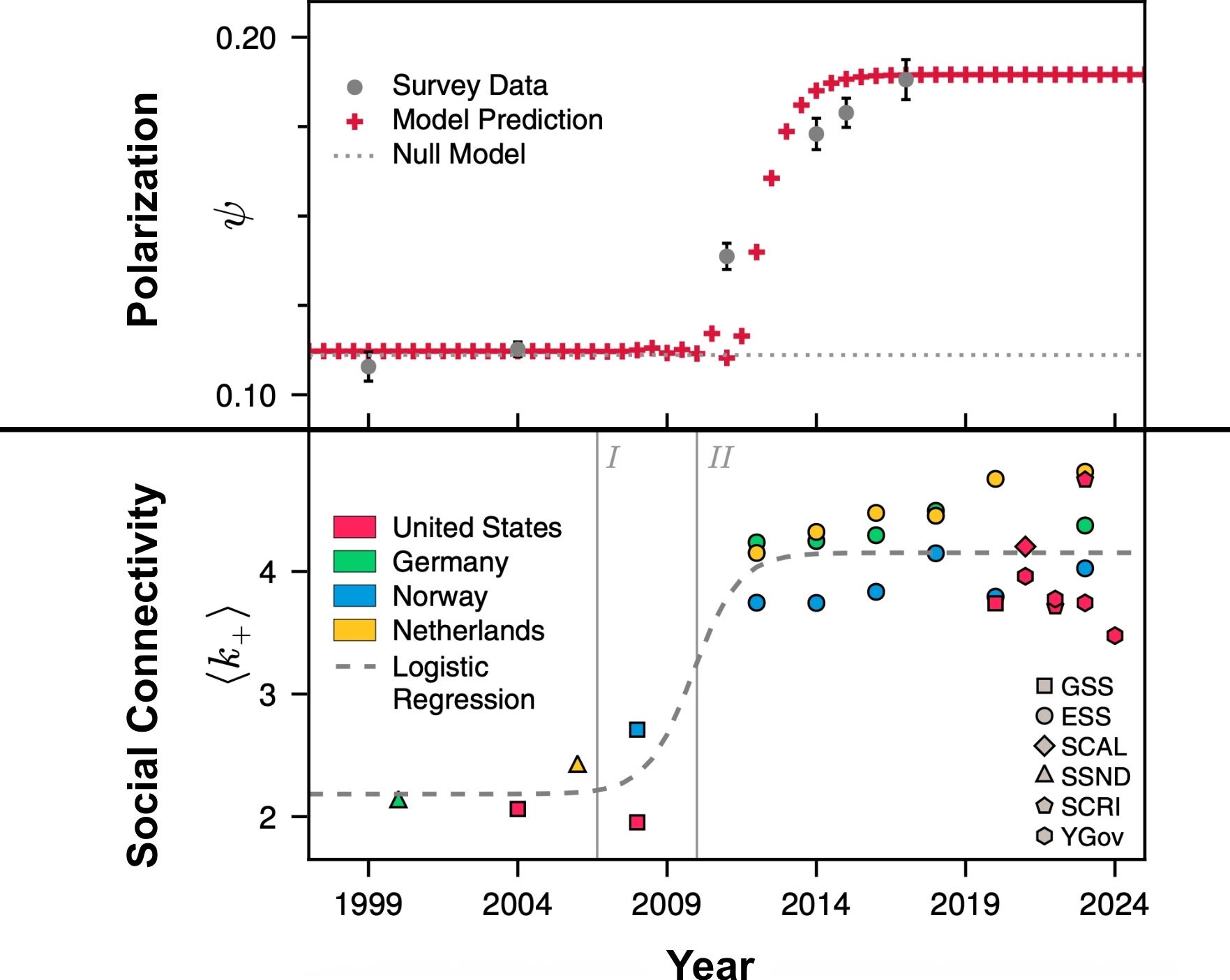
Between 2008 and 2010, social polarization rose sharply at the same time that people’s close social circles expanded—from an average of two close friends to about four or five. This parallel shift may help explain why societies across the globe are increasingly dividing into distinct ideological bubbles.
“The big question that not only we, but many countries are currently grappling with, is why polarization has increased so dramatically in recent years,” says Stefan Thurner from the Complexity Science Hub (CSH), explaining the study’s motivation. The research was published in Proceedings of the National Academy of Sciences (PNAS).
The researchers’ findings confirmed that increasing polarization is not merely perceived—it is measurable and objectively occurring. “And this increase happened suddenly, between 2008 and 2010,” says Thurner. The question remained: what caused it?
The Friendship Shift: From Two to Five Close Contacts
To investigate, Thurner and his team investigated changes in social networks, focusing on whether people’s closest friendships had evolved. “For decades, sociological studies showed that people maintained an average of about two close friends—people who could influence their opinions on important issues,” explains Thurner.
Here too, the researchers identified a striking change: “Around 2008, there was a sharp increase from an average of two close friends to four or five,” explains CSH scientist Jan Korbel.
The Paradox: More Connection, More Division
Were these two shifts connected? Could having more close friends—and therefore denser social networks—actually promote fragmentation and polarization within society?
Using a model based on real data, the researchers discovered this could indeed be the case: “When network density increases with more connections, polarization within the collective inevitably rises sharply,” says Markus Hofer from CSH.
“This finding impressed us greatly because it could provide a fundamental explanation for the peculiar form of polarization we’re currently observing simultaneously across many parts of the world—one that definitely threatens democracy,” Thurner continues. “When people are more connected with each other, they encounter different opinions more frequently. This inevitably leads to more conflict and thus greater societal polarization,” adds Korbel.
Although polarization has always been part of social life, today’s version appears stronger and more entrenched than ever before. The increase in connectivity has produced fewer but more tightly bound groups that hold sharply opposing views, with little communication between them. “There are few bridges between these ‘bubbles,’ and when they exist, they are often negative or even hostile,” says Korbel. “This is called fragmentation, and it represents a new social phenomenon,” adds Thurner.
Behind the Numbers: Tracking Polarization Through Decades of Data
For their study, the researchers analyzed extensive existing survey data on both polarization and social networks.
“To measure political polarization, we used over 27,000 surveys from the Pew Research Center, which regularly records political attitudes of people in the US,” explains Hofer. “The key advantage of this data is that the questions have remained virtually unchanged over time, enabling reliable long-term comparisons.”
The researchers found that political attitudes became significantly more one-sided between 1999 and 2017. For example, only 14% of respondents consistently expressed liberal views in 1999, but by 2017, this had risen to 31%. Conversely, only 6% of respondents consistently held conservative views in 1999, compared to 16% in 2017. “More and more people are clearly aligning themselves with one political camp rather than holding a mixture of liberal and conservative views,” explains Hofer.
To analyze friendship networks, the researchers combined 30 different surveys totaling over 57,000 respondents from Europe and the US, including the General Social Survey (US) and the European Social Survey. “Despite minor differences between individual surveys, the data consistently show that the average number of close friendships rose from 2.2 in 2000 to 4.1 in 2024,” says Hofer.
“The decisive contribution of this study is that it reconciled both phenomena using a mathematical social model,” explains Thurner. “This enabled us to show that increasing connectivity must lead to sudden polarization once a critical connectivity density is exceeded—just like a phase transition in physics, such as water turning to ice,” adds Hofer. “It is fascinating that these phase transitions also exist in societies. The exact location of these critical thresholds still needs clarification. According to our results, for close relationships, it lies somewhere between three and four people,” the researchers note.
The Smartphone Era: When Connection May Have Become Fragmentation
The sharp rise in both polarization and the number of close friends occurred between 2008 and 2010—precisely when social media platforms and smartphones first achieved widespread adoption. This technological shift may have fundamentally changed how people connect with each other, indirectly promoting polarization.
“Democracy depends on all parts of society being involved in decision-making, which requires that everyone be able to communicate with each other. But when groups can no longer talk to each other, this democratic process breaks down,” emphasizes Stefan Thurner.
Tolerance plays a central role. “If I have two friends, I do everything I can to keep them—I am very tolerant toward them. But if I have five and things become difficult with one of them, it’s easier to end that friendship because I still have ‘backups.’ I no longer need to be as tolerant,” explains Thurner.
What disappears as a result is a societal baseline of tolerance—a development that could contribute to the long-term erosion of democratic structures. To prevent societies from increasingly fragmenting, Thurner emphasizes the importance of learning early how to engage with different opinions and actively cultivating tolerance.
Reference: “Why more social interactions lead to more polarization in societies” by Stefan Thurner, Markus Hofer and Jan Korbel, 31 October 2025, Proceedings of the National Academy of Sciences.
DOI: 10.1073/pnas.2517530122
The research was made possible by the ReMass project funded by the Austrian Science Fund FWF and the CSH Postdoc Program funded by the Federal Ministry for Innovation, Mobility, and Infrastructure (BMIMI).
Never miss a breakthrough: Join the SciTechDaily newsletter.
Follow us on Google and Google News.
4 Comments
I don’t think society is so divided due to people having more friends. I think it’s due to having access to too much information. I can’t even find people who watch the same tv shows as I do anymore. There are a million channels to choose from and a million shows to choose from. Everyone is living in their own world. When I was a kid, everyone had OTA TV and there were like 6 channels. So, we all were exposed to the same things as far as TV shows and commercials, so we had common knowledge and shared experiences through watching TV and we had things to talk about. And more importantly, we all watched the same news. Nowadays, many people pick their news sources based on how it makes them feel rather than fact checking things, so there are now actual disagreements on REALITY and what is real or fake and what is the truth or not. In order for people to get along, they must agree on reality. That is no longer the case. We can’t agree on what’s real and true anymore.
Beautifully said.
Without shared history, we fragment. Before the internet, look at the “Generational Divide” for such proof.
Try increased poverty with wealth and power concentrated in the hands of relatively very few coupled with increased access to the internet.
totally agree. it seems pretty evident that these amazing so-called “smartphones” will actually be our downfall.
we flew too close to the sun…