

The study, carried out by two researchers at the Instituto de Astrofísica de Canarias, shows that the “change in position” observed in the nucleus of the galaxy M87 is not due to a displacement of its supermassive black hole, but to variations in the emission of light in the center of the galaxy caused by outbursts coming from its jet, a flow of relativistic material along a narrow beam, emitted from just outside the black hole itself.
Nowadays researchers often assume, that massive galaxies have a supermassive black hole (SMBH) in their nuclei. In recent years observers are looking for galaxies that might have an SMBH which is displaced from its equilibrium position. Among the scenarios which might cause such a displacement are the merger of two SMBHs or the existence of a binary pair of SMBH, and finding an example would give us information about the evolution of galaxies, and about the frequency of the formation and of mergers of this type of objects.
One of the candidates for a displaced SMBH is the giant elliptical galaxy M87, which contains one of the nearest and most studied galactic nuclei (AGN). Previous work on the displacement of the SMBH of M87 had given results that were very different from one another, and therefore confusing. However, a new study, by a student at the University of La Laguna, Elena López Návas, has produced new data which suggest that the SMBH in this galaxy is in its equilibrium position, and that the displacements found previously were due to variations in the center of production of light, the “photocenter” caused by outbursts from its relativistic jet, a flow of material which is expelled from close to the surface of the black hole at velocities close to that of light.
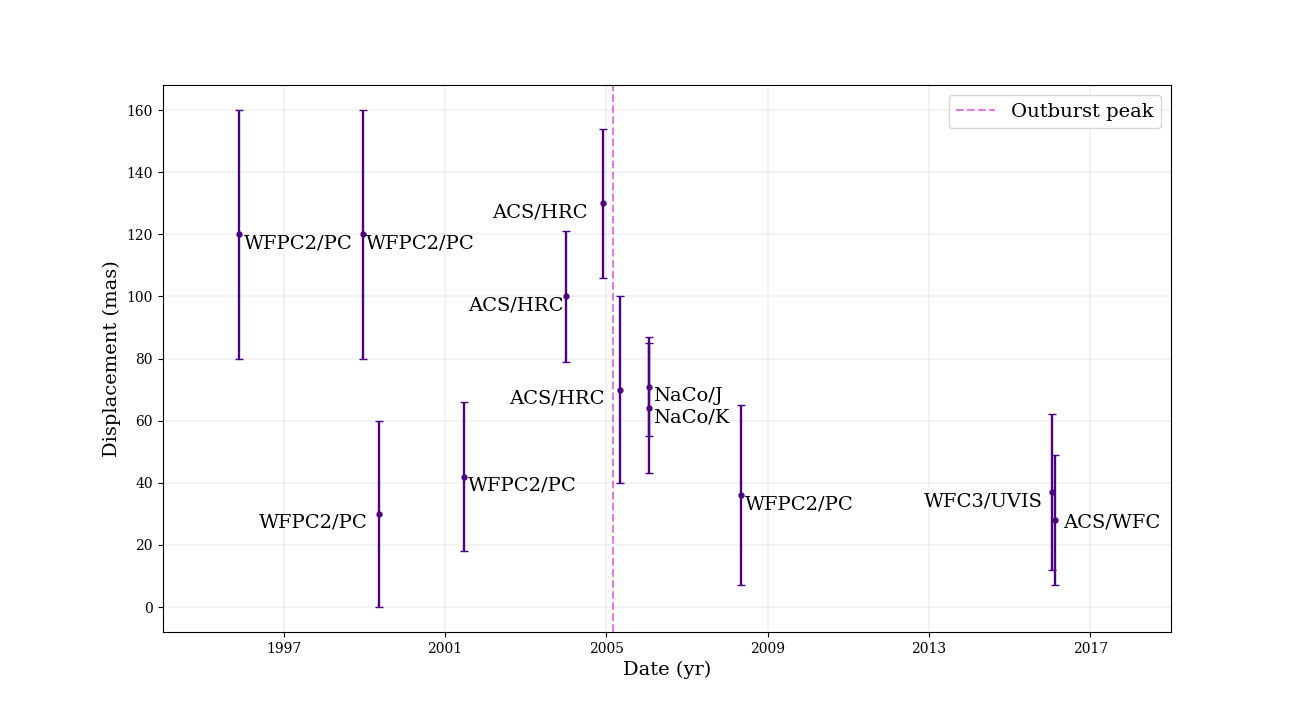
To perform this research it was necessary to analyze a large number of high-resolution images of M87 taken at different times and with different instruments on the NASA/ESA Hubble Space Telescope (HST) and on ESA’s Very Large Telescope (VLT) (Cerro Paranal, Chile). “In our work, we have found that the SMBH has been in a very stable position for the past 20 years; on the contrary, what has changed is the center of light production, the ‘photocenter’,” explains López, the author of this study, carried out as a Final Master’s degree study in Astrophysics, which has just been published in the journal Monthly Notices of the Royal Astronomical Society (MNRAS).
“As a result of what we have found, we realized that the images which appeared to show a displacement of the center of the galaxy were taken at an epoch when M87 had a major outburst, which could be measured over the whole range of the electromagnetic spectrum” adds Almudena Prieto Escudero, co-author of the article and a researcher at the Instituto de Astrofísica de Canarias (IAC). This outburst took place between the years 2003 and 2007 in a knot within the jet known as HST-1, the closest knot to the nucleus of M87. While this outburst lasted, this knot increased in brightness so much that it even outshone the nucleus itself. “A time series analysis of the displacements of the center of the galaxy shows that this outburst is related to the change in the position of the photocenter,” explains the astrophysicist “but afterward the photocenter and the nucleus were in the same place, so that we inferred that the nucleus and the black hole were always in the same place, which is the potential mínimum at the center of the galaxy.”
These new data have caused much interest in the astrophysical community, because studying the position of the SMBH in M87 is critical for understanding the evolution of this galaxy, and for the analysis of jets in other AGNs. “In addition, this research reminds us that we must be very careful when we study variable sources which show irregularities, as does this enormous jet,” warns Lopez, who is now working with a training research contract at the IAC.
Reference: “The photocentre-AGN displacement: Is M87 actually harbouring a displaced supermassive black hole?” by E López-Navas and M A Prieto, 8 August 2018, Monthly Notices of the Royal Astronomical Society.
DOI: 10.1093/mnras/sty2148
Never miss a breakthrough: Join the SciTechDaily newsletter.
Follow us on Google and Google News.