
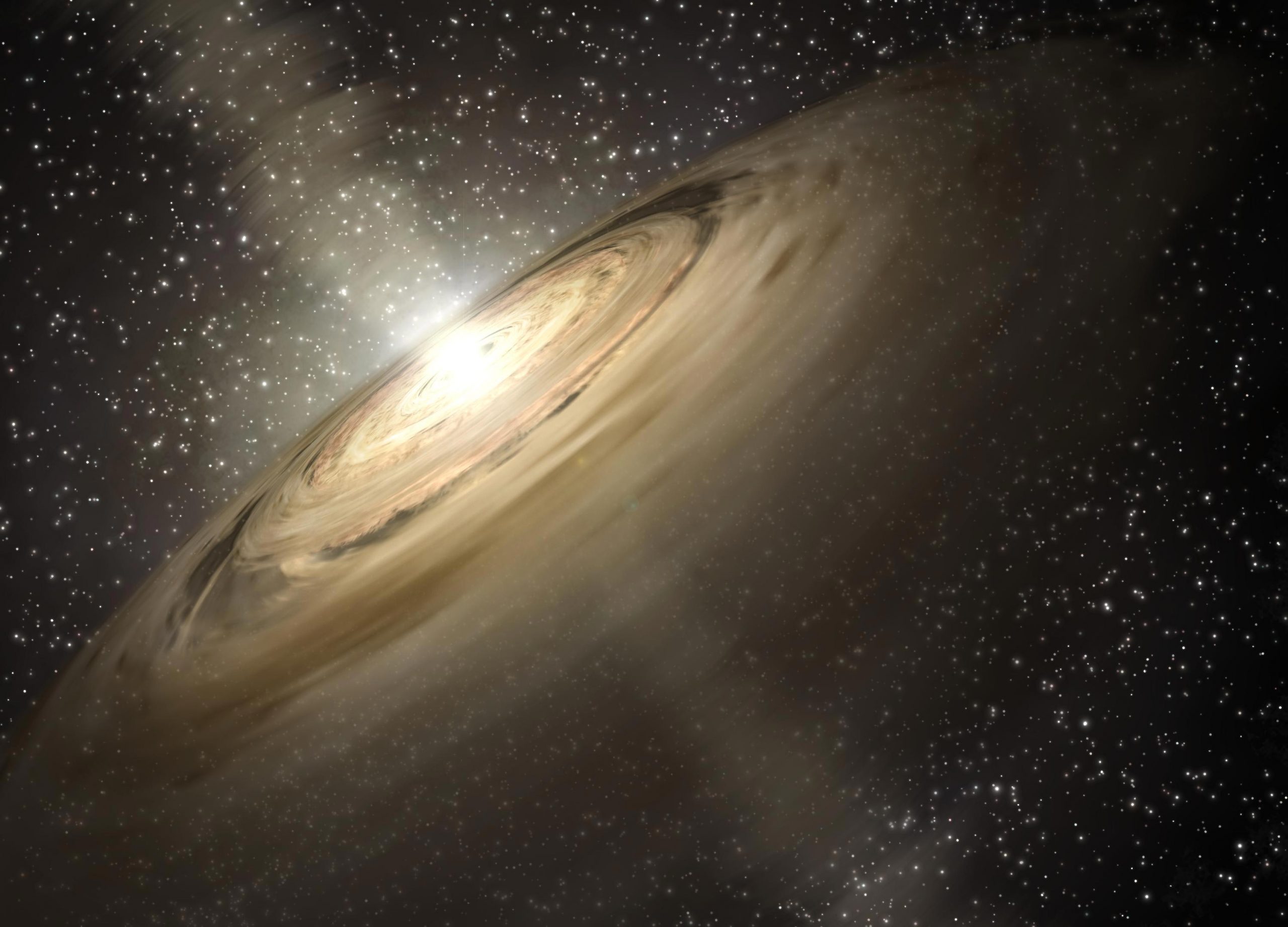
Analysis by University of Chicago scientists reverses earlier findings, suggests large temperature swings.
A new analysis of ceramic chips embedded in meteorites suggests the formation of our solar system was not as quiet and orderly as we once thought.
A new study from University of Chicago scientists builds evidence that the baby solar system likely witnessed wild temperature swings and changing conditions—contradicting the decades-old theory that the solar system had gradually and steadily cooled following the formation of the Sun.
Published in January 2021 in Science Advances, the study finds its answers in gifts from outer space. Because rocks on Earth are constantly pulled under tectonic plates, melted, and reformed, they don’t offer much evidence for what our solar system looked like four and half billion years ago. Instead, scientists look to meteorites.
“These meteorites are basically aggregates of the dust that was in the solar nebula when the planets formed,” said Nicolas Dauphas, a professor in the Department of Geophysical Sciences at the University of Chicago and co-author of the paper. “They are a snapshot of what was going on at the particular time period.”
Ceramic Clues from Carbonaceous Chondrites
A particular kind of meteorite called a carbonaceous chondrite often comes studded with bits of ceramic material, like chocolate chips in a cookie. These chips are even older than their cookies; they are thought to be witness to the first 100,000 years of our solar system.
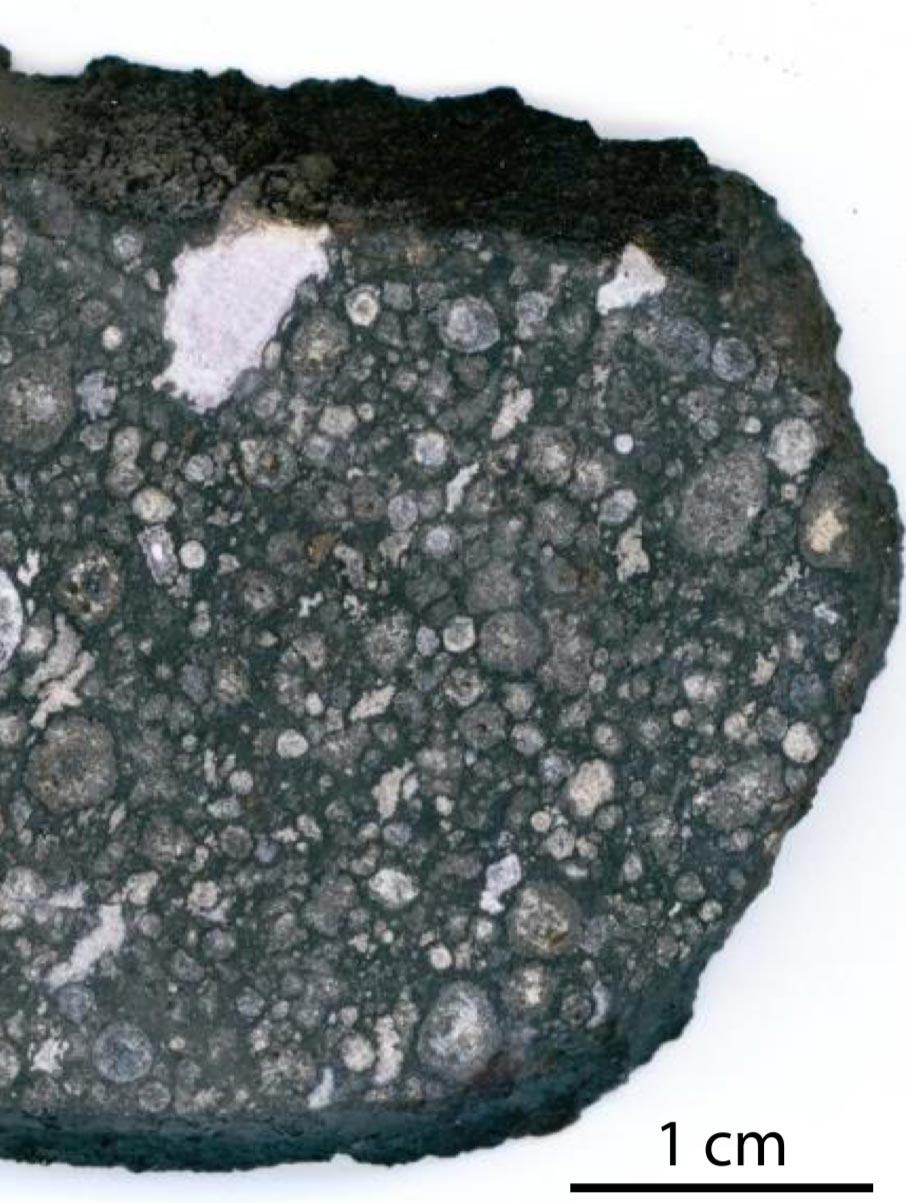
For decades, scientists have analyzed meteorites to try to understand the conditions of the early solar system, which can offer clues as to how the planets formed. (Much of this pioneering work was done at the University of Chicago throughout the 20th century.) The prevailing view was that the sun had cooled gently and steadily, and objects such as the ceramic chips were formed out of solar gas that had quietly condensed.
But some other recent findings have caused scientists to question this view, and new technology means we are now capable of much more rigorous studies. Armed with new techniques, UChicago graduate student Justin Hu sought to analyze the makeup of the ceramic chips with extreme precision.
Hu and Dauphas wanted to measure the amounts of different isotopes in the chips, which can tell you about the conditions in the gas as the chips formed. Using complex equipment in Dauphas’ Origins Lab, including a one-of-a-kind patented purification system that the team developed, Hu measured the isotopes for eight different elements inside the chips.
“They did not have the signature we were expecting,” said Hu, who is the first author on the study. “The results indicated that temperatures these ceramic inclusions encountered as they formed would have been over 1,600 Kelvin—or about 2,400 degrees Fahrenheit—over tens to hundreds of years.”
A Star’s Violent Youth Shapes the Planets
This picture indicates a young star that was flaring and fluctuating over a long time period, affecting everything around it.
Scientists had observed such extreme flares around young stars in other solar systems, but they weren’t sure whether this happened in our own system.
“Understanding these conditions is very important because it sets the stage for the formation of the planets,” Dauphas said. “They can tell you about the processes that shaped the composition of solar system planets—for example, why do Earth and Mars have different makeups?”
“This isn’t the first evidence that the early stages of our sun were violent years,” said Prof. Andrew M. Davis, another co-author, “but there’s a richness to these findings that allows us to say more about the timescale over which this occurred—which is many, many days.”
Davis was among a group of UChicago scientists who conducted some of the first such studies on similar meteorites back in the 1970s. “Justin has now proved the primary process was evaporation, not condensation,” he said. “It’s very satisfying to see our ideas from a long time ago that were partially right, but also to see them proved wrong in a really elegant and quantitative way.”
Reference: “Heating events in the nascent solar system recorded by rare earth element isotopic fractionation in refractory inclusions” by J. Y. Hu, N. Dauphas, F. L. H. Tissot, R. Yokochi, T. J. Ireland, Z. Zhang, A. M. Davis, F. J. Ciesla, L. Grossman, B. L. A. Charlier, M. Roskosz, E. E. Alp, M. Y. Hu and J. Zhao, 6 January 2021, Science Advances.
DOI: 10.1126/sciadv.abc2962
The study included several other co-authors from UChicago’s Department of Geophysical Sciences: graduate students Francois Tissot (now at Caltech) and James Zhang, postdoctoral researcher Thomas Ireland (now at Boston University), Research Associate Professor Reika Yokochi, Prof. Fred Ciesla and Prof. Emeritus Lawrence Grossman.
Other co-authors were Michael Y. Hu and Jiyong Zhao with Argonne National Laboratory, Mathieu Roskosz with the Pierre and Marie Curie University in France, and Bruce Charlier with the Victoria University of Wellington in New Zealand. Meteorite samples were provided by the Robert A. Pritzker Center for Meteoritics and Polar Studies at the Field Museum.
Funding: NASA, National Science Foundation
Never miss a breakthrough: Join the SciTechDaily newsletter.
Follow us on Google and Google News.
2 Comments
So…what minerals actually compose these “ceramic” fragments?
From the linked paper abstract:
“This is partly motivated, by the observation that the depletions in both the least and most refractory rare earth elements (REEs) in meteoritic group II calcium-aluminum–rich inclusions (CAIs) can be reproduced by thermodynamic models of solar nebula condensation. We measured the isotopic compositions of Ce, Nd, Sm, Eu, Gd, Dy, Er, and Yb in eight CAIs to test this scenario.”
From Wikipedia [ https://en.wikipedia.org/wiki/Calcium%E2%80%93aluminium-rich_inclusion ]:
“CAIs consist of minerals that are among the first solids condensed from the cooling protoplanetary disk. They are thought to have formed as fine-grained condensates from a high temperature (>1300 K) gas that existed in the protoplanetary disk at early stages of Solar System formations. Some of them were probably remelted later resulting in distinct coarser textures. The most common and characteristic minerals in CAIs include anorthite, melilite, perovskite, aluminous spinel, hibonite, calcic pyroxene, and forsterite-rich olivine.”