
Close Menu
    Facebook X (Twitter) Instagram
    SciTechDaily
    • Biology
    • Chemistry
    • Earth
    • Health
    • Physics
    • Science
    • Space
    • Technology
    Facebook X (Twitter) Pinterest YouTube RSS
    SciTechDaily
    Home»Health»“Zombie Cells” Hold Clues to Improved Healing of Spinal Cord Injuries
    Health

    “Zombie Cells” Hold Clues to Improved Healing of Spinal Cord Injuries

    By Institute of Molecular MedicineJuly 6, 2021No Comments3 Mins Read
    Facebook Twitter Pinterest Telegram LinkedIn WhatsApp Email Reddit
    Share
    Facebook Twitter LinkedIn Pinterest Telegram Email Reddit
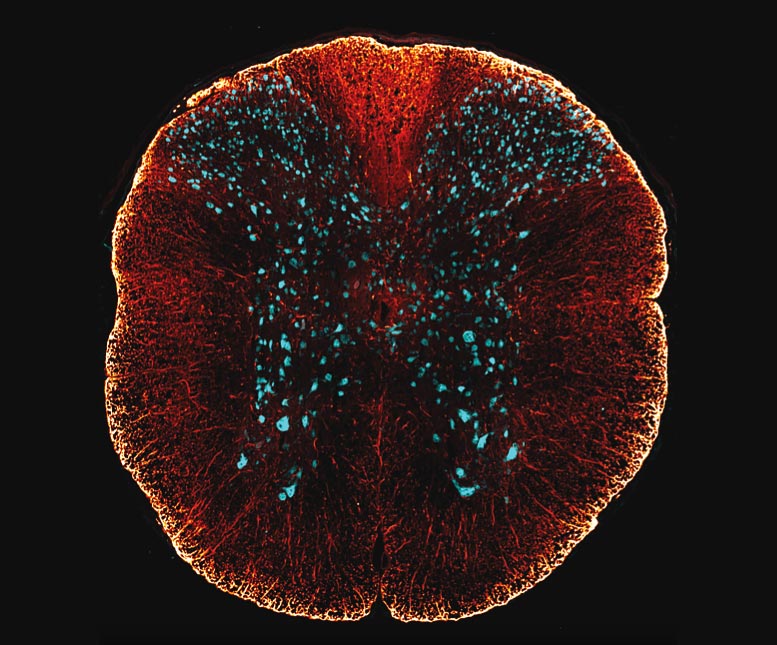
    Mouse Spinal Cord Transversal Cross Section
    The image represents a transversal cross-section of a mouse spinal cord. Neuronal cell bodies are represented in light blue delineating the butterfly shape characteristic of the gray matter, while glial projections are represented in orange-red. Credit: Diogo Paramos-de-Carvalho

    Targeting senescent cells with senolytic drugs has been shown to reduce spinal cord scarring and inflammation in mammals, improving recovery outcomes

    Mammals have a poor ability to recover after a spinal cord injury which can result in paralysis. A main reason for this is the formation of a complex scar associated with chronic inflammation that produces a cellular microenvironment that blocks tissue repair.

    Now, a research team led by Leonor Saude, group leader at Instituto de Medicina Molecular Joao Lobo Antunes (iMM; Portugal) and Professor at Faculdade de Medicina da Universidade de Lisboa, have shown that the administration of drugs that target specific cellular components of this scar, improve functional recovery after injury. The results now published in the scientific journal Cell Reports set the basis for a new promising therapeutic strategy not only for spinal cord injuries, but potentially for other organs that lack regenerative competence.

    This study was performed at iMM with collaboration from researchers at CEDOC NOVA Medical School and was funded by “la Caixa” Foundation – CaixaResearch Call and Fundacao para a Ciencia e a Tecnologia (Portugal).

    Leonor Saude and her team have been studying spinal cord injury using two different models: the zebrafish, where there is spinal injury recovery, and mammals that show poor recovery. The dense scar that forms at the lesion site has been of particular interest. In mammals, upon spinal cord injury, researchers observed that cells start to accumulate at the lesion periphery. But not any cells: “These cells are known as senescent cells. They have specific features and markers and are what we can call “zombie cells,” where growth and division is interrupted, but where the normal cell death program is not activated,” explains Leonor Saude.

    “Zombie Cells” and the Scar They Leave Behind

    “While in zebrafish, the accumulation of these cells at the injury periphery is cleared out over time, in mammals, these cells persist and are important components of the dense scar observed. Because senescent cells have specific molecular markers, there are specific drugs that could be tested in this context,” says Diogo Paramos-de-Carvalho, first author of the study. “With the administration of different senolytic drugs, that specifically target these senescent cells, we have observed a progressive decrease of these cells, a decrease in the scar extension and lower levels of inflammation due to a decreased secretion of pro-fibrotic and pro-inflammatory factors. The observed changes at the molecular level underlie the improved locomotor, sensory, and bladder functions that we have also found,” explains Isaura Martins, also first author of the study.

    “Although we are still far from healing spinal cord injuries in humans, we are learning more about the molecular signatures of these lesions and these new promising results can open new therapeutic strategies that can be applied not only to spinal cord injuries but in other conditions that lack regenerative competence,” says Leonor Saude.

    Reference: “Targeting senescent cells improves functional recovery after spinal cord injury” by Diogo Paramos-de-Carvalho, Isaura Martins, Ana Margarida Cristóvão, Ana Filipa Dias, Dalila Neves-Silva, Telmo Pereira, Diana Chapela, Ana Farinho, António Jacinto and Leonor Saude, 6 July 2021, Cell Reports.
    DOI: 10.1016/j.celrep.2021.109334

    Never miss a breakthrough: Join the SciTechDaily newsletter.
    Follow us on Google and Google News.

    Cell Biology Injury Molecular Biology Popular Spinal Cord
    Share. Facebook Twitter Pinterest LinkedIn Email Reddit

    Related Articles

    Recipe Revealed for Even More Powerful COVID-19 Vaccines – Better Protection Against Coronavirus Variants

    New Defense Against Bacterial Superbugs: Taking Fish Oil May Reduce Antibiotic Resistance

    Antidepressant Power of Lactate Revealed in New Research

    COVID-19 Causes “Unexpected” Cellular Response in the Lungs, Surprising Scientists

    Corona Inhibitors: X-ray Screening Identifies Promising Drugs for Treatment of COVID-19

    Melatonin Produced in the Lungs Prevents COVID-19 Infection

    Scientists Discover a Gene to Stay Thin – Protects Against Diet-Induced Obesity

    Gene Identified That Could Explain Why COVID-19 Causes No Symptoms in Some and Serious Illness or Death in Others

    Infection Researchers Identify How Coronaviruses From Animals Need to Change to Spread to Humans

    Leave A Reply Cancel Reply

    • Facebook
    • Twitter
    • Pinterest
    • YouTube

    Don't Miss a Discovery

    Subscribe for the Latest in Science & Tech!

    Trending News

    Scientists Say This Natural Hormone Reverses Obesity by Targeting the Brain

    35-Million-Year-Old Mystery: Strange Arachnid Discovered Preserved in Amber

    Is AI Really Just a Tool? It Could Be Altering How You See Reality

    JWST Reveals a “Forbidden” Planet With a Baffling Composition

    The Protein “Sabotaging” Aging Muscle Recovery Could Be Key to Surviving Aging

    This Diet–Gut Interaction Could Transform Fat Into a Calorie-Burning Machine

    Scientists Discover Hidden Virus Linked to Colorectal Cancer

    Scientists Discover 132-Million-Year-Old Dinosaur Tracks on South Africa’s Coast

    Follow SciTechDaily
    • Facebook
    • Twitter
    • YouTube
    • Pinterest
    • Newsletter
    • RSS
    SciTech News
    • Biology News
    • Chemistry News
    • Earth News
    • Health News
    • Physics News
    • Science News
    • Space News
    • Technology News
    Recent Posts
    • 500 Million Years Ago, Life Changed Forever: Scientists Reveal the DNA Changes That Helped Animals Move Onto Land
    • Surprise RNA Discovery Challenges Long-Held Beliefs About How Genes Work
    • Your IQ at 23 Could Predict Your Wealth at 27, Study Finds
    • 320 Light-Years Away, a Planet Confirms a Fundamental Cosmic Assumption
    • Astronomers Solve Decades-Long Mystery About Saturn’s Spin – “Something Strange Was Happening”
    Copyright © 1998 - 2026 SciTechDaily. All Rights Reserved.
    • Science News
    • About
    • Contact
    • Editorial Board
    • Privacy Policy
    • Terms of Use

    Type above and press Enter to search. Press Esc to cancel.