
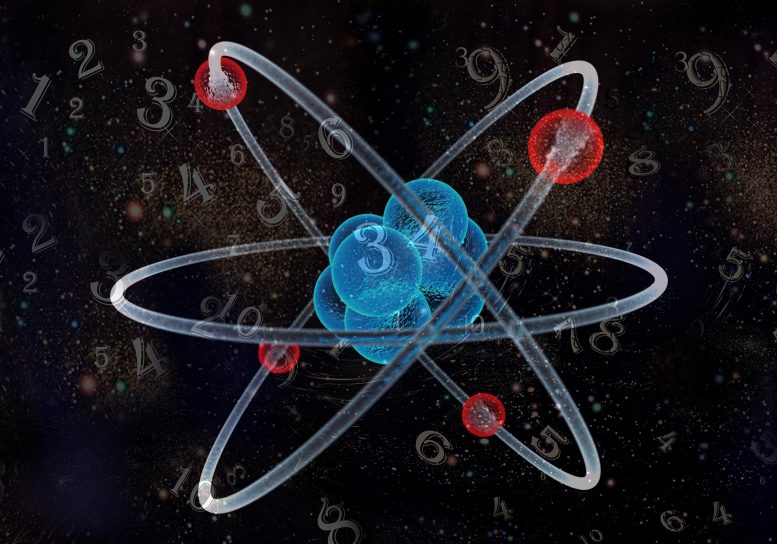
An international collaboration led by scientists from the University of Hong Kong, RIKEN (Japan), and CEA (France) have used the RI Beam Factory (RIBF) at the RIKEN Nishina Center for Accelerator-base Science to show that 34 is a “magic number” for neutrons, meaning that atomic nuclei with 34 neutrons are more stable than would normally be expected. Earlier experiments had suggested, but not clearly demonstrated, that this would be the case.
The experiments, published in Physical Review Letters, were performed using calcium 54, an unstable nucleus which has 20 protons and 34 neutrons. Through the experiments, the researchers showed that it exhibits strong shell closure, a situation with neutrons that is similar to the way that atoms with closed electron shells, such as helium and neon, are chemically inactive.
While it was once believed that the protons and neutrons were lumped together like a soup within the nucleus, it is now known that they are organized in shells. With the complete filling of a nuclear shell, often referred to as the “magic number,” nuclei exhibit distinctive attributes that can be probed in the laboratory. For example, a large energy for the first excited state of a nucleus is indicative of a magic number.
Recent studies on neutron-rich nuclei have hinted that new numbers need to be added to the known, canonical numbers of 2, 8, 20, 28, 50, 82, and 126.
Initial tests on calcium 54, also carried out at the RIBF in 2013, had already indicated that the number should exist. During the new experiment, the research focus shifted toward determining its actual strength. In the current experiment, the team around Sidong Chen directly measured the number of neutrons occupying the individual shells in calcium 54 by painstakingly knocking out the neutrons one at a time.
To do this, the group used a beam containing the calcium traveling at around 60% of the speed of light, selected and identified by the BigRIPS isotope separator, and collided the beam into a target of thick liquid hydrogen, or protons, cooled to a tremendously low temperature of 20 K. The detailed shell structure of the isotope was inferred from the cross-sections of the neutrons knocked out as they collided with the protons, allowing the researchers to associate them with different shells.
According to Pieter Doornenbal of the Nishina Center, “For the first time, we were able to demonstrate quantitatively that all the neutron shells are completely filled in 54Ca, and that 34 neutrons is indeed a good magic number.” The finding demonstrates that 34 is a part of the set of magic numbers, though its appearance is restricted to a very limited region of the nuclear chart. Sidong Chen continues “Major efforts in the future will focus on delineating this region. Moreover, for more neutron-rich systems, like 60Ca, further magic numbers are predicted. These ‘exotic’ systems are currently beyond the reach of the RIBF for detailed studies, but we believe that thanks to its increasing capabilities, they will become accessible in the foreseeable future.”
Reference: “Quasifree Neutron Knockout from 54Ca Corroborates Arising N=34 Neutron Magic Number” by S. Chen et al., 30 September 2019, Physical Review Letters.
DOI: 10.1103/PhysRevLett.123.142501
Never miss a breakthrough: Join the SciTechDaily newsletter.
Follow us on Google and Google News.