
Close Menu
    Facebook X (Twitter) Instagram
    SciTechDaily
    • Biology
    • Chemistry
    • Earth
    • Health
    • Physics
    • Science
    • Space
    • Technology
    Facebook X (Twitter) Pinterest YouTube RSS
    SciTechDaily
    Home»Earth»Winds of Change Move 963,269 Square Mile Smoke Cloud Over Pacific Ocean
    Earth

    Winds of Change Move 963,269 Square Mile Smoke Cloud Over Pacific Ocean

    By Lynn Jenner, NASASeptember 12, 20203 Comments3 Mins Read
    Facebook Twitter Pinterest Telegram LinkedIn WhatsApp Email Reddit
    Share
    Facebook Twitter LinkedIn Pinterest Telegram Email Reddit

    Wind Smoke Pacific

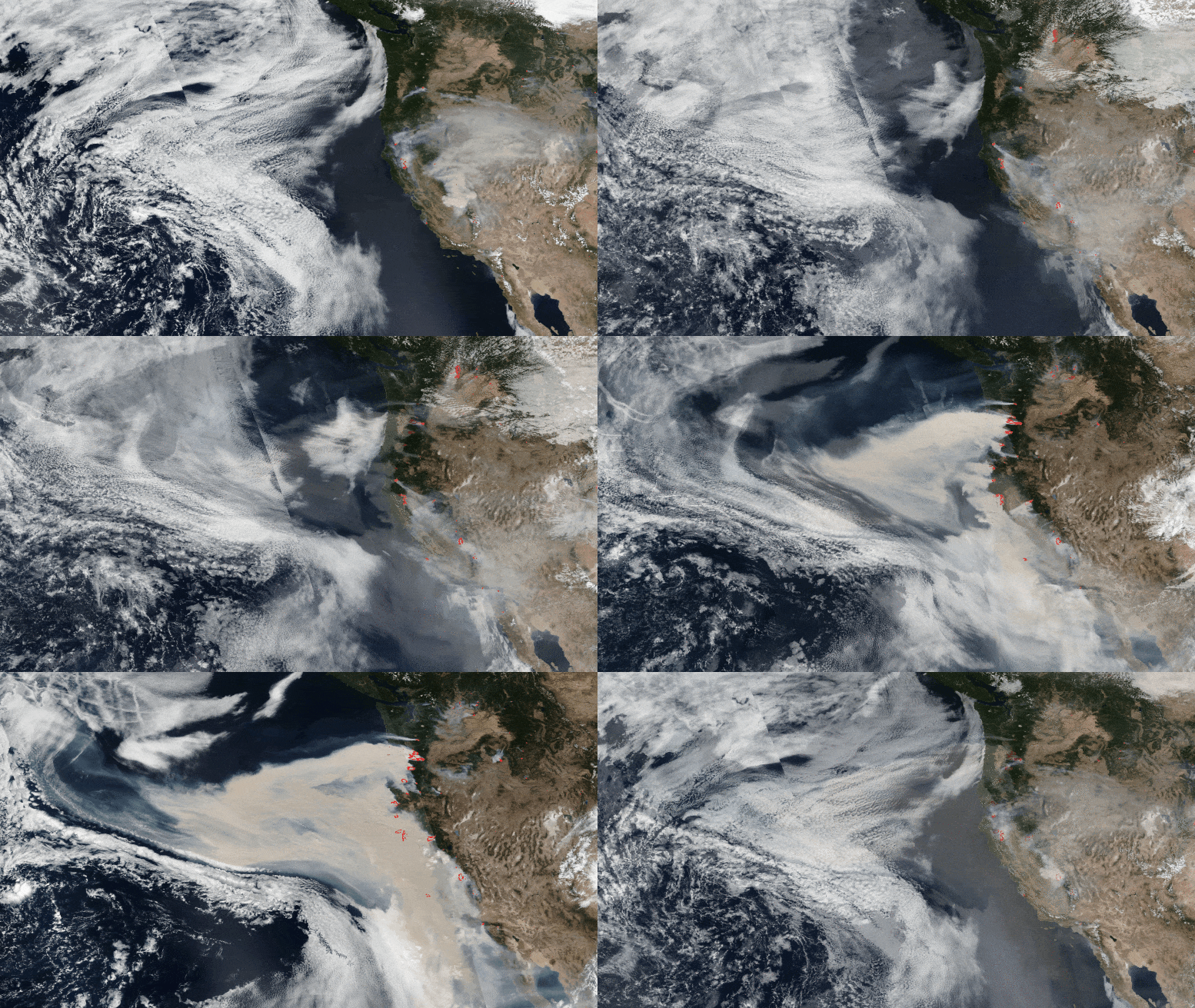
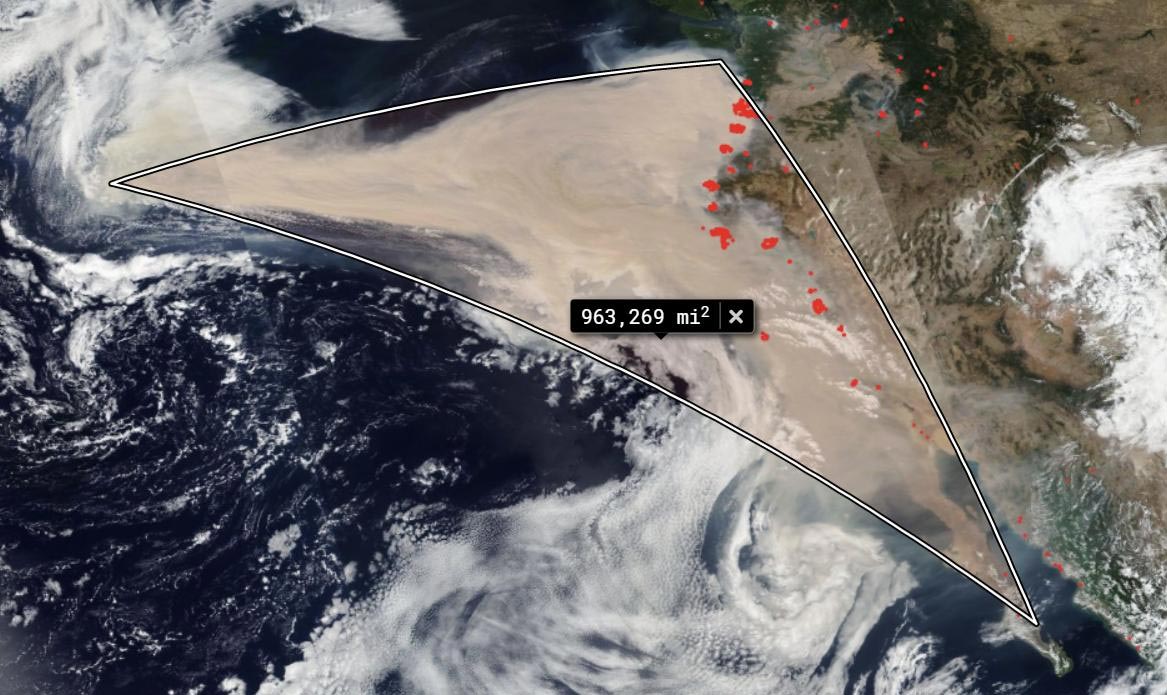
    NOAA/NASA’s Suomi NPP satellite captured these series of images (made into an animated GIF) showing the winds changing direction on September 6, 2020, when choking clouds of brown smoke began to billow and cascade into the Pacific Ocean. (Dates displayed in lower left hand corner.) By September 10, the smoke cloud had traveled over 1,300 miles. The square miles of smoke in the image below totals 963,269. That estimate has been computed using the measurement tool within the NASA Worldview application. 

    A stunning 3.1 million acres have burned this year in California alone (per CAL fire), which is up from a total of 2.5 million acres as of Wednesday, September 9, 2020. In addition, 805,314 acres have been lost in Oregon (State of Oregon Fires and Hotspots Dashboard, as of 9:30 a.m. EDT September 11) and 500,000 acres (Northwest Interagency Coordination Center) in Washington state. Winds blowing through the west have been stoking fires and helping spread them quickly as evidenced in the growth of over a half million acres in less than two days.

    There have been 12 wildfire-related fatalities this year.
    Smoke 963269 Square Miles
    The square miles of smoke in the image below totals 963,269. That estimate has been computed using the measurement tool within the NASA Worldview application. Credit: NASA Worldview

    Records have been shattered during this fire season and experts continue to blame drought, excessive heat and strong winds for this tragedy. Because the climate continues to change, scientists also believe that these types of fire events will not only continue but will worsen. Predictive meterologist for the National Interagency Fire Center, Nick Nausler, tweeted: “Multiple fires made 20-plus mile runs in 24 hours over the last few days in California, Oregon and Washington. Such distances traveled so quickly may not be all that rare in grassland fires. However, most of these fires are making massive runs in timber and burning tens of thousands of acres and in some cases 100,000-plus acres in one day. The sheer amount of fire on the landscape is surreal.”

    NASA’s Earth Observing System Data and Information System (EOSDIS) Worldview application provides the capability to interactively browse over 700 global, full-resolution satellite imagery layers and then download the underlying data. Many of the available imagery layers are updated within three hours of observation, essentially showing the entire Earth as it looks “right now.” Actively burning fires, detected by thermal bands, are shown as red points. Image Courtesy: NASA Worldview, Earth Observing System Data and Information System (EOSDIS).

    Never miss a breakthrough: Join the SciTechDaily newsletter.
    Follow us on Google and Google News.

    NASA Wildfires
    Share. Facebook Twitter Pinterest LinkedIn Email Reddit

    Related Articles

    Satellite Imagery Shows Ferocious Fires in Australia Intensify

    NASA: Amazon Fires Were Fueled by Drought-Stressed Forest

    NASA’s Terra Satellite Images California’s Kincade Fire Burn Scar From Space

    NASA Satellite Image – Southern California’s Getty Fire Continues to Burn

    NASA’s Terra Satellite Images the Destructive Kincaid Fire in Sonoma County, California

    NASA Satellite Data Shows Climate Change’s Impact on Fires [Video]

    NASA’s ECOSTRESS Detects Amazon Fires from International Space Station

    NASA Satellite Image: Amazon Fires Shroud South America in Smoke

    Carbon Monoxide From Brazil Fires Mapped by NASA Satellite

    3 Comments

    1. John-Paul on September 12, 2020 4:09 pm

      laughs putting up my hand saying it just works.

      Reply
    2. Lee Hellinger on September 13, 2020 12:39 pm

      Now we need lots of rain to cause mudslides and debris flows for more dramatic news on television hyped up for effect.

      Reply
    3. XonEarth on September 13, 2020 1:22 pm

      It is a direct result of ever-increasing emissions from our big pollution industries and it is only going to get much worse for everyone on the planet since these industries are increasing their output.

      Reply
    Leave A Reply Cancel Reply

    • Facebook
    • Twitter
    • Pinterest
    • YouTube

    Don't Miss a Discovery

    Subscribe for the Latest in Science & Tech!

    Trending News

    Scientists May Have Discovered How To Heal Damaged Kidneys

    Interstellar Visitor 3I/ATLAS Is Bursting With an Unexpected Chemical

    Scientists Just Found All 5 Genetic “Letters” of DNA and RNA on an Asteroid

    The 4,000-Year-Old City That Defied History’s Rules on Wealth and Power

    The World’s Biggest Population Fear Has Flipped – and It Could Change Everything

    This “Fake” Pill Improved Memory and Physical Performance in Just 3 Weeks

    Scientists Say Frequent Ejaculation May Improve Sperm Quality and Fertility

    Scientists Have Found “The Heaven Sword” After Years of Looking

    Follow SciTechDaily
    • Facebook
    • Twitter
    • YouTube
    • Pinterest
    • Newsletter
    • RSS
    SciTech News
    • Biology News
    • Chemistry News
    • Earth News
    • Health News
    • Physics News
    • Science News
    • Space News
    • Technology News
    Recent Posts
    • Scientists Create Tiny “Mini Livers” That Could One Day Replace Liver Transplants
    • This Surprising Factor May Predict Heart Disease Decades Before It Strikes
    • New Nonsurgical Knee Treatment Delivers Lasting Pain Relief
    • Scientists Discover Hidden Rule That Could Make Fuel Cells Cheaper and More Powerful
    • New Water-Harvesting Jacket Pulls up to 30 Ounces of Drinking Water From the Air Daily
    Copyright © 1998 - 2026 SciTechDaily. All Rights Reserved.
    • Science News
    • About
    • Contact
    • Editorial Board
    • Privacy Policy
    • Terms of Use

    Type above and press Enter to search. Press Esc to cancel.