
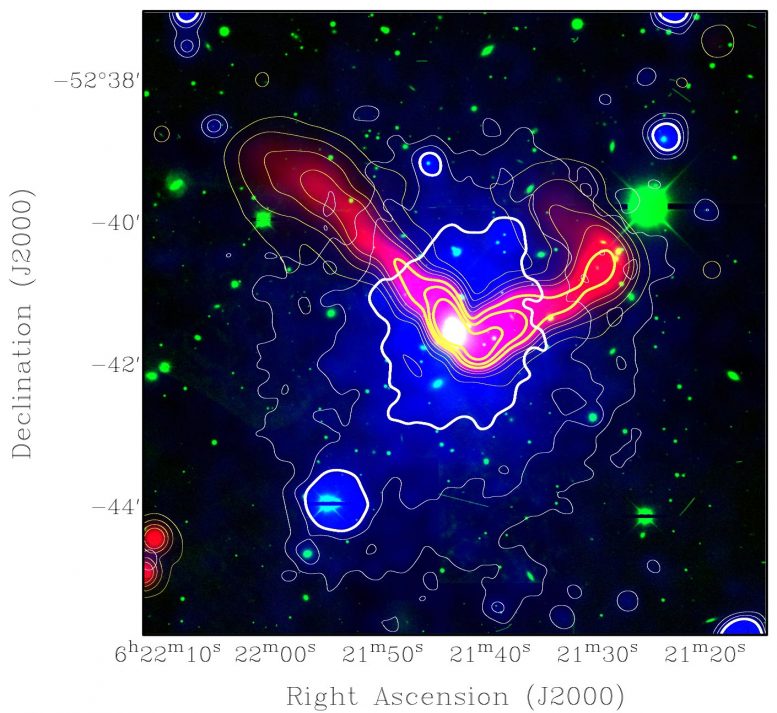
An international group of astronomers has created images with never-before-seen detail of a galaxy cluster with a black hole at its center, traveling at high speed along an intergalactic ‘road of matter’. The findings also support existing theories of the origins and evolution of the universe.
The concept that roads of thin gas connect clusters of galaxies across the universe has been difficult to prove until recently, because the matter in these ‘roads’ is so sparse it eluded the gaze of even the most sensitive instruments. Following the 2020 discovery of an intergalactic thread of gas at least 50 million light-years long, scientists have now developed images with an unprecedented level of detail of the ‘Northern Clump’ – a cluster of galaxies found on this thread.
By combining imagery from various sources including CSIRO’s ASKAP radio telescope, SRG/eROSITA, XMM-Newton and Chandra satellites, and DECam optical data, the scientists could make out a large galaxy at the center of the clump, with a black hole at its center.
In a press conference overnight, the eROSITA team at the University of Bonn presented their observations of the clump, which appears to be moving at high speed. Jets of matter are streaming out behind it “like the braids of a running girl,” says lead author of the study, Angie Veronica from the Argelander Institute for Astronomy at the University of Bonn.
The leader of the EMU project, which contributed data from ASKAP for the study, Professor Andrew Hopkins of Australian Astronomical Optics, Macquarie University, says, “The excellent sensitivity of the ASKAP telescope to faint extended radio emission is the key that allows the detection of these jets of radio emission from the supermassive black hole. The shape and orientation of these jets in turn provide important clues to the motion of the galaxy hosting the black hole.”
Professor Thomas Reiprich of the University of Bonn says, “We are currently interpreting this observation such that the Northern Clump is losing matter as it travels. However, it could also be that even smaller clumps of matter in the thread are falling toward the Northern Clump.”
Galactic Clusters Grow via Cosmic Infall
Overall, the observations confirm the theoretical view that the gas filament is an intergalactic road of matter. The Northern Clump is moving along this road at high speed toward two other, much larger galaxy clusters called Abell 3391 and Abell 3395.
“It’s sort of falling into these clusters and will continue to enlarge them — just like the principle of ‘winner takes all’,” says Professor Reiprich. “What we’re seeing is a snapshot of that fall.”
The observations agree with the result of the Magneticum computer simulations developed by researchers of the eROSITA consortium. They can therefore also be taken as an argument that the current assumptions about the origin and evolution of the Universe are correct. This includes the view that a large part of matter is invisible to our measuring instruments. 85 percent of our universe is believed to consist of this ‘dark matter’. In the standard model of cosmology, it plays an important role as a condensation nucleus that caused gaseous matter to condense into galaxies after the Big Bang.
Reference: “Radio observations of the merging galaxy cluster system Abell 3391-Abell 3395” by M. Brüggen, T. H. Reiprich, E. Bulbul, B. S. Koribalski, H. Andernach, L. Rudnick, D. N. Hoang, A. G. Wilber, S. W. Duchesne, A. Veronica, F. Pacaud, A. M. Hopkins, R. P. Norris, M. Johnston-Hollitt, M. J. I. Brown, A. Bonafede, G. Brunetti, J. D. Collier, J. S. Sanders, E. Vardoulaki, T. Venturi, A. D. Kapinska and J. Marvil, 26 February 2021, Astronomy & Astrophysics.
DOI: 10.1051/0004-6361/202039533
Participating institutions and funding
More than 20 scientists from Germany, Italy, USA and Australia were involved in the study. eROSITA was developed with funding from the Max Planck Society and the German Aerospace Center (DLR). The current study was funded by the German Research Foundation (DFG).
The full EMU project, starting in late 2021, will use ASKAP to map the entire Southern sky, revealing the details of many hundreds of galaxy clusters like this. It will also measure over 40 million individual galaxies, more than ten times the number currently known through radio surveys, as well as mapping our own Milky Way Galaxy in unprecedented detail.
ASKAP is owned and operated by CSIRO, Australia’s national science agency, as a national research facility. We acknowledge the Wajarri Yamatji people as the traditional owners of the Murchison Radio-astronomy Observatory, where ASKAP is located.
Never miss a breakthrough: Join the SciTechDaily newsletter.
Follow us on Google and Google News.