
Sometimes half measures can be a good thing — especially on a journey this long. The agency’s latest rover only has about 146 million miles left to reach its destination.
NASA’s Mars 2020 Perseverance rover mission has logged a lot of flight miles since being lofted skyward on July 30 — 146.3 million miles (235.4 million kilometers) to be exact. Turns out that is exactly the same distance it has to go before the spacecraft hits the Red Planet’s atmosphere like a 11,900 mph (19,000 kph) freight train on February 18, 2021.
“At 1:40 p.m. Pacific Time today, our spacecraft will have just as many miles in its metaphorical rearview mirror as it will out its metaphorical windshield,” said Julie Kangas, a navigator working on the Perseverance rover mission at NASA’s Jet Propulsion Laboratory in Southern California. “While I don’t think there will be cake, especially since most of us are working from home, it’s still a pretty neat milestone. Next stop, Jezero Crater.”
The Sun’s gravitational influence plays a significant role in shaping not just spacecraft trajectories to Mars (as well as to everywhere else in the solar system), but also the relative movement of the two planets. So Perseverance’s route to the Red Planet follows a curved trajectory rather than an arrow-straight path.
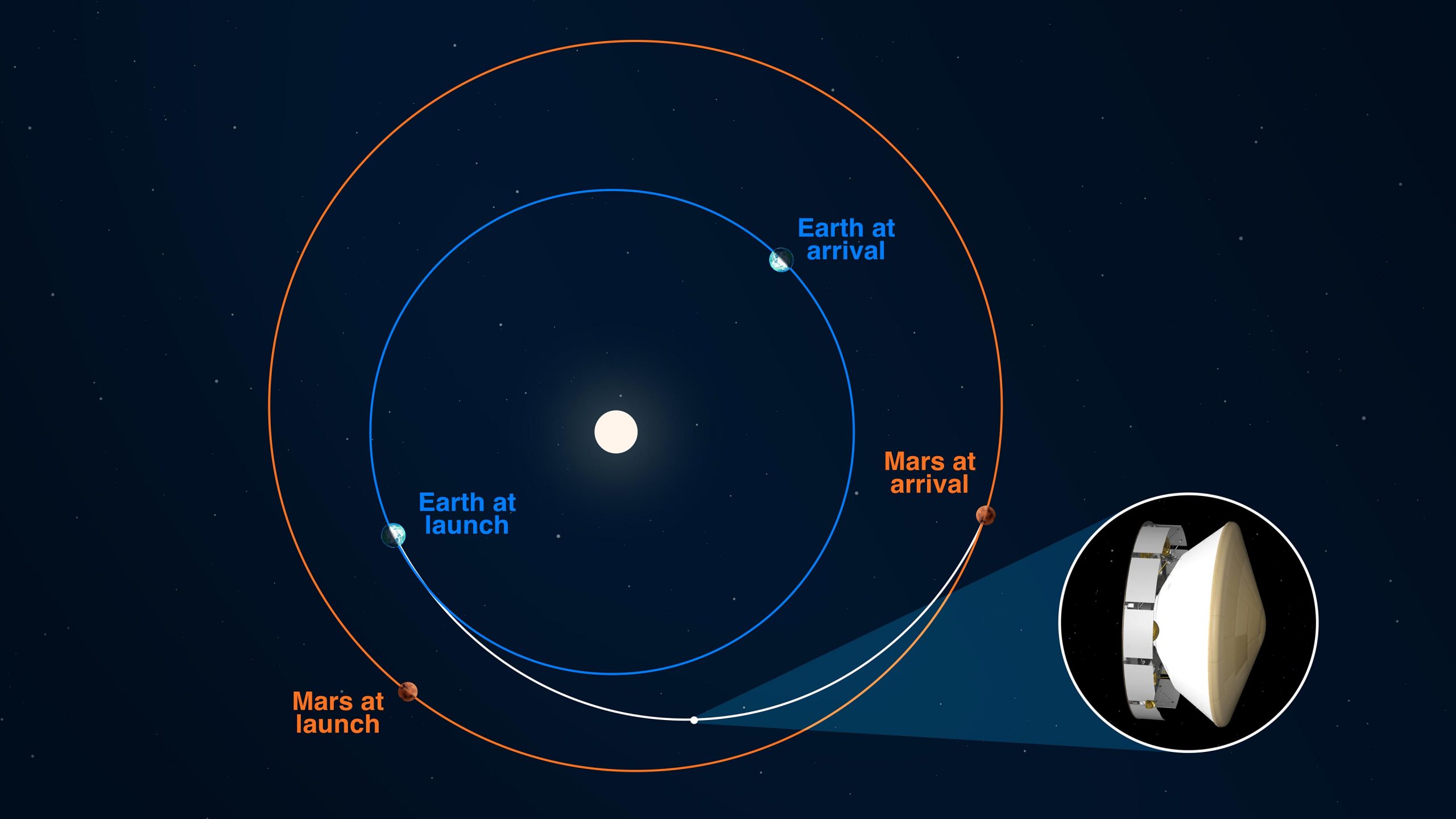
“Although we’re halfway into the distance we need to travel to Mars, the rover is not halfway between the two worlds,” Kangas explained. “In straight-line distance, Earth is 26.6 million miles [42.7 million kilometers] behind Perseverance and Mars is 17.9 million miles [28.8 million kilometers] in front.”
At the current distance, it takes 2 minutes, 22 seconds for a transmission to travel from mission controllers at JPL via the Deep Space Network to the spacecraft. By the time of landing, Perseverance will have covered 292.5 million miles (470.8 million kilometers), and Mars will be about 130 million miles (209 million kilometers) away from Earth; at that point, a transmission will take about 11.5 minutes to reach the spacecraft.
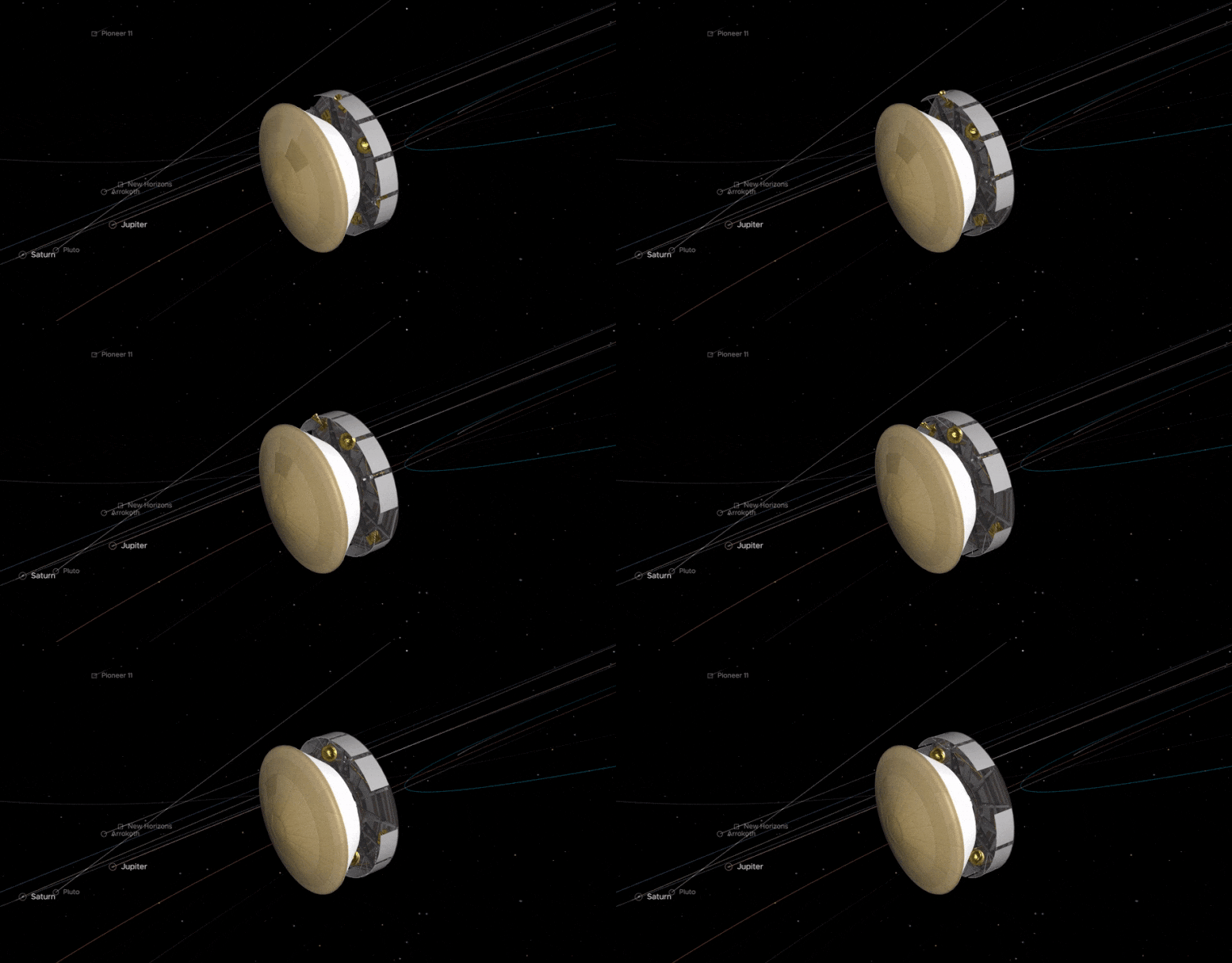
NASA’s Mars 2020 Perseverance rover has logged 146.3 million (235.4 million kilometers) of space miles – exactly half of what will be covered before reaching the Red Planet. View the full interactive experience at Eyes on the Solar System.
Work Continues En Route
The mission team continues to check out spacecraft systems big and small during interplanetary cruises. Perseverance’s RIMFAX and MOXIE instruments were tested and determined to be in good shape on October 15. MEDA got a thumbs-up on October 19. There was even a line item to check the condition of the X-ray tube in the PIXL instrument on October 16, which also went as planned.
“If it is part of our spacecraft and electricity runs through it, we want to confirm it is still working properly following launch,” said Keith Comeaux, deputy chief engineer for the Mars 2020 Perseverance rover mission. “Between these checkouts — along with charging the rover’s and Mars Helicopter’s batteries, uploading files and sequences for surface operations, and planning for and executing trajectory correction maneuvers — our plate is full right up to the landing.”
More About the Mission
A key objective of Perseverance’s mission on Mars is astrobiology, including the search for signs of ancient microbial life. The rover will characterize the planet’s geology and past climate, pave the way for human exploration of the Red Planet, and be the first mission to collect and cache Martian rock and regolith (broken rock and dust).
Subsequent missions, currently under consideration by NASA in cooperation with ESA (European Space Agency), would send spacecraft to Mars to collect these cached samples from the surface and return them to Earth for in-depth analysis.
The Mars 2020 mission is part of a larger program that includes missions to the Moon as a way to prepare for human exploration of the Red Planet. Charged with returning astronauts to the Moon by 2024, NASA will establish a sustained human presence on and around the Moon by 2028 through NASA’s Artemis lunar exploration plans.
JPL, which is managed for NASA by Caltech in Pasadena, California, built and manages operations of the Perseverance and Curiosity rovers.
Never miss a breakthrough: Join the SciTechDaily newsletter.
Follow us on Google and Google News.
2 Comments
Suggestionsvgiven ealier for Persevereance 2!
If only you had built a intelligent Robot to be a passanger on such long distance journeys , many of the suggestions could have been implemented in the current one!
Remember you are traveling at speeds not approaching the 130 G acceleration achieves that a Spider in South America can achieve. If you have a intelligent Robot as the passanger in the next Rover, then probably you could get the next one ( Persevence 2 ) to the Red Planet faster than the Perseveance which is traveling like the snail mail delivered by the reliable Post Man!
Come rain , or shine or sleet the Postman never let you down!
Knowledge growth is faster than the speed of light, as it travels at the speed of thought ,which I suspect is limitless!
Ofcourse , this assumes that the world will leave it to the Japanese t clean up the broken pieces of sattelites and other matter left behind by those which break up in space and also debris already floating in space eitheras a result of past space wars or future space wars or Star Wars! These pose a continuing danger and risk to space craft madeup of matter traveling at a speed appraching the speed of light,, unless it is made up of matter which is indestructible to such high speed space travel… or we develop a science which manages to repel any particle reagrdless of size ! Even the slightest bit of matter will end up blowing up the space vehicle and create even more debris when we travelat wrap speed
Suggestions from a risk management perspective and dedicated to Kalpana and her Colleagues