
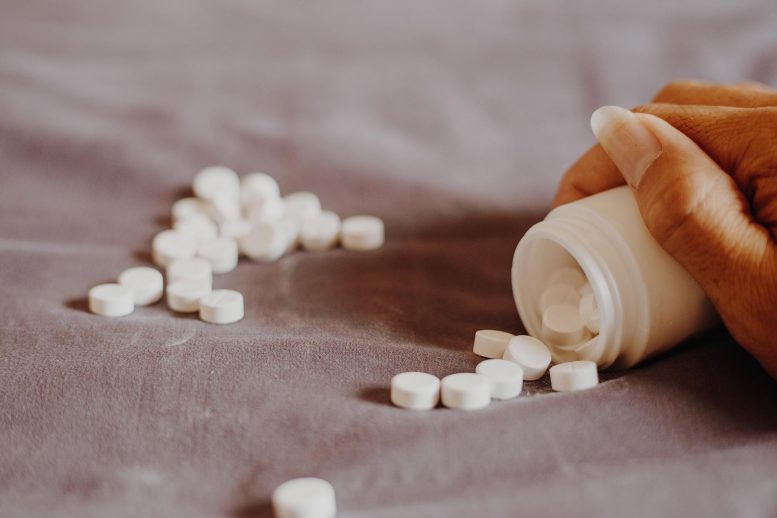
Intentional suspected suicide attempts increased by 80.3% for isolated gabapentin exposures over a five-year period and 43% for baclofen over a four-year period.
A major new analysis of the non-opioid medications, gabapentin, and baclofen, shows “worrying” increases in related suicide attempts and hospital admissions in US adults since 2013 — coinciding with a decrease in opioid prescriptions.
With the risks of opioid medications widely publicized, there has been a dramatic decline in prescriptions in the United States since they peaked in 2010-2012. But with millions of US adults still living with chronic pain, non-opioid medications are widely viewed as safer alternatives for pain management. Prescriptions for gabapentin have increased 64% from 39 million in 2012 to 64 million by 2016 when it was the 10th most commonly prescribed medication in the US.
In this latest study, published in Clinical Toxicology, researchers from the University of Pittsburgh looked at over 90,000 cases of exposure to the medications and saw large increases in misuse and toxicity — with isolated abuse instances of using gabapentin (from 2013 to 2017) rising by 119.9%, and baclofen (2014-2017) 31.7%.
Reviewing the data, collected in the National Poison Data system of trends in exposures reported to US Poison Centers, their results show that all US states have seen increases in gabapentin exposures. Most also saw increases in baclofen exposures, gabapentin misuse/abuse, and baclofen misuse/abuse over the study period:
During the five-year period (2013-2017), there were 74,175 gabapentin exposures. All gabapentin exposures increased by 72.3%; isolated exposures by 67.1% and isolated abuse/misuse by 119.9%.
During the four-year period (2014 to 2017), there were 15,937 baclofen exposures. All baclofen exposures increased by 36.2%; isolated exposures by 35% and isolated misuse/abuse increased by 31.7%.
They also showed that admissions to a healthcare facility were required in 16.7% of isolated gabapentin exposures and 52.1% of isolated baclofen exposures. Intentional suspected suicide attempts increased by 80.3% for isolated gabapentin exposures over a five-year period and 43% for baclofen over a four-year period. Co-ingestion of sedatives and opioids were common for both medications.
Lead author Kimberly Reynolds, of the University of Pittsburgh, said: “We are seeing a worrying increase in harmful exposures to gabapentin and baclofen in US adults over recent years, which may be an unintended consequence of the move away from opioid prescriptions for pain management.
“Building a better understanding of the risks carried by these non-opioid medications is necessary so that providers and patients can make better-informed decisions about their role in pain management — and could also lead to the introduction of new public health measures.”
Due to growing concerns related to the misuse of gabapentin, new measures have been introduced in several US states during the final year or after the data collection period of the study — either re-classifying the drug as a Schedule V controlled substance or mandating the reporting of prescriptions. Re-evaluations of prescribing and exposure trends in these states may provide insight into the effects of such programs.
The authors recommend that patients who are prescribed these medications should be screened for substance use disorders, mood disorders, and suicidal ideation utilizing validated screening tools and the prescription drug monitoring program.
Reference: “Trends in gabapentin and baclofen exposures reported to U.S. poison centers” by Kimberly Reynolds, Robert Kaufman, Amanda Korenoski, Laura Fennimore, Joshua Shulman and Michael Lynch, 1 December 2019, Clinical Toxicology.
DOI: 10.1080/15563650.2019.1687902
Never miss a breakthrough: Join the SciTechDaily newsletter.
Follow us on Google and Google News.
1 Comment
It’s a very sad realization of the fact that people need an escape or to relax/ get high.. and no matter what’s legal or illegal to use, there will always be some way to fulfill their perceived needs of escape, even if only for a short time!.. This is just a fact in our country now. And instead of letting them use what they want or had in the past, they resort to actually taking worse drugs.. way worse in a lot of cases. There is always going to be a void that needs filling!
I think that instead of basically forcing people to take these riskier drugs, that society should focus on ways to stop them from using drugs at all. Figuring out other ways for everyone using to find different outlets altogether! Other productive ways to focus their attention when stopping using