
Close Menu
    Facebook X (Twitter) Instagram
    SciTechDaily
    • Biology
    • Chemistry
    • Earth
    • Health
    • Physics
    • Science
    • Space
    • Technology
    Facebook X (Twitter) Pinterest YouTube RSS
    SciTechDaily
    Home»Science»Yale Engineers Believe Cornstarch Could Lead To Better Protective Gear
    Science

    Yale Engineers Believe Cornstarch Could Lead To Better Protective Gear

    By Yale UniversityAugust 24, 2015No Comments3 Mins Read
    Facebook Twitter Pinterest Telegram LinkedIn WhatsApp Email Reddit
    Share
    Facebook Twitter LinkedIn Pinterest Telegram Email Reddit

    New research from the Yale School of Engineering & Applied Science is examining how cornstarch could lead to better protective gear for police, military and athletes.

    A quick scan of Eric Brown’s laboratory finds all the requisite high-tech equipment and equation-filled whiteboards. More incongruous are the many containers of Argo cornstarch – the same kind that might be in your kitchen. Brown sees in it the potential to reduce concussions or save a police officer’s life.

    The combination of water and cornstarch offers a fascinating, but not entirely understood phenomenon. Fill a pool with this liquid and then run on it. Keep running, and you might as well be on a hard floor. Stop running, though, and you sink right in.
    Cornstarch Could Lead To Better Protective Gear
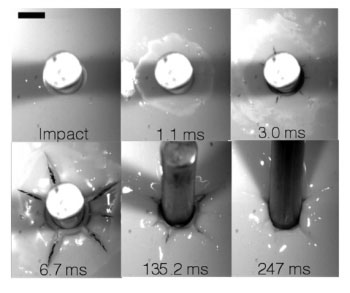
    A rod is jammed into a container of the water-and-cornstarch solution and it causes cracking.

    “Think about what it says about the material,” says Brown, Assistant Professor of Mechanical Engineering & Materials Science. “It’s very good about responding to impacts. If we can figure out the properties of this material, he said, we can figure out how to use it for making helmets, bulletproof vests and sports padding.

    It’s related to a phenomenon known as shear thickening. Certain types of fluids will change properties dues to various stresses. But water-and-cornstarch solutions’ response to impact is unique, so Brown and his team have developed a special rheometer to measure these effects. A high-speed camera captures what happens when a rod is jammed into a container of the solution. One thing they noticed is that it actually causes cracking (see photo on the right).

    “Fluids don’t crack, so that’s one of the things that tells us it’s behaving like a solid.”

    But only for a few seconds; then it goes back to a fluid state. The potential for this is huge. Crack a bike helmet, and you have to get a new one. But what if it were made from material that heals itself? It could also make for a very flexible material.

    “That’s also been a big issue for policemen and military,” Brown said. “Bulletproof vests do great at stopping bullets. But they’re so bulky and rigid that they’re hard to wear for someone running and doing all this physical activity.”

    Brown says they’re about “halfway there,” to finding real uses for this quirky phenomenon.

    “The thing we don’t understand still is, how does it transition into a solid?” he said. “We can tell that it does but don’t know exactly what’s happening at the microscopic level, so that’s something we’re still trying to understand. That’s one of the open research questions.“

    Never miss a breakthrough: Join the SciTechDaily newsletter.
    Follow us on Google and Google News.

    Engineering Materials Science Safety Yale School of Engineering & Applied Science Yale University
    Share. Facebook Twitter Pinterest LinkedIn Email Reddit

    Related Articles

    It May Soon Be Easy And Practical To Use Metals With 3D Printing

    New Technique Allows Researchers to Use Low-Intensity Magnets to Control Block Copolymers

    Yale Engineers Develop a New Tool to Fight Dust

    Engineers Demonstrate Active Electromagnetic Cloaking

    Researchers Create 3D Structures Out of Liquid Metal

    Researchers Control Water Movement by Varying Surface Stiffness

    Engineers at SEAS Develop a Microelectronic Device That Mimics Functions of Real Cells

    The Counterintuitive Behavior of the Cucumber Tendril

    Designing Biomaterials Both High in Rigidity and Bioactivity

    Leave A Reply Cancel Reply

    • Facebook
    • Twitter
    • Pinterest
    • YouTube

    Don't Miss a Discovery

    Subscribe for the Latest in Science & Tech!

    Trending News

    Popular Sugar-Free Sweetener Linked to Liver Disease, Study Warns

    What Is Hantavirus? The Deadly Disease Raising Alarm Worldwide

    Scientists Just Discovered How the Universe Builds Monster Black Holes

    Scientists Unveil New Treatment Strategy That Could Outsmart Cancer

    A Simple Vitamin May Hold the Key to Treating Rare Genetic Diseases

    Scientists Think the Real Fountain of Youth May Be Hiding in Your Gut

    Ravens Don’t Follow Wolves, They Predict Them

    This Common Knee Surgery May Be Doing More Harm Than Good

    Follow SciTechDaily
    • Facebook
    • Twitter
    • YouTube
    • Pinterest
    • Newsletter
    • RSS
    SciTech News
    • Biology News
    • Chemistry News
    • Earth News
    • Health News
    • Physics News
    • Science News
    • Space News
    • Technology News
    Recent Posts
    • “Totally Unexpected” – Scientists Discover Pancreatic Cancer’s Fatal Addiction
    • A Strange Quantum Effect May Explain One of Biology’s Greatest Mysteries
    • NASA’s Psyche Spacecraft Is About To Fly Shockingly Close to Mars
    • This Mars Rock Refused To Let Go of NASA’s Curiosity Rover
    • James Webb Telescope Reveals the Universe’s Hidden Cosmic Web in Stunning Detail
    Copyright © 1998 - 2026 SciTechDaily. All Rights Reserved.
    • Science News
    • About
    • Contact
    • Editorial Board
    • Privacy Policy
    • Terms of Use

    Type above and press Enter to search. Press Esc to cancel.