
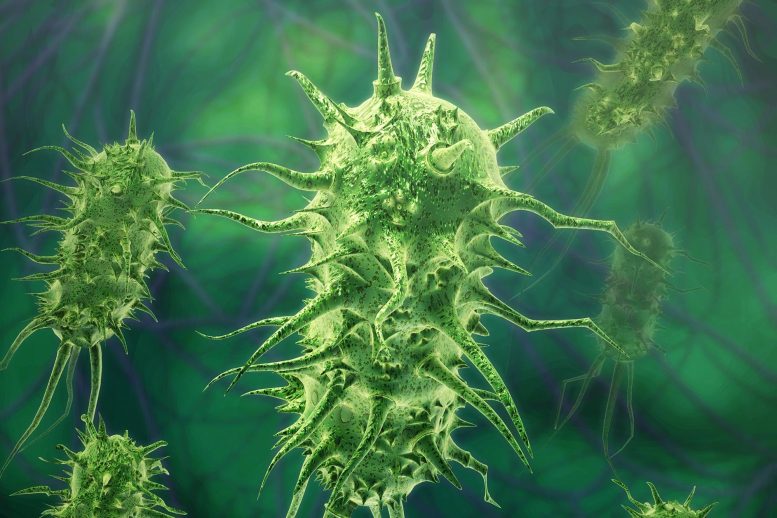
Scientists have identified Paenibacillus thiaminolyticus as the cause of postinfectious hydrocephalus in Ugandan infants, leading to new strategies for diagnosis, treatment, and prevention.
In 2007, Yale pediatric neurosurgeon, Dr. Steven Schiff, visited his colleague Dr. Benjamin Warf at the CURE Children’s Hospital in Uganda. The scenes at the hospital stunned him: every day mothers came from all over the country carrying infants with enlarged heads, desperate for a cure.
The mothers all told a similar story: their children were born without complications, but within their first few weeks, they contracted a serious infection. Once they recovered, their heads started to grow at an alarming rate over the subsequent weeks to months. Unbeknownst to these mothers, their babies were suffering from postinfectious hydrocephalus.
Hydrocephalus, or “water on the brain,” is a devastating neurological condition caused by an abnormal buildup of cerebrospinal fluid within the ventricles deep within the brain. This excess fluid causes the ventricles to expand, putting harmful pressure on the brain’s tissues. It can be congenital or develop after an infection or hemorrhage in the brain.
There is no known cure, and the need to relieve pressure on the brain forms the most common indication for neurosurgery in infancy worldwide. East Africa had become a hotbed for pediatric hydrocephalus for mysteriously unknown reasons, with an estimated 4,000 new cases in Uganda alone each year.
Without easy access to advanced care, babies often died, and even those who made it to the CURE Children’s Hospital in the early stages of the disease struggled to recover because of the damage already created by the infection. Schiff was struck by the magnitude of suffering that he saw. “As a physician and scientist and as a father, I am struck by how much we don’t know about newborn infections in developing countries. I am concerned that one reason is that the newborn infants who die there have no political voice,” he would later testify in front of the Congressional Subcommittee on Africa, Global Heath, and Human Rights.
On June 14, 2023, after 16 years of persistent pursuit of answers, the team published a landmark paper in The Lancet Microbe detailing the results of three linked studies, conclusively identifying the Paenibacillus thiaminolyticus bacteria as responsible for postinfectious hydrocephalus in Uganda.
“These results are the culmination of decades of collaboration and provide a clear path forward for testing the impact of targeted diagnosis and treatment of Paenibacillus infections,” says Sarah Morton, MD, PhD, assistant professor of Assistant Professor of Pediatrics, at Harvard Medical School and co-lead author of the paper.
A New Frontier
While the cause of newborn infections and postinfectious hydrocephalus in developed countries is often well-known and less common than other causes of hydrocephalus, the infectious agent for thousands of hydrocephalic Ugandan babies eluded researchers for years. The bacteria didn’t grow with traditional culture methods, which made it impossible to identify and characterize. Uganda’s electrical grid made it often challenging to keep samples deep-frozen and stored at treatment sites for later analysis. What’s more, it isn’t easy to draw enough blood in infants to reliably analyze for bacteria.
And although it was possible to use advanced gene sequencing methods to identify bacteria that would not grow in culture, those technologies were both expensive and not readily available in Uganda. This combination of challenges made the question of what was causing all these cases of postinfectious hydrocephalus in Ugandan babies daunting. But Schiff was determined to tackle this mystery, believing that it was a solvable problem.
After nine years of smaller-scale failed efforts, their big break came when they received several NIH Director’s awards to scale up their efforts. “The NIH Director’s high-risk high-reward programs took a risk on us, and we never could have brought the teams together and cracked this mystery properly if they had not given us this chance,” Schiff says.
A Breakthrough in Diagnosis Using Gene Sequencing
By 2020, Schiff’s team of assembled investigators at Columbia and Penn State Universities identified through genomic sequencing that an organism previously thought to be harmless in the cerebrospinal fluid, called Paenibacillus thiaminolyticus, was swimming in the brains of the Ugandan infants with hydrocephalus. The researchers stumbled upon a way of successfully growing some of these strains – using blood culture bottles for cerebrospinal fluid. This allowed them to discover that the organism was resistant to the first-line antibiotics used to treat sick infants. They also found that these African strains picked up a virulent toxin that was highly lethal. In 2020 they published these findings from sequencing and culture in Science Translational Medicine.
Over the next three years, the team set out to discover where the bacteria was coming from and if it was indeed the underlying cause of postinfectious hydrocephalus or if it was an infection showing up in the hydrocephalic infants weeks and months later but not the cause of the hydrocephalus itself.
Since many newborn infections are transmitted from mothers, they ran a maternal trial of 100 laboring Ugandan women from different regions but did not find any evidence that Paenibacillus bacteria was carried by the mothers or being transferred to infants. They then examined 800 newborns who had developed a serious infection – sepsis – from different areas of Uganda. Here, they did find the Paenibacillus bacteria – in about six percent of cases. Of the newborns that survived the sepsis infection, many developed post-infectious hydrocephalus.
In 400 cases of hydrocephalus in infants, 44 percent of postinfectious cases had PCR confirmation of Paenibacillus infection. And when the team ran PCR tests on samples of those newborns with sepsis who had developed postinfectious hydrocephalus, the same bacteria was found causing the newborn infection and, following treatment, still present when they returned for treatment weeks and months later with an enlarging head from hydrocephalus.
The resulting papers published in The Lancet Microbe and the journal Clinical Infectious Disease conclusively identified the Paenibacillus infection not only as the disease-causing widespread hydrocephalus in infants, but also newborn deaths.
“Our results suggest that Paenibacillus is an underrecognized cause of neonatal infection, which is important because the antibiotics that are commonly used to treat neonatal sepsis often won’t work for Paenibacillus infections,” says Jessica Ericson, MD, assistant professor of pediatric and infectious diseases at Penn State, lead author of the paper published in the journal Clinical Infectious Disease.
“For the first time, we were able to describe the progression of infections during the neonatal period to the development of infant post-infectious hydrocephalus enabling us to guide the crucial diagnostics and interventions needed to prevent the devastating brain damage associated with post-infectious hydrocephalus,” says Christine Hehnly, PhD, post-doctoral fellow and co-lead author of The Lancet Microbe paper.
From Discovery to Treatment
The team was now confident that the Paenibacillus bacteria is at the root of thousands of postinfectious hydrocephalus cases each year in Uganda. They also found that the pathogen has an affinity for wet places – the cases clustered around the swampy regions on the northern banks of Lake Victoria, the source of the Nile River, and the northern and southern banks of Lake Kyoga, where the Nile River flows in and out. Cases are also directly correlated with the rainy seasons, consistent with an environmental source of the Paenibacillus.
To get around the limitations that prevent doctors from using gene sequencing and PCR for diagnosis in resource-limited settings, Schiff and collaborators are using geolocation and daily satellite rainfall measurements to better predict whether a newborn patient was likely infected with Paenibacillus bacteria depending on when and where they had been infected. His team is working with local Ugandan hospitals to develop robust treatment protocols for these patients.
Currently, Schiff is focusing on uncovering the locations within rural environments where this bacterium lurks through fieldwork, and to understand the cultural newborn care practices that may contribute to high infection rates with this bacterium. “After all we have learned, the last thing we want to be doing is trying to treat infants after they’ve been infected with these highly virulent bacteria. If we can nail down how it is getting into the infants, then we can develop public health policies that can prevent these infections”, Schiff said.
Having cracked the answer to one seemingly intractable problem, Schiff and his colleagues are already setting their technologies and sights on others. They are studying similar infections in Vietnam, Kenya, and the U.S. and looking at the possibility of developing inexpensive sequencing systems at points of care to confirm infectious agents and tailor patient treatment.
“This is why doctors do research,” says Schiff. “If we’re really lucky, we can go from treating one person at a time to treating large numbers of people. I’m thrilled that after all these years working on this, we found a new disease process and grateful to the doctors, scientists, and the patients’ families who have worked so hard together to enable us to get to this point. Newborn infants at risk of dying are the universal currency binding together so many people who have worked so hard together on this problem.”
References: “Paenibacillus spp infection among infants with postinfectious hydrocephalus in Uganda: an observational case-control study” by Sarah U Morton, Christine Hehnly, Kathy Burgoine, Paddy Ssentongo, Jessica E Ericson, M Senthil Kumar, Cornelia Hagmann, Claudio Fronterre, Jasmine Smith, Mercedeh Movassagh, Nicholas Streck, Lisa M Bebell, Joel Bazira, Elias Kumbakumba, Francis Bajunirwe, Ronald Mulondo, Edith Mbabazi-Kabachelor, Brian K Nsubuga, Davis Natukwatsa, Esther Nalule and Steven J Schiff, 19 June 2023, The Lancet Microbe.
DOI: 10.1016/S2666-5247(23)00106-4
“Neonatal Paenibacilliosis: Paenibacillus Infection as a Novel Cause of Sepsis in Term Neonates With High Risk of Sequelae in Uganda” by Jessica E Ericson, Kathy Burgoine, Elias Kumbakumba, Moses Ochora, Christine Hehnly, Francis Bajunirwe, Joel Bazira, Claudio Fronterre, Cornelia Hagmann, Abhaya V Kulkarni, M Senthil Kumar, Joshua Magombe, Edith Mbabazi-Kabachelor, Sarah U Morton, Mercedeh Movassagh, John Mugamba, Ronald Mulondo, Davis Natukwatsa, Brian Nsubuga Kaaya, Peter Olupot-Olupot, Justin Onen, Kathryn Sheldon, Jasmine Smith, Paddy Ssentongo, Peter Ssenyonga, Benjamin Warf, Emmanuel Wegoye, Lijun Zhang, Julius Kiwanuka, Joseph N Paulson, James R Broach and Steven J Schiff, 5 June 2023, Clinical Infectious Diseases.
DOI: 10.1093/cid/ciad337
Never miss a breakthrough: Join the SciTechDaily newsletter.
Follow us on Google and Google News.